


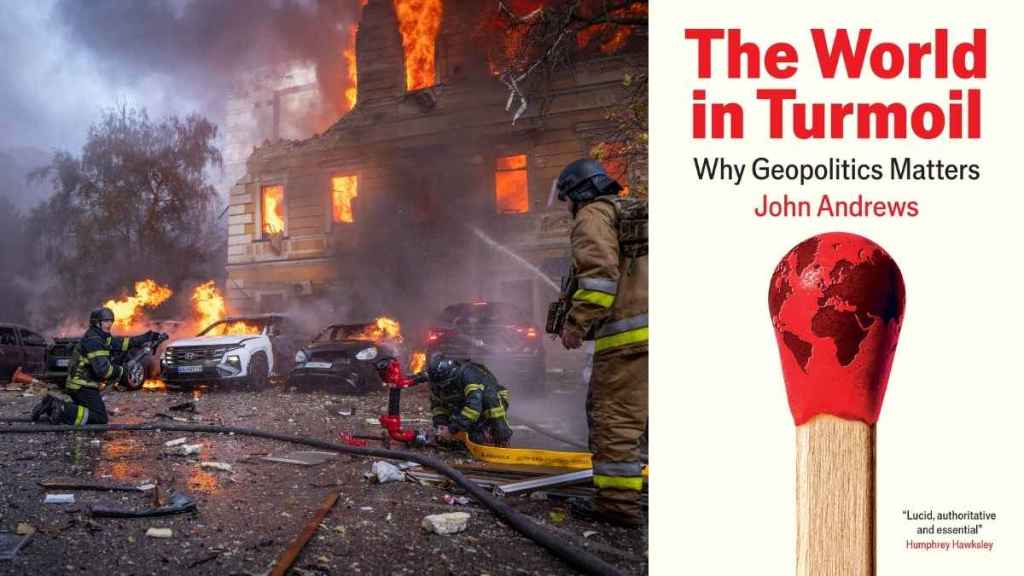

The title of the book under review captures the current ambience of the global strategic and security environment in a pithy manner. The festering war in Ukraine, the choking of two critical chokepoints in West Asia (the Strait of Hormuz and Bab el-Mandeb), tribal wars in Africa — and the all too palpable inability of the major powers to arrive at any effective and equitable modus vivendi to mitigate crisis situations is one layer of this turmoil.
The more intractable issues, akin to increasing entropy and structural disorder within a system (in this case planet Earth), are climate change and the galloping advent of AI, while the prudent management of WMD (weapons of mass destruction) has been taken off the global radar.
Author John Andrews has an impressive pedigree: The Economist’s most experienced foreign correspondent; stints in North Africa and the Middle East that enabled interviews with Muammar Qaddafi and PLO leader Yasser Arafat; and various postings across Europe, Asia and America.
One picks up The World in Turmoil — the successor to the author’s The World in Conflict: Understanding the World’s Troublespots — expecting deep, distilled judgment by a black-belt. What emerges is an earnest, very readable and wide-ranging book, but thinner than that expectation.
Andrews sets himself a large task in the 152 pages of the main text. The themes are grouped into four substantial chapters: Nations and Empires; Ideology; Outlaws and Non-State Actors; Hard, Soft and Smart Power (Joseph Nye introduced soft power in 1990 and later extended the frame to “smart power”), and a closing look at The World Ahead.
To meaningfully address their
complexity, any one of those subjects could fill a book. At roughly 20 pages each in the current volume, coverage is bound to stay at the surface. The prose is lucid, sometimes brisk, in the manner of a senior journalist marinated at The Economist.
That is no constraint but it does mean the book works best as a primer. Andrews is clear about his aim. The book, he clearly states , is meant “to inform rather than instruct… a guide rather than a polemic.” That candour deserves to be taken at face value. The second half, about a hundred pages of A-Z terms, short histories and careful both-sides summaries, does exactly that kind of guiding.
A sense of tentativeness permeates the book, and in late 2026 that kind of restraint is understandable. However, it also leaves less room for the distinctive element many readers will have come for: what has Andrews himself concluded after a lifetime in the field?
This aspect is slim and the argument becomes circular in a quiet way. Geopolitics is often treated as what large powers do because might is right; what large powers do is then taken as proof that geopolitics matters. Hard power matters because strong states use it; smart power matters because nimble states use it well. That describes the landscape more than it explains it. It is a limitation of the form more than a failure of intent.
Where Andrews allows himself a sharper line, the book acquires verve. He is at his most useful on the Trump effect (Page 66) in abetting global turmoil and raises a troubling question: “But who can compel the American hegemony to follow the rules it was so influential in creating after the second world war?” Alas, no one. Change, if any, in US policies will have to begin with the American voter and the ballot box.
Some assertions are debatable. The book posits that history is primarily defined by geography and that “human civilization is a story of empires — and by definition they exist by expanding their territory.” That framing still treats power as a contest over land.
In the current context where AI beckons, territory has expanded to subsume the new global commons: maritime, space, cyber and spectrum, and the networks that hold it all together is where expansion and conquest are unspooling.
Identity is a substantive issue in reviewing the current political dynamic, and the author avers: “The underlying message in the geopolitics of the 21st century is that identity — be it ethnic or religious — is a political force, and often a destabilizing one.”
That is a rich seam and the chapter moves on quickly. Examples run from Africa to Asia but they illustrate more than they interpret. The India reference shows the strain of compression. The country is described, in language that also appeared in The World in Conflict, as a place where “Hindu and Muslim clashes are all too frequent” (Page 72).
As a single sentence in 2026, that undersells the change in scale. India has not seen communal violence of the order of 1984, 1992-93 or 2002 for more than two decades. Official police figures show overall riot cases falling sharply since the mid-2010s (from the mid-sixties of thousands a year toward the high thirties of thousands by 2023), while separately tallied communal/religious riot cases have generally sat in the hundreds rather than in the thousands, much of it local and contained, in a population of 1.4 billion.
Civil society monitors still record dozens of communal incidents a year. Communal tension has not vanished, but the old formula no longer quite fits the evidence.
The closing turn to Yuval Noah Harari is consistent with a guide that prefers other voices to a last personal word. After so much first-hand experience, many readers will wish the final page sounded more like Andrews.
This book is a valuable and lucid overview of geopolitics: clear, measured, and useful to anyone who wants a quick 101 and a summary of terms and themes. It is less the reflective account of a correspondent who has seen power coalesce and come apart.
For that discerning reader, the disappointment is not that the book is not rewarding. It is that an author whose professional career in tracking the turmoil of geopolitics is this long and distinguished has chosen to remain reticent.
C Uday Bhaskar is director, Society for Policy Studies
The World in Turmoil: Why Geopolitics Matters
John Andrews
Hachette
Pp 304, Rs 599