


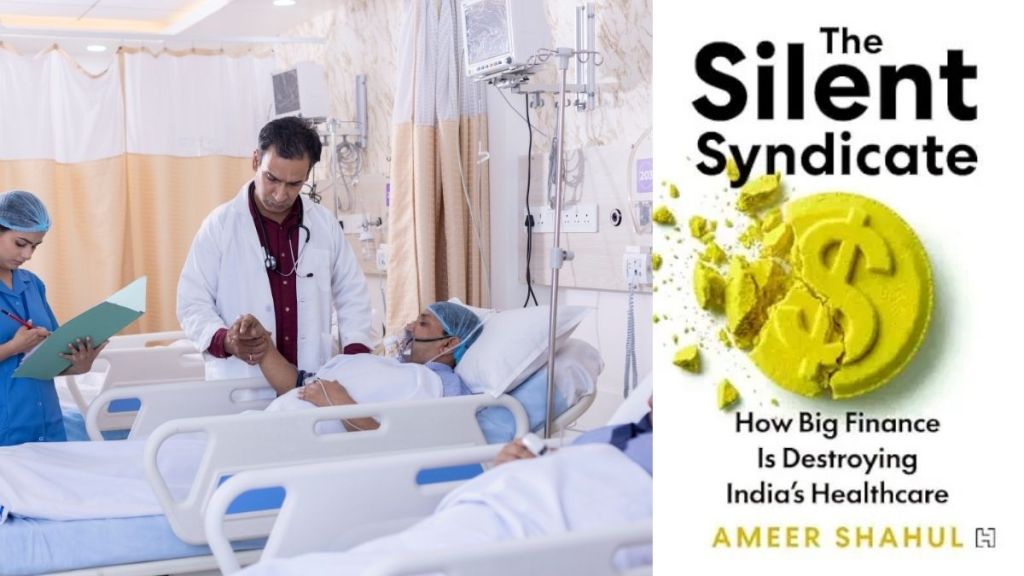

Have the global PEs been just investing or quietly taking over decision-making in Indian hospitals and other healthcare sub-sectors? This topic has been the buzz in corridors and cafeterias at Indian hospitals for the past few years now, particularly in the post-pandemic phase. Now, former journalist and public-policy consultant Ameer Shahul pulls that cafeteria conversation out of industry corridors into the glare of public discourse by posing the same question in his book, The Silent Syndicate: How Big Finance is Destroying India’s Healthcare. He asks the right questions: ‘who prices your health?’, implying who is really determining the price points at which you access healthcare services in this country?
“If the answer lies not in your doctor, not even in your country or Parliament but in your distant boardrooms of New York, Basel, Silicon Valley, then what we are witnessing is not just a policy drift, but a surrender,” concludes the author.
Shahul starts with Kerala-headquartered KIMSHEALTH, and indicates — using patient experiences and staff interviews — how culture there has shifted from empathetic to cold, room rents have shot up, doctors feel pressured to meet increasing revenue targets and the mission of care has been compromised for margins after a PE-backed platform grabbed a majority share of the hospital chain through a complex web of deals.
Aggressive PE Expansion
In subsequent chapters, Shahul details how PEs have not only made inroads into, but worryingly captured control of many Indian hospital and diagnostic chains — both national as well as regional, besides med-tech companies. He also interrogates whether massive troves of sensitive health data — patient records, billing data, insurance histories, behavioural health details — that sits in hospital and diagnostic chain systems are really protected, or are they being shared with PE companies. “The risk is that Indian health data — gleaned from prescriptions, lab reports, fitness trackers, and hospital EMR (electronic medical records) — quietly flows into foreign controlled platforms, far beyond the jurisdiction of Indian law,” he states, suggesting that the Digital Personal Data Act, under which health data is supposed to be regulated, is still in the process of being rolled out.
What is also being indicated is that the sudden interest of PEs across healthcare supply chains may have to do with this big data that comes with consolidation of hospital chains, diagnostic chains, e-pharmacies and digital healthcare firms that connect doctors, diagnostic players and pharmacies with patients. Imagine the kind of data an overseas entity such as a global PE player, which has a controlling stake across these healthcare entities, can mine in the name of improving efficiencies. These efficiencies should ideally reduce cost of care, but does that pass on to patients? Anecdotes suggest otherwise.
The author also covers how new cancer drugs under patent can be exorbitantly priced to exclude almost the whole population, making them inaccessible to most except the ultra rich. Whenever Indian players have challenged such pricing (such as Indian pharma firm Natco in case of cancer drug Nexavar through compulsory licensing, or Cipla by slashing the cost of HIV drugs), the companies in question and India as a trading partner have faced enormous backlash from Big Pharmas and US government agencies, not only in the pharmaceuticals space, but in other economic aspects too. Such are the rules of negotiations in global trading realms.
While dealing with the health insurance sector, the author argues that many multinational insurers who had partnered with domestic players in the early 2000s to enter an emerging market in post-liberalised India later lobbied with the BJP government to do away with FDI caps in the sensitive sector, only to exit at higher valuations, after the government gradually opened up the sector. He also claims that the entry of global re-insurers — companies that are insurers of insurance companies who take part of the risk by charging a premium in India — in 2016, has meant more rigid policies, pricier premiums, narrower coverage of diseases, more exclusions and a fine print that becomes difficult to navigate for patients and families in times of crisis. Health insurance complaints have surged 41% in the year ending March 2026 over the previous, according to regulatory data. This rise is largely driven by claim disputes, delays and partial settlements.
Shahul is at his best while discussing ‘lobbies at play’ in the power corridors of Delhi in 2022, where he happened to be a firsthand witness, on the question of whether drugs (usually pricey patented ones) under patient access programmes by multinational pharmaceuticals should be put under price control through trade-margin-rationalisation, a mechanism using which government had earlier successfully capped prices of 42 anti-cancer drugs in 2019.
This is an urgent topic, particularly the circling of Indian hospitals, diagnostics, health tech firms, that is being hotly debated by industry leaders owning hospital chains. Shahul should be credited for attempting to place all the information in one account and contributing to a public debate on it. However, the book has more information than insights. It painstakingly details on ‘who bought what and when’ across healthcare sub-sectors, but lacks the rigour of research in detailing “how big finance is destroying India’s healthcare”, which is the subtitle of the book. This framing is as much an assumption as a conclusion. It is not a question.
Much of what the author describes — skyrocketing hospital tariffs, broken trust in healthcare sector, nightmarish harassment by insurance players in your most vulnerable moments — rings true from personal experience, and anecdotes. But convincingly establishing ‘how’ big finance is destroying India’s healthcare would entail more — comparing prices of common procedures in facilities in pre and post-PE entry, or comparing prices of common procedures between PE-owned hospitals and non-PE owned hospitals, interviews with doctors and other stakeholders to suggest which unnecessary tests are being administered to jack up bills, or accessing communications between PEs and hospital employees on how this pressure on revenue per patient really works, or even going through the journey of other countries, including the US, to show how the PE ownership of hospitals has led to surge in health service prices.
It would also have been useful to analyse how the government has dealt with similar challenging phases in the past. For instance, between 2006 and 2010 when a series of FDI deals in the pharma sector started seeming worryingly predatory, the government brought in a clear distinction between brownfield and greenfield foreign investments and imposed additional gatekeeping checks, asking such investments to be put on a special government approval route, without capping FDI in pharmaceuticals. This allowed the government to place conditions on deals on a case-to-case basis, and ward off extraction without curbing capital flow.
The book successfully warns us of the problem statement — as global capital circles India’s healthcare, and increasingly takes ownership, profit is becoming their top priority. Where it falls short is in proving ‘how’ profit is replacing patient as the centre of Indian healthcare. In that sense, it remains a well-reasoned perspective, not solid evidence.
Soma Das is the author of The Reluctant Billionaire and an adviser to agencies in the development sector
The Silent Syndicate: How Big Finance Is Destroying India’s Healthcare
Ameer Shahul
Hachette
Pp 312, Rs 799