


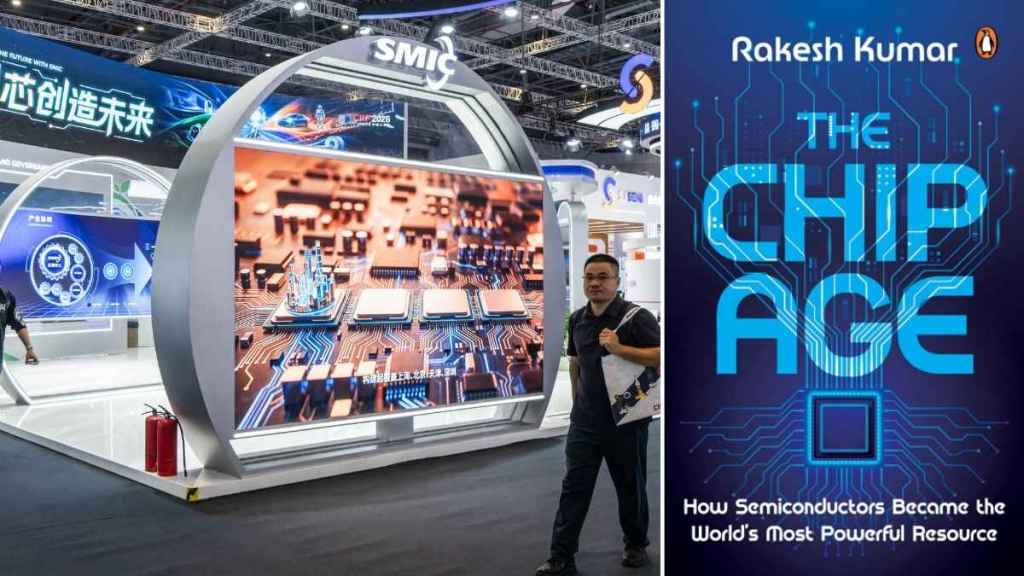

The chip is one of the smallest objects to have acquired an outsized importance in today’s world, and not without reason. Apart from powering everything from smartphones and cars to missiles and artificial intelligence, it has become a measure of industrial strength, economic competitiveness and geopolitical power. Therefore, Rakesh Kumar’s The Chip Age is a timely account of how this tiny piece of technology acquired such extraordinary importance and what it means for the world ahead.
Kumar, who is an electrical and computer engineering professor at the University of Illinois Urbana-Champaign, and a researcher in semiconductor technology, provides a detailed account of the chip’s evolution, from its early days to the extraordinarily complex global industry that exists today. But he doesn’t stop at explaining transistors, processors and manufacturing processes. He also traces the companies, countries and technological breakthroughs that shaped the industry and made it indispensable to the global economy.
The narrative moves across Silicon Valley, Japan, Taiwan, South Korea, China and the US, showing how the centre of gravity of the semiconductor industry has shifted over time. The rise of Japanese electronics companies, the emergence of Taiwan as the centre of advanced chip manufacturing and China’s determination to reduce its dependence on foreign technology are all part of a larger account of technological competition.
The most interesting aspect of the book is its description of the businesses that operate behind the better-known chip companies. The analogy with a period in American history when there was a rush for gold mining is particularly insightful. When everyone was rushing to find gold, a smart businessman saw a chance to make money by selling equipment needed to mine the same. The semiconductor industry offers a similar lesson. Some of the most strategically important companies are not chipmakers but those that supply the specialised equipment, materials and technologies needed to make sophisticated chips.
So, the race is not simply between Intel, TSMC, Samsung or Nvidia. It is an elaborate ecosystem in which companies and countries depend on one another. The US has enormous strengths in chip design and equipment, Taiwan in advanced manufacturing, South Korea in memory and Japan in materials and manufacturing technologies. The Netherlands, through ASML, occupies a unique position in lithography. No country, therefore, controls the entire chain, but some control critical links within it.
That interdependence is also what makes semiconductors central to the changing relationship between the US and China. Kumar explains how an industry built on globalisation and specialisation has gradually become entangled with national security. Access to advanced chips, manufacturing equipment and design technologies is now part of a much larger contest for technological and economic influence.
Taiwan inevitably occupies an important place in this story. The concentration of advanced semiconductor manufacturing on the island has given a technology industry an importance that would have been difficult to imagine a few decades ago. Any serious disruption to that ecosystem would have consequences far beyond electronics, affecting industries, economies and the strategic calculations of major powers.
It’s clear that the semiconductor supply chain is being reshaped by geopolitics. Efficiency and cost, which once drove companies to distribute production across countries, are now being weighed against resilience, security and technological sovereignty. The US, China, Japan, South Korea and Europe are all trying in different ways to strengthen their positions, with governments putting public money behind industries that were once largely left to market forces.
The implications for India are worth considering, even though India is not the central subject of the book. The discussion on legacy or mature-node chips is particularly relevant. Much of the attention today is on the most advanced processors powering AI, but mature chips remain critical to automobiles, industrial equipment, telecom and power electronics. For India, which is building its semiconductor ecosystem through initiatives such as Semicon 2.0, this suggests that the opportunity need not be confined to competing at the technological frontier. Equipment, materials, packaging, testing, design and mature-node manufacturing can all provide entry points into the global ecosystem.
Kumar’s technical background gives the book depth, but some of the detailed explanations of semiconductor technology can get boring for non-technical readers. Even if they gloss over these sections, however, they would still be able to understand why certain companies acquired their importance and why some manufacturing capabilities are so difficult to replicate. The book is, therefore, an interesting read not just for technology enthusiasts but also for those interested in global history, international relations and the changing balance of power.
The larger message is that the semiconductor is no longer merely a component of the products that define modern life, but is part of the infrastructure of power itself. Countries that control critical parts of the ecosystem will have an influence that extends well beyond the technology sector.
For India, that presents an opportunity, but not necessarily one that requires it to replicate Taiwan or South Korea. The more relevant question may be where India can build capabilities that are globally competitive and difficult to replace. In a semiconductor world increasingly shaped by geopolitics, finding those niches could matter as much as chasing the most advanced chip.
The book is timely not just for those trying to understand semiconductors, but for anyone trying to understand where the world economy and international order may be headed.
The Chip Age: How Semiconductors Became the World’s Most Powerful Resource
Rakesh Kumar
Penguin Random House
Pp 312, Rs 599