



By Nawaid Anjum
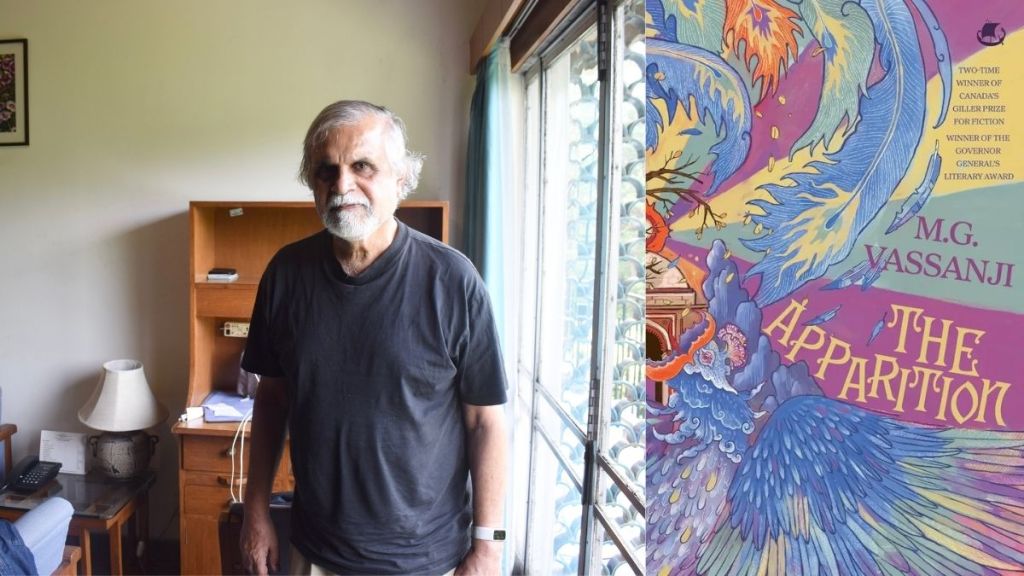
MG Vassanji did not begin The Apparition knowing that half-human, half-bird creatures would eventually descend upon Delhi. “Initially, I thought I would write a historical novel,” says the Toronto-based writer, 76. “I started with medieval history and then it just occurred to me to take it into another direction,” he adds. The novel is set in the last years of Alauddin Khilji’s rule, in a Delhi plagued by famine, court intrigue, religious persecution and fear. “It was a very chaotic time. People were getting murdered,” says Vassanji. “I thought maybe I would imagine a writer or philosopher of that period in his despair, imagining another outcome.”
That witness is Amir Hassan al-Shirazi, poet, historian, Sufi, court insider, and narrator of the novel, dedicated to “the children of Gaza, slaughtered as we watched”. Alauddin asks him whether his rule has been just and tells him to write honestly, without flattery. Amir is close enough to power to see its cruelties but never fully belongs to it. Vassanji says he is an invented character, only “very superficially” linked to historical figures. “I had to make him up.” Amir’s Sufi master, Sheikh Sadruddin, is modelled on Nizamuddin Auliya, but “there’s no one-to-one correspondence. I needed a Sufi I respected.”
While writing, Vassanji became absorbed in medieval Islamic philosophy, mathematics and science. He brings up Hayy ibn Yaqzan, Ibn Tufayl’s 12th-century Arabic novel about a child raised by a doe in isolation, who comes to understand the physical world through observation and reason. It’s close to the questions Vassanji was thinking about: how far reason can take us, and whether knowledge of the material world is enough. “In spite of knowing everything about the physical world, you still need something more,” Vassanji says.
He was also drawn to the Mongols, the Nizari Ismailis, also known as the ‘Assassins’, and Alamut, the Persian mountain fortress destroyed by the Mongols in the 13th century. Alamut has a personal resonance for Vassanji, who comes from a Khoja Ismaili background and has written about tracing his community’s spiritual and historical roots in Gujarat back through its pirs and teachers. From there, his reading led him to Alauddin’s violent final years and the rise of his slave-turned general, Malik Kafur.
Another text fascinated him: the animal fables in the Epistles of the Brethren of Purity, in which animals make their case against humans before the King of the Jinn. The work sharpened his interest in creation, knowledge and humanity’s treatment of animals. “I learned a lot,” he says. Yet he is wary of pretending every historical thread must neatly connect. “When you’ve read enough, then some of the connections come,” he says. “And some don’t come.”
The novel’s deepest argument is about assimilation. “When the Mongols came here, the Sultan had started local culture to accommodate,” Vassanji says, thinking aloud about how societies change when new people arrive. The British did the same in another form elsewhere. With every encounter come resistance, adaptation, fear and exchange. “The same anxieties of losing your history, your identity, your culture,” he says. “And at the same time assimilating, whether you want to or not.”
Born in Nairobi (Kenya) to Indian immigrants, raised in Tanzania and later settled in Canada after studying in the United States, Vassanji knows that unease intimately. Even Swahili, which he speaks with his wife, has absorbed so much English that the boundaries have blurred; he regrets not passing more of it to his sons. “That feeling always remains. Basically, I put that into this novel. That loss.” He traces this restlessness further back to his Lohana ancestors, generations who moved through western India and then to Kenya, Zanzibar, Colombo and elsewhere. “It’s kind of a nomadic existence,” he says. “That’s my theory.”
The pattern continues in his own family; his sons, too, have made lives across countries. “Somehow, for our community, rootedness is harder to accomplish.” His 2024 essay collection Nowhere, Exactly asks whether home can ever be singular for people formed by several places. Vassanji no longer sounds troubled by not having one answer. “I’m always rooted in a place,” he tells me. “But then I find that I feel comfortable in a place only because I know I can always travel.” He calls himself “a creature of habit who travels”.
Delhi entered that long journey through travel rather than ancestry. Whenever he came to India, Vassanji says, Delhi was usually the first stop. “I would first come here,” he says. It became “the key” through which the rest of India’s geography began to make sense to him.
Gujarat, Shimla, Calcutta and other places branched out from it. That relationship has already produced A Delhi Obsession, but the Delhi of The Apparition demanded a different imagining an older city whose records can tell a novelist only so much.
Vassanji is working on another novel, now “almost finished”. It looks at a generation slightly older than his own, formed by university life, decolonisation and the political idealism of the 1960s and early 1970s, when Tanzania was a frontline state in the struggles against white minority rule in Rhodesia and apartheid South Africa. “That awareness was very much part of our growing up,” he says.
Vassanji also returns to East African writers he feels have slipped from view, among them Peter Nazareth and Bahadur Tejani, particularly when compared with the attention given to West African writers. Tejani’s Day After Tomorrow interests him because it tried to imagine a genuinely African-Indian future through an interracial relationship. “There was, of course, among the Indians, Asians, racial resistance,” Vassanji says, adding that African communities had their own traditions and boundaries. “There’s a relative ignorance, mutual ignorance, between Africans and Asians.”
He remembers Tanzania Publishing House and Walter Bgoya, later founder of Mkuki na Nyota. The press is now run by Bgoya’s son, Mkuki, and Vassanji has sent him a new collection of stories set entirely in the small part of Dar es Salaam where he grew up. When his regular publisher worried about too many books appearing close together, Vassanji replied, “But I’m not getting younger either.” Sending the stories back to Tanzania felt right: “It was like going back… my homage to the place I grew up in.”
That return to place loops back neatly to The Apparition. The novel is interested not only in conquest, but in what follows: what people surrender without noticing, what they acquire, and when something once foreign becomes ordinary. As Amir’s Sufi master comes to understand, Vassanji says, “the world is bigger and, therefore, you have to accommodate what’s in there.”
“What do you gain and what do you lose when your world, whether you like it or not, opens up?” The question belongs as much to the present as to Vassanji’s medieval Delhi. He sees the novel as a response to the anxieties around identity, migration, conquest, globalisation and cultural change. “If you don’t travel, the world comes to you,” he says. “In this case it is the Avians who come.” And when they do, “you have to realise that the world was much bigger”.
Nawaid Anjum is a freelancer
The Apparition
MG Vassanji
Tranquebar,
Pp 298, Rs 799
Disclaimer: The views expressed are the author’s own and do not reflect the official policy or position of Financial Express.