


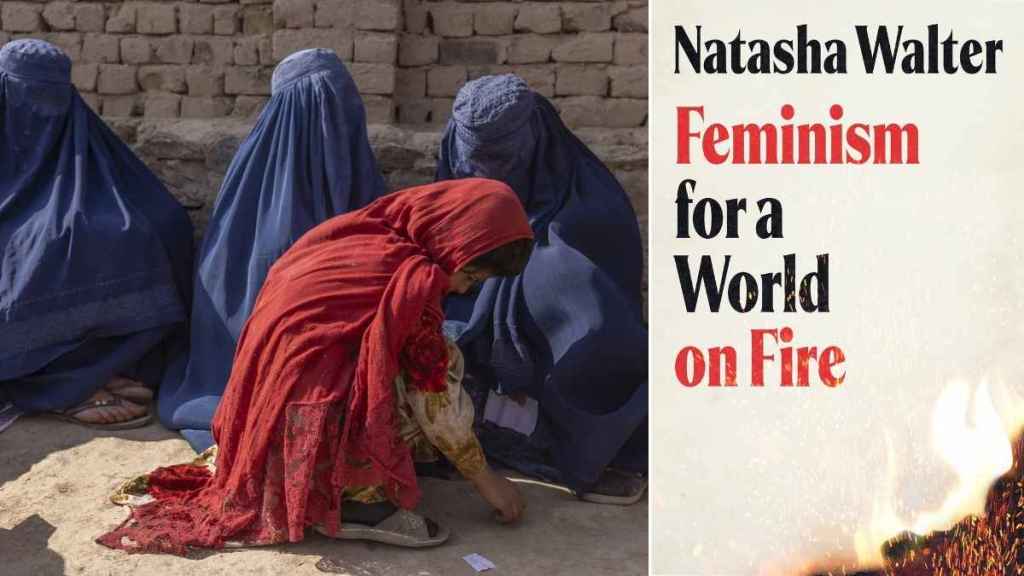

Where do women’s movements for equality, justice and rights stand? What are the challenges? What lies ahead? As many countries in the world take an authoritarian turn, Natasha Walter’s vital new book, Feminism for a World on Fire, tackles these questions in three parts: first, she provides an overview of what has been happening in women’s movements; second, she studies the obstacles or “storms that are gathering for women everywhere”; and third, she observes ideas and practices around the world that could help women achieve a better, gentler future.
There’s a lot of work to be done because everywhere women are struggling to “defend their freedoms”. Women in Afghanistan, for instance, after being shown the way forward for two decades, have had to go back behind the veil with all their rights under attack from the Taliban. As Walter writes, “just when it’s so important to hold on to the possibility that women can organize to build a better future, our movements are often foundering in uncertainty and division.”
Walter faults ‘constant consumerism’, the untrammelled ‘exploitation’ of fuels and other natural resources, and a warming climate that is ‘destabilising ecosystems’, for the unprecedented threat to women’s freedoms.
“At times of crisis, from drought to flood, from storm to fire, women’s vulnerability to violence and exploitation increases. When heat rises, so does male violence. When droughts hit and crops fail, girls eat less than boys do. When conflicts arise over increasingly scarce resources, women suffer. The ecological crisis is amplifying every threat to women,” she observes.
The rise of the far right is another cause for concern. With it, says Walter, there is a rise in “a kind of rhetoric which takes women’s justified anger at violence and poverty and channels it not against those with the power to shape the conditions in which inequality and violence thrive, but against migrants and the marginalized.”
Walter puts faith in the ability of women to organise themselves in the face of growing challenges, and disrupt unequal and violent systems. There is no dearth of issues women come up against besides sexual violence — they need to fight for education, maternal health, anti-trafficking laws, land rights and so forth. Silences can be broken if women agitate together for rights. She gives many examples from around the world — India, Poland, Liberia, South Korea — of how protest movements led by women generated visible change. In India, after the Nirbhaya rape in 2012, criminal laws were amended making punishment more stringent.
But post 2017, when the Merriam-Webster dictionary made feminism its word of the year, there has been “a sense of exhaustion and fragmentation” leading to a muted show of protest. The result is that women are far from expecting equality and safety, and hence, there is an urgent need to reorganise and rethink the movement.
For instance, there is the question of care. Raising this critical issue, Walter and several economists and feminists ask why are women still doing most of the care work that everyone relies on but nobody values. They also wonder why the feminist revolution has stalled in the area of caring, and is instead alarmingly retreating to being tradewives, often displayed on social media, “caring, loving, cooking, tending”.
Walter puts it on the trend of individual feminism that has engulfed most of the world — it’s as if it’s fine if only a few women break the glass ceiling — and urges a refocus on collective, local movements to empower as many women as possible. As she researched her book, she came across many examples where women “are chipping away at new stone, creating new visions”. She interacted with a determined bunch of feminists at Rojava in Syria who were not only dealing with violence and insecurity but “boldly imagining what should grow in place of patriarchy”.
Even in the most difficult of times and places she found women working to provide for hungry families or imparting online education to Afghanistan women banned from attending school or even raising money for women to travel for an abortion because those rights had been snatched away. As Walter found out — and we read about it in the papers everyday — aid budgets are being slashed while needs are growing. In such a scenario, Walter says women, who comprise the majority of lower-paid and unpaid workers, will still provide food and care for those in need. It’s a kind of “feminism that toils at the grassroots and never stops.” It is often overlooked, but this is the kind of feminism that needs urgent support, says Walter.
As more precarious and uncertain times loom, it’s imperative, points out Walter, to ground feminist campaigns in the grassroots. “…everyone has to start from where they are. I return to the recognition that a daring vision can only be sustained if it is rooted in ordinary, everyday practices.” And while it may be impossible to save the world all in one go, Walter argues that it is possible to protect, guard and save homes and communities, little by little, one step at a time. To do this, women need solidarity more than ever.
Sudipta Datta is a books critic based in Kolkata
Feminism for a World on Fire
Natasha Walter
Hachette
Pp 368, Rs 899