



By Ananth Narayan
I started my career in Citibank’s cash management business. Citi then had branches in India’s four metros only, but had built a successful nationwide collections and disbursements franchise using correspondent banks, technology and, above all, mastery of logistics. Those days, an outstation cheque could take several days to clear. That delay represented ‘float’, and float was valuable. If you could collect a cheque in Coimbatore or Kanpur and get the money to your corporate client in Mumbai faster than the competition, you had a business. Citi’s business proposition was simple: make money from inefficiency by being a little more efficient than everybody else.
Three decades later, I can take out my phone, scan a QR code at a roadside stall in Agartala and move money instantly from my Palakkad bank account to the vendor’s. The business whose economics helped start my career has been destroyed. And that is a very good thing.
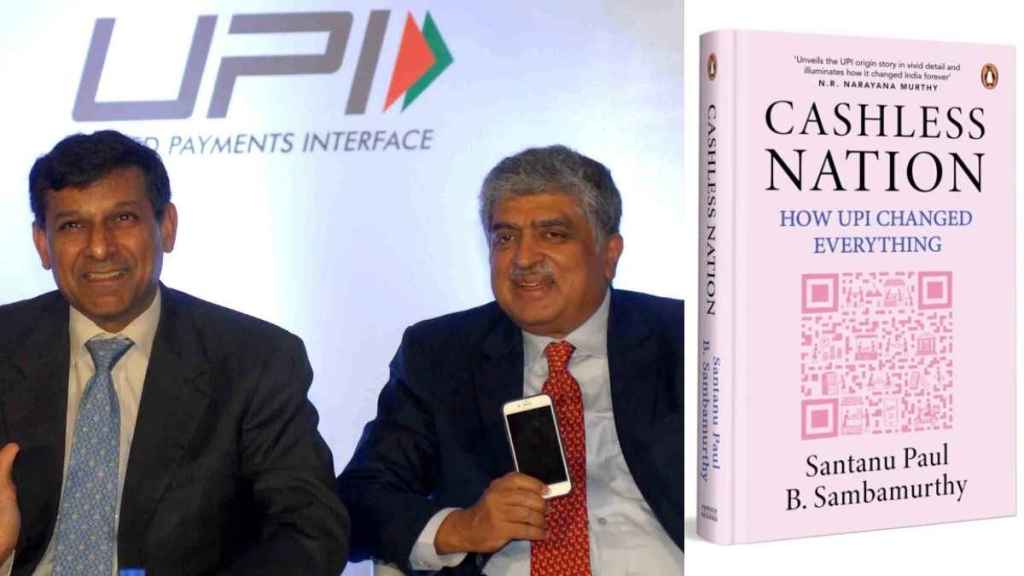
Cashless Nation: How UPI Changed Everything by Santanu Paul and B Sambamurthy is the story of how India got from there to here.
Paul and Sambamurthy show that UPI was not the product of one eureka moment, one government, or one institution. It was the culmination of decades of experiments, arguments, false starts, regulatory interventions and technological advances. The cast is large: C Rangarajan, YV Reddy, Raghuram Rajan and other RBI officials; Nandan Nilekani and the Aadhaar ecosystem; NPCI’s AP Hota and Dilip Asbe; banks, telecom companies, fintech entrepreneurs and successive governments. The authors interviewed four former RBI governors and many others who participated in this journey. That gives the book credibility and a ringside quality.
One of my favourite stories from the book comes from the early days of bank computerisation. Rangarajan, then an RBI deputy governor, arrived at SBI for a board meeting and encountered bank employees protesting automation. He was mobbed so vigorously that someone yanked his safari jacket and tore it. Today, arguing against computerisation of bank ledgers sounds faintly absurd, but at the time, it threatened jobs and established ways of working. There is a broader lesson here. Efficiency is wonderful for the economy as a whole; it can be terrible for every incumbent whose livelihood depends on that inefficiency.
We have seen this elsewhere in Indian finance. Screen-based trading, dematerialisation of securities and shorter settlement cycles all seem self-evidently desirable in hindsight. They were not universally welcomed by the existing ecosystem. Reform often requires a regulator or some other force to overcome the rational reluctance of incumbents to eliminate profitable friction. Ultimately though, efficiency brings its own rewards of growing the pie for the ecosystem. UPI is perhaps the mother of all such exercises in Indian finance.
The book shows how the pieces accumulated. Bank computerisation was followed by electronic clearing, RTGS and NEFT. Financial inclusion brought no-frills accounts, business correspondents and eventually Jan Dhan. Aadhaar provided portable digital identity. NPCI emerged as an industry utility. IMPS supplied the technological plumbing on which UPI could be built. Smartphones and cheap mobile data supplied the device and connectivity. Then came November 2016.
The authors are nuanced about demonetisation. They do not pretend it created UPI. But it provided an extraordinary behavioural shock. Monthly UPI transactions, barely visible at 0.1 million in October 2016, jumped twentyfold by December. BHIM was built and launched quickly. Banks that had been hesitant suddenly wanted in. Fintechs raced ahead. The fire had been lit. Yet the book’s most important insight is not about technology. It is about architecture. India could have ended up with competing payment islands. Instead, it built common, interoperable rails on which banks and technology companies could compete. The infrastructure was shared; innovation at the customer interface was competitive. That
helps explain why UPI achieved a scale and ubiquity that payment systems elsewhere in the world have struggled to match.
Paul and Sambamurthy tell this story brilliantly. The book is well researched, erudite and highly readable. More importantly, it accommodates competing perspectives. This was not a frictionless journey towards frictionless payments. Banks fought telecom companies, incumbents resisted disruption, policymakers made mistakes, technologies failed and solutions were repeatedly tweaked.
Perhaps that is what makes Cashless Nation an optimistic book about India. We should wonder why a country capable of making payments so easy can make other everyday transactions so complicated. That is precisely why the UPI story deserves to be understood.
It shows that India can build institutions across governments, combine public infrastructure with private innovation, learn from mistakes, overcome incumbent resistance and create something that does not merely catch up with the world but leads it.
For someone who once made a living from getting cheques cleared a little faster, that is progress I am happy to celebrate.
Ananth Narayan is a former whole-time member of Sebi
Cashless Nation: How UPI Changed Everything
Santanu Paul & B Sambamurthy
Penguin Random House
Pp 336, Rs 899