



By Mohit Hira
Like many people of my vintage, I grew up wearing Bata shoes. And then outgrew them — again like many of my ilk. Somewhere between the Hawai chappal, Naughty Boy shoes and the launch of North Star, Marie Claire and Hush Puppies, Bata lost its footing. Some reports indicate that from a near 70% market share of India’s post-independence footwear market, it now hangs on to just 4-5% of a highly fragmented category.
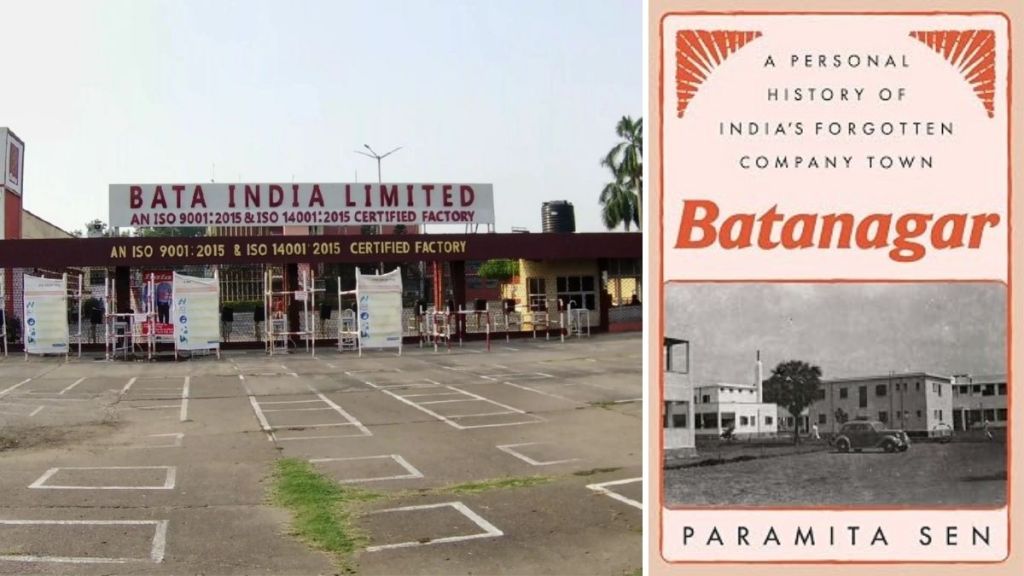
But this review — and the book in question — is not about Bata’s market or brand. It’s about Batanagar, a sprawling township built in 1934 to house the company’s managers and workers on the outskirts of Calcutta (now Kolkata). On the banks of the placid Hooghly river, it was envisaged as the twin city of Zlín, the Czech garden city by industrialist Tomáš Bata. Bata’s vision went far beyond factory floors: his endeavour was to create an integrated social architecture designed to house, educate, look after, and entertain workers within a self-contained ecosystem. However, India was no stranger to this concept: Tatanagar was already a thriving city, and other homegrown industrialist families including the Birlas and Kirloskars had established these townships for their workforce.
But Batanagar: A Personal History of India’s Forgotten Company Town, by Paramita Sen, who grew up in the township, tries to give a memoir an industrial-sociological veneer. It reminds me of a piece of graffiti I had come across decades ago: “Nostalgia is a thing of the past.” And like the river that meanders past the place, the book wanders in and out of personal anecdotes, national history and socio-economic events. It is clearly a tribute to what was once a home; but is likely to have limited readership among Bata’s alumni — more so, since Batanagar is a derelict township ruined by an apathetic West Bengal’s declining economy and Brand Bata is fading into irrelevance for today’s Indian youth.
The author sets a historical stage by detailing the daring of Czech architect Betislav Martinec and his team, who transformed snake-infested marshlands into a functional modern grid of brick homes, lush green boulevards, social clubs and sports complexes. The foundation stone read: “A monument to international understanding and collaboration.” In early 20th-century India, Batanagar was hailed an example of progressive global welfare capitalism, earning the curiosity and admiration of figures ranging from Rabindranath Tagore to Jawaharlal Nehru. How a Czech company ingrained itself into the lifeblood of a young nation is admirable — for, most Indians believe Bata to be a desi company.
Growing up in Batanagar, Paramita Sen’s narrative is replete with evocative recollections of growing up in the township during the 1970s and 1980s. The daughter of a long-time Bata executive, she paints a wistful yet observant picture of everyday colony life including its cosmopolitan community, rituals, festivals, and general camaraderie. None of this is, however, unique to the township for, as anyone who has grown up in a cloistered colony knows, these are commonplace.
To her credit, the author does acknowledge Batanagar’s contradictions and faultlines. She documents early corporate hierarchies, segregation between senior management and factory hands, and the labour unrest of 1939 that redefined worker-management relations. Since it was set up just before India became independent, the country’s turbulent history of the time impacted the cocooned township. The Bengal Famine of 1943 and Partition put immense pressure on Bata’s internal welfare and ration networks during devastating food shortages. A couple of decades later, the Naxalbari movement and labour militancy brought class warfare directly to the factory gates, leading to frequent lockouts and strikes as West Bengal’s industrial ecosystem gradually frayed. The state is yet to recover from these malaises, but Batanagar was fatally hit. By the mid-1980s, unable to grapple with West Bengal’s labour politics and a Communist government, Bata moved key production units elsewhere. This triggered a corporate exodus from West Bengal that relocated Sen’s own family in 1985 to Bangalore. However, if a reader believes the book will provide deeper insights into the company’s performance or labour economics of that era, there will be acute disappointment.
In contemporary India, where work is increasingly fragmented and hybrid, cities are costly and the sense of career loyalty is waning, Paramita Sen’s recollection of a township built around an enduring community is fairly indulgent. Though she stops short of urging that company towns should be revived, the book does prompt a niggling question: what have we lost when employers, governments and city planners dissociate work from society at large? To that extent, the book is a stimulant.
But read it only if you have some linkage to Bata as an employer, or are in the mood for a walk down memory lane.
Mohit Hira is co-founder, Myriad Communications, and venture partner at YourNest Capital Advisors
Batanagar: A Personal History of India’s Forgotten Company Town
Paramita Sen
Pan Macmillan
Pp 225, Rs 399