


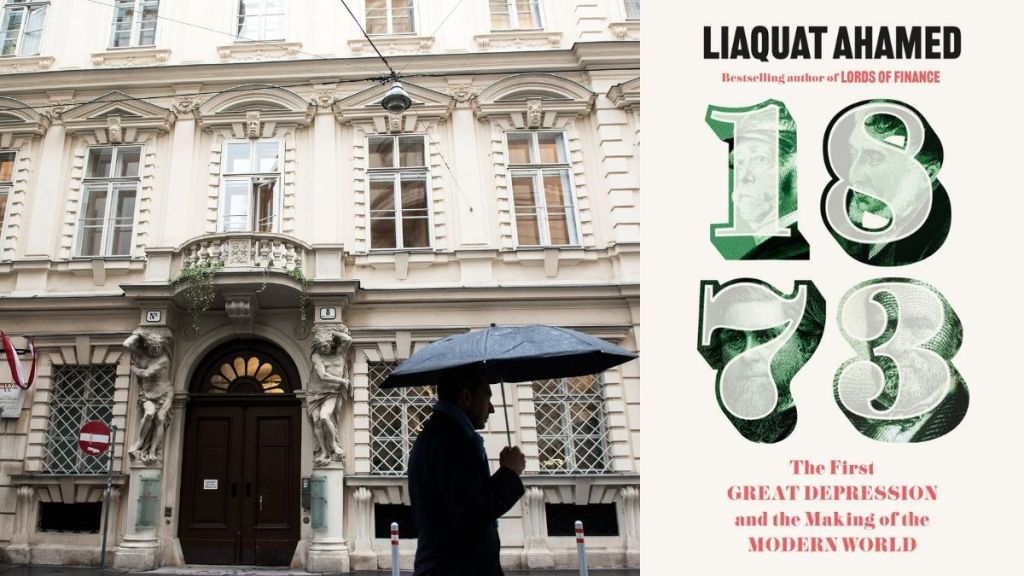

Liaquat Ahamed’s gripping history of the first global financial crisis shows how speculation, leverage and human folly can travel from markets into politics, society and the lives of ordinary people. Reading Liaquat Ahamed’s 1873 gives one of those strange experiences in which history begins to look less like history and more like a film we have watched before. The railroad mania of the nineteenth century has an unmistakable echo in today’s excitement around artificial intelligence. Markets are buoyant, capital is chasing a transformative technology, valuations can run ahead of underlying cash flows, and everyone has a convincing reason why this time is different.
In India, the backdrop is even more layered: demographic transition, the rapid formalisation of finance, high public and private investment, geopolitical fragmentation, supply-chain rewiring, energy transition, climate risk and the possibility that AI will alter jobs and productivity before institutions have understood its consequences. The worry is familiar enough to make the past feel uncomfortably close. 1873 is a story of how financial excess escapes the balance sheet and enters the bloodstream of society.
Ahamed’s story begins when the world itself was becoming newly connected. By the end of the 1860s, railways were stitching countries together, capital was crossing borders and governments and entrepreneurs had discovered the bond market as a way of borrowing against the future. America was building railways across a continent. Germany was flush with funds from the French indemnity after the Franco-Prussian War. Vienna was awash with property speculation. British and French bankers were financing projects and sovereign borrowers far beyond their own shores. The world economy had enjoyed two extraordinary decades of growth, trade had expanded dramatically and capital investment had surged.
Then came May 1873. The Vienna Stock Exchange collapsed. In a single day the market lost nearly half its value. The panic travelled to Berlin and, across the Atlantic, to New York, where the failure of Jay Cooke & Co, one of America’s most important investment houses, turned anxiety into a banking panic. Railway bonds unravelled, companies failed, investors lost fortunes and construction projects stopped. The new transatlantic cable meant financial fear could cross the ocean at unprecedented speed.
But the most revealing stories are not always in the trading rooms. Ahamed follows the shock into Egypt, where Khedive Ismail had borrowed heavily for canals, railways, palaces and the ambitions of a ruler determined to make Egypt look like a modern European power. Debt eventually became a route to foreign control, culminating in Britain’s takeover of Egypt. In the Ottoman Empire, sovereign borrowing and financial weakness produced another kind of humiliation: default eroded fiscal sovereignty and opened the door to greater European influence. In America, economic distress and political fatigue helped weaken reconstruction.
The Rothschilds sit at the centre of this sprawling narrative. Their banking instinct was conservative enough to keep them from many of the excesses that damaged others. Yet when the system broke, their name became useful to people looking for someone to blame. Ahamed shows how financial confusion can acquire a political vocabulary: the complicated mechanics of debt, currencies and speculation become easier to explain through conspiracy. The anger directed at Jewish financiers was one of the darker afterlives of the crisis, showing how quickly economic grievance can mutate into social hatred.
And then there is money itself. This is where 1873 becomes more than a story of a market crash. As major economies moved away from silver and towards gold, the supply of money tightened just when economies were struggling under debt. Prices fell for years. Deflation made debts heavier in real terms, squeezed farmers and producers, and strengthened the position of creditors. What looked like an arcane argument about gold and silver became a fight over who would carry the burden of adjustment. One reason the bond market matters so much in Ahamed’s story is that bonds reveal the price at which the world is willing to finance an ambition. They bring together the borrower’s credibility, the investor’s risk appetite, the cost of money and the market’s collective judgment about the future.
A lesson for Indian financial experts is that its corporate bond trading remains shallow and concentrated. A deeper debt market would give the economy something more valuable than another source of capital: a sharper market-based measure of how the world prices India’s risk, growth and ambition.
Ahamed’s history becomes particularly alive when it moves between finance and human behaviour. Mark Twain appears as an amused and sceptical observer of the speculative age. Karl Marx watches capitalism’s convulsions from another vantage point. Jay Gould represents the ruthless opportunism of the period. The Rothschild family embodies the extraordinary reach of private finance. Politicians, monarchs, bankers and speculators repeatedly convince themselves that they can control forces that have already begun to outrun them. Ahamed has a gift for making these figures feel alive, with their vanity, intelligence, courage, greed and blind spots.
One description in the book is especially unsettling. Antonio Gallenga, The Times’ correspondent in Constantinople, wrote in the 1870s of a man who seemed “destitute of all powers of reasoning”, incapable of breaking through “the magic circle of his concentrated selfishness” to feel sympathy for another human being. It could have been written yesterday. Across politics, business and public life, human society has acquired extraordinary material power without necessarily acquiring greater wisdom. Our machines are faster. Our markets are deeper. Our communication is instant. The human capacity for vanity, self-interest and wilfull blindness remains stubbornly intact.
That is perhaps the hardest lesson of 1873. The book is a further reminder that financial resilience begins with strong capital and disciplined leverage. History has delivered that warning repeatedly, across countries, markets, financial products and generations, and yet every boom persuades people that old restraints have become obsolete. Still, the temptation to borrow against an imagined future remains remarkably durable. In an interconnected world, who will save individuals and institutions from themselves?
Ahamed’s achievement is to make that question difficult to dismiss. 1873 was not merely a year in which a stock exchange fell. It was the moment a new global financial system discovered how quickly confidence could travel, how painfully debt could settle, and how easily distress could become political resentment and social hatred. It left behind deflation, populism, protectionism, antisemitism and a rearrangement of power that reached from Wall Street to Constantinople, Cairo and the American South. Every serious history of global finance eventually brings us back to prudence and human folly. Ahamed does so with a storyteller’s instinct for character and consequence. By the end, the reader has almost been transported into that century: hearing the market panic, watching fortunes disappear, seeing governments improvise and societies search for someone to blame.
And then comes the question that refuses to remain in the nineteenth century. After so many crashes, so much regulation, so much financial sophistication and so much accumulated knowledge, have we really learnt from the past?
Srinath Sridharan is an author, corporate adviser & independent director on corporate boards
1873: The First Great Depression and the Making of the Modern World
Liaquat Ahamed
Penguin Random House
Pp 368, Rs 1,499