



Where do people in Kerala go when they want to go for a walk in the morning? The easier answer could be — the Gulf. On a more serious note, it is a crushing reality that the state with the highest social indices that have become the owner’s pride and neighbour’s envy, and even draw mighty praises from such iconic figures as Nobel laureate-economist Amartya Sen, haven’t thought about having public parks and areas for people to stretch their body and imagination. It is a recurring joke in Kerala that the sprawling museum in Thiruvananthapuram, the state capital, is crawling with so many walkers in the morning that the congested streets outside feel like a walk in the park. It’s also no wonder that public events in Kerala are sold-out affairs and its beaches, festivals and cinemas — except bandhs — are all swarming in their multitude even on weekdays.
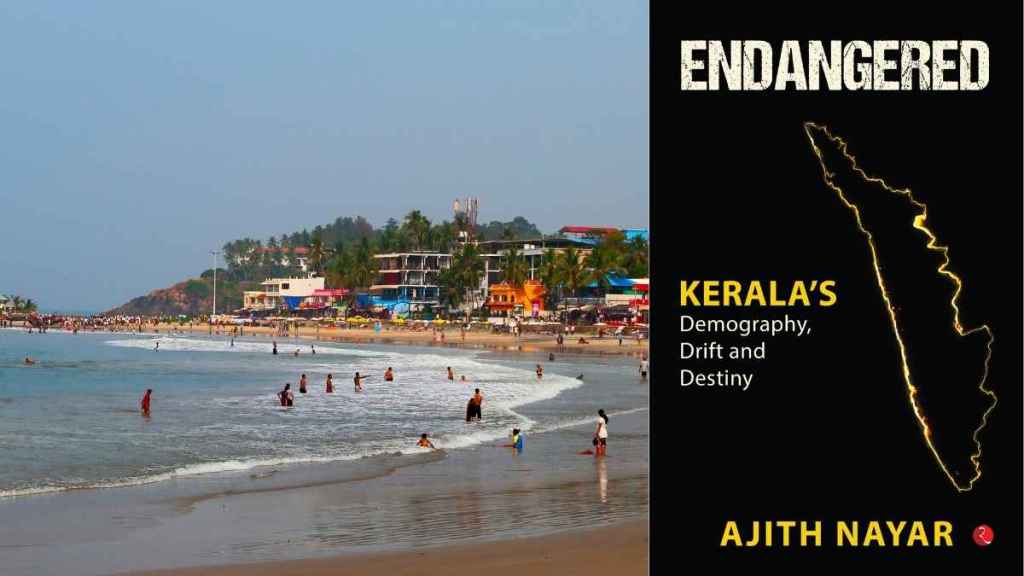
It seems parks and public places are going to be the least of Kerala’s worries in the future, if Ajith Nayar’s new book, Endangered: Kerala’s Demography, Drift and Destiny, is any indication. Nayar, a former non-resident Indian (NRI), who returned to his native state to become an entrepreneur, argues that Kerala has outgrown its so-called successes in human development, migration, foreign remittances, social welfare, equality, secularism, politics and literacy, and is already staring at a gradual decline. While acknowledging the spectacular success of the state in the past, the author warns that “prolonged success produces a dangerous illusion: the belief that the conditions that enabled past victories will automatically enable future ones”.
The book lists out what has been afflicting different levels of social, economic and political progress and points to what could be done to sight the signals. Calling the current condition of the state as not a collapse, but an erosion, the book goes on to mention the major moments that constitute the condition. One such is the state of the institutions, which have “failed to recognise when their original mandate was fulfilled and when a new one was required”. Education, it continues, has reached a saturation point, economy decoupled, demography shifted and fertility declined.
“Kerala’s institutions were misled by their own success,” Nayar writes, explaining that because “collapse didn’t occur, redesign felt unnecessary”. In the area of education, he says because the state already had high literacy and widespread access to basic education, “the need for a second leap”, into research, advanced professional training and globally competitive institutions was underestimated. At the intellectual level, the book argues that debate became the “proof of progress”, therefore, failing to demand “design, execution and institutional stamina”. In Kerala, the moral authority, it adds, was reduced to a “scandal economy” and “reaction republic”. And the Kerala Model, “once a dynamic framework, hardened into doctrine”.
The book spends long pages in articulating missed opportunities in turning other strengths of the state, like migration, diaspora and foreign remittances, into its advantage, by romanticising about diaspora success while not doing enough for diaspora involvement back home. It also deals in detail about the danger of ignoring signals by successful societies by drawing comparisons with countries such as Japan, South Korea, Japan and Lebanon.
Nayar writes that corrections underway in these countries are not “admissions of failure”, but “acknowledgement that past success does not guarantee future viability”. The author calls out Kerala’s universally acclaimed progress, saying the exception that the state is socially advanced, morally grounded and historically literate becomes a dangerous proposition when it “mutates into exemption — from arithmetic, from demographic law, from institutional entropy”.
Nayar makes the correct calls about the state and its imminent decline, but uses the wrong examples and narrative structure. For one, the arithmetic that he leans on is largely absent, even in a chapter devoted to numbers and data. The comparisons he provides are of far-away cultures and countries, mostly developed nations detached from the reality in a part of a Third World nation. In a glorified melange of management cliches and self-help formulae, Endangered drives itself into a path laid with good intentions, but bad design. Something like a place that wants its residents to walk, but doesn’t provide any public parks.
Faizal Khan is a freelancer
Endangered: Kerala’s Demography, Drift and Destiny
Ajith Nayar
Rupa Publications
Pp 272, Rs 595