


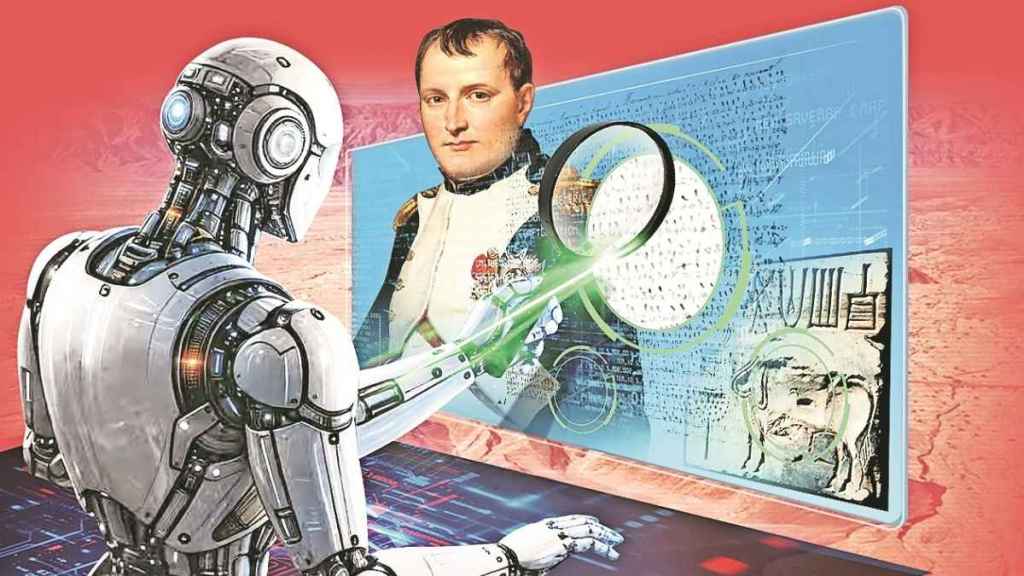

For centuries, archaeology has been a discipline of painstaking observation where researchers would spend years excavating sites, comparing fragments, studying inscriptions and mapping landscapes in the hope of finding evidence that could answer questions left behind by ancient civilisations. Artificial intelligence (AI) is changing how some of that evidence is analysed, with machine-learning systems scanning images, recognising patterns and helping researchers identify objects and structures that might otherwise take years to locate.
One recent example comes from a 217-year-old coded letter associated with Napoleon Bonaparte. In September, AI engineer Carter Church used OpenAI’s GPT-6 Astra to decipher a military cipher that had remained unsolved since 1809. The document contained about 1,300 symbols in a homophonic code, in which multiple symbols could represent the same letter.
Church supplied the model with a low-resolution scan of the letter, a partial table of known symbols and a prompt. The cipher was solved in six hours. The solution was verified and the cipher was marked as solved. The letter did not reveal an unknown episode of the Napoleonic Wars as much of its content was consistent with information already available but the whole process demonstrated that AI could test patterns in a historical document that had resisted conventional decipherment for more than two centuries.
In Peru’s Nazca desert, AI has been used to search for geoglyphs which are enormous figures created by removing layers of the desert surface. Researchers trained a deep-learning model to examine aerial imagery and identify locations where previously unknown figures could exist. In a six-month survey, the system helped researchers locate 303 previously unknown figurative geoglyphs, almost doubling the number of such figures known at the time. The discoveries included representations of humans, animals and birds, including a killer-whale figure.
The technology is useful for archaeological landscapes because the features being sought can be extremely difficult to distinguish from their surroundings. Aerial photographs and satellite images can contain thousands of potential shapes and patterns, while vegetation, erosion and the sheer size of a landscape can make systematic human examination difficult.
Light detection and ranging, known as LiDAR, is providing another large dataset for AI to analyse. The technology uses laser pulses to create detailed measurements of the Earth’s surface and can reveal changes in elevation associated with archaeological structures. In a study published in Advances in Archaeological Practice in April, researchers tested whether deep-learning models could locate archaeological features in LiDAR data even when there were not enough real examples available to train the system.
The researchers created simulated archaeological objects and embedded them into real LiDAR-derived terrain from the Kisatchie National Forest in Louisiana. They then trained Mask R-CNN models to identify the simulated structures. Field investigations showed that the structures were not the historic tar kilns the researchers had hypothesised, but another type of historic feature. The experiment demonstrated that artificially generated training data can help researchers use deep learning to search LiDAR landscapes where conventional archaeological training datasets are limited.
AI is being used at a much smaller scale to examine the markings left on individual archaeological objects. For example the Indus script, used by the Indus Valley Civilisation, researchers have used computational methods to analyse the sequence and frequency of its symbols, searching for patterns in inscriptions that are often only a few characters long. A 2017 study developed a deep-learning pipeline that could process images of Indus inscriptions, separate possible text from other markings, isolate individual graphemes and classify them. The system could identify the most frequent Indus “jar” sign with 92% accuracy. But this does not mean that AI has deciphered the Indus script. The script’s short inscriptions, the absence of a bilingual text and uncertainty about the underlying language remain major barriers.
The use of AI is expanding across the recognition and classification of ancient scripts. Recent research has examined deep-learning systems for Egyptian hieroglyphs, Oracle Bone inscriptions, ancient Greek inscriptions and other writing systems. These systems can assist with image recognition, segmentation and classification, particularly when inscriptions are damaged or when researchers need to work through very large collections.