


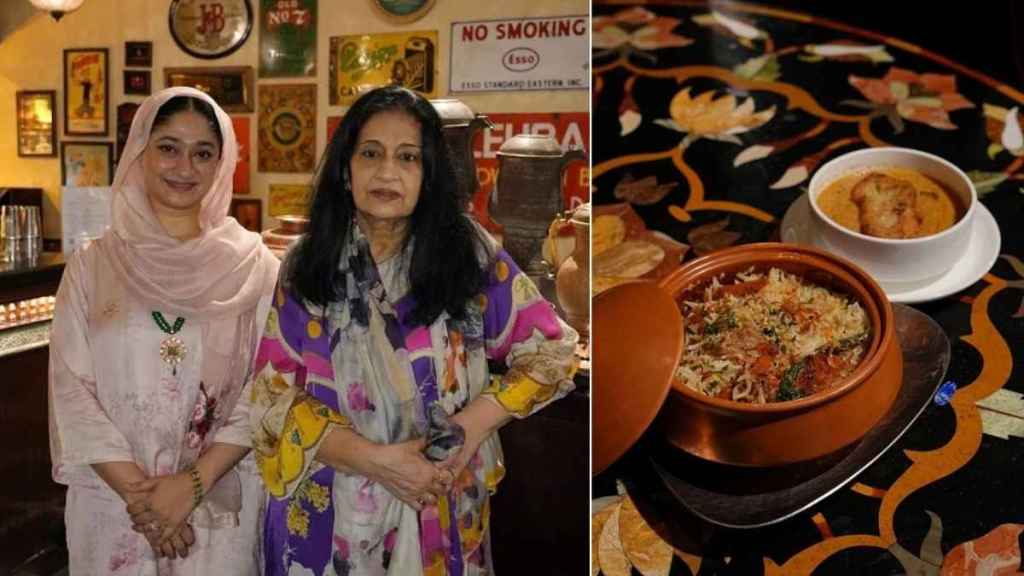

Think Hyderabadi biryani and the palate remembers big bold flavours of a spicy dish of meat and rice. But there exists a version that does not shout, but sings, very softly, with flavours so subtle, they are barely there. Belonging to Hyderabad’s Salar Jung royal family, chef Kulsum Begum brings the forgotten element of ‘delicacy’ to her cooking, be it haleem or a biryani or a salan or kalia.
Specialising in Hyderabadi and Mughlai cuisine, Kulsum has preserved more than 300 heirloom recipes from her family’s royal kitchen, maintaining the techniques and traditions behind each preparation. Even today, she insists on doing things as they were done years back, like soaking and peeling almonds one by one instead of boiling them to force their peels out, as done in commercial kitchens, reveals her daughter Maliha Khan, who is carrying forward the legacy of the royal kitchens.
Her haleem is mostly mutton, minced fine with subtle spices, with no chana dal or excessive oil or loud spices. “Haleem is not supposed to have any dal. But the version we see even in popular old Delhi eateries is one with dal, possibly to bulk up the dish,” she says. Having cooked at a pop up at Chor Bizzare recently in Delhi, she treated diners to haleem, shorba, coriander chicken, mutton biryani, arbi ka salan, where each dish was revelatory in its restrained use of spices and unexpected flavours.
But her biryani is unlike the popular version. “The reason why our biryani is so different compared to the commercialised version is because originally, Hyderabadi Biryani had Persian and Turkish influences, which used subtle spices to bring out flavours. From the way of cutting the onions differently specifically for the biryani, the rice being juicy and not dry, to use of spices, these small details make this biryani stand out. A big misconception is using red chillies, which is another result of its commercialisation. According to its true heritage, traditional Hyderabadi Biryani has a flavourful yet non-intrusive taste, because each spice never overlaps the other,” says Kulsum.\
Recipe for mutton biryani
- 1 kg basmati rice
- 1 and a half kg mutton
- 2 tea spoon raw papaya
- 250 grams fried onion
- 250 grams yogurt
- 2 table spoon garlic paste
- Half table spoon ginger paste
- Salt
- Half tea spoon haldi
- 1 table spoon chopped green chillies
- 2 table spoon mint leaves chopped
- 2 table spoon coriander leaves chopped
- Half tea spoon cardamon powder
- Half tea spoon clove powder
- Half tea spoon cinnamon powder
- 1 tea spoon shah zeera powder
- Marinate mutton with all spices and keep overnight
- Boil water, add whole dalchini, cardamom, clove, tejpatta, shahzeera and salt. Then add rice and lemon juice, and cook till rice is 80% done.
- Bring mutton to room temperature and spread in a big lagaan. Layer with rice. Add cardamom powder, saffron dissolved in milk, and desi ghee in between the rice layers. Garnish with mint leaves and fried onions and cover with foil. Put on high flame for 15 minutes. Then shift the lagaan onto a tawa on high flame for another 15 minutes, after which lower the flame for another 15 minutes. Wait for a few minutes before opening the lagaan to serve the biryani.