


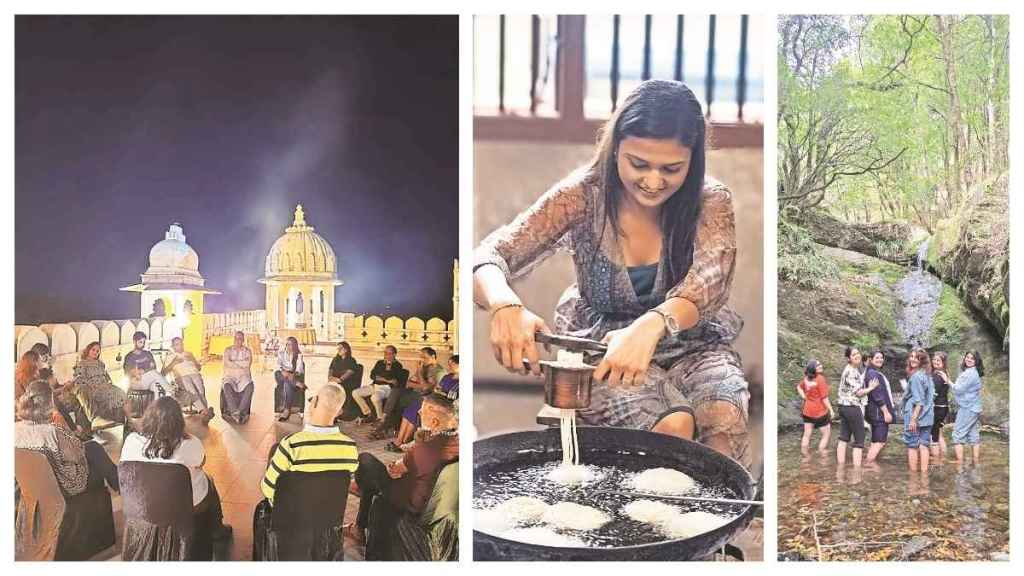

The modern holiday has acquired an unlikely luxury, which is not having to plan it. There is no comparing 7 hotels, no arguing over where to eat, no Google Maps itinerary with 11 saved spots, and no waking up to ask, “What are we doing today?”. Instead, a growing category of retreats is selling something specific, where a holiday built around a mood, an interest, a community or the need to switch off. There are retreats for burnout, women-only getaways, senior-friendly holidays, creative communities and slow stays. Some come with workshops and structured sessions, while others leave the day blank.
What’s on offer?
At Creativegarh Retreats, which began in 2000, the proposition is transformation through creativity and self-exploration. Founder Arun Verma says the idea is to move beyond the traditional holiday as an escape from everyday life. “People are looking for depth of experience, not just more experiences,” he says. The retreats bring together self-enquiry, behavioural psychology, creativity, spirituality, meditation, storytelling, play and conversation, usually in groups of 15-18 people. The idea is to return with a different perspective. “The question has changed from simply, ‘Where did you go?’ to ‘What happened to you while you were there?'” says Verma.
For those who want something less introspective, there is the slow-retreat model. At The Slowhouse in Pangot and Nainital, guests are invited to do less. The property is inside a bird sanctuary, surrounded by Kumaon forest, and there is no activity desk or elaborate schedule. “Most of our guests aren’t picking a destination so much as buying a few unbroken days,” says Gunjan of The Slowhouse. The house runs at roughly 80% occupancy in season and 60% off season. More than 100 Indian and international guests have stayed there, she says, with most new bookings coming through referrals or returning guests. Its women-only Maitri retreat, six women over four days, is booked through December 2026, with a waitlist.
Hotels are designing stays around the character of the place itself, taking care of the planning while giving travellers access to experiences they may not find on their own. At THE Lotus Palace Chettinad, for instance, the idea is to experience the region through its food, architecture, history and traditions. Its curated programmes combine a stay with local experiences, expert talks, food trails and visits to places that aren’t ordinarily open to tourists. Its Suvai-Chettinad Food Exploration Festival includes local food tours, cooking showcases, expert talks and themed meals, including a traditional Chettiar wedding feast and a Burmese-themed meal.
Guests can also visit local snack factories and family-run businesses making pickles and sun-dried produce. The Kalai-Chettinad Art and Architecture Festival takes guests into private mansions, centuries-old temples, Athangudi tile factories and workshops of local craftsmen, with experts explaining the region’s architectural and cultural history. “We believe a holiday experience should be more than just a comfortable stay,” says Sandeep S, hotel manager. “Guests should be able to book their stay, arrive at the property and enjoy a planned experience without having to organise every activity themselves.”
How it works
Go with a purpose: It doesn’t have to be profound. You might want to meet people, write, paint, recover from burnout, spend time in nature or simply sleep for eight hours.
Beyond yoga & meditation: The category has expanded. There are creative retreats, women-only trips, food-led stays, nature immersion, senior-focused holidays and experiences built around community.
Look beyond photogenic: “Restorative and photogenic have almost nothing to do with each other,” says The Slowhouse’s Gunjan. A beautiful property may make for good photographs but it doesn’t automatically make for a good retreat.
Look at the group size: For retreats involving personal conversations or community-building, a small group can make a difference. Creativegarh keeps its retreats to around 15-18 people.
Don’t expect transformation on demand: A retreat cannot guarantee an epiphany by Thursday afternoon. Creativegarh’s Verma says, “You cannot programme transformation into an itinerary.” The point is to create the conditions for something to happen rather than prescribe the outcome.
Pay attention to the place: A well-curated retreat should have a relationship with its setting. At The Lotus Palace in Chettinad, guests can choose from experiences such as guided mansion tours, village explorations, traditional kolam lessons and Kili Josyam, while the hotel can also arrange day trips to Tanjore, Rameshwaram, Madurai and Trichy.
Don’t pack every minute: This may be the hardest rule for habitual itinerary-makers. Sometimes the most successful part of a retreat is the hour that wasn’t planned. At The Slowhouse, guests have spent days sitting on the terrace rather than rushing out to see the sights.
The appeal of these retreats is less about escaping travel’s old routines than redefining what a holiday is supposed to accomplish. “Most of our guests have tried the packed version of a holiday and would rather pay more than do it again,” says Gunjan. That may be the clearest description of the new travel luxury.