


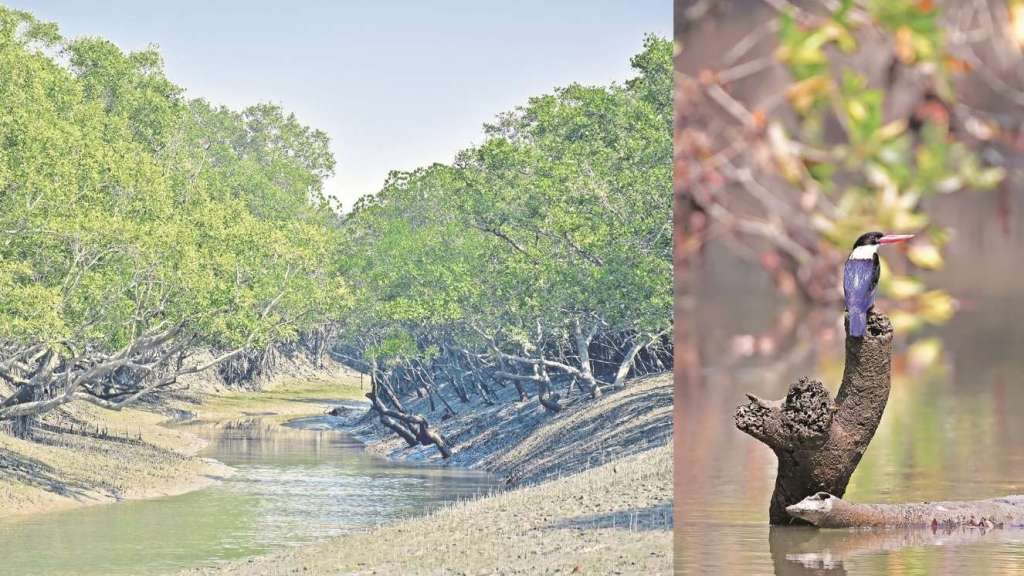

Someone speaks of a Royal Bengal Tiger and you know where to find one, the Sundarbans. But the world’s largest mangrove forest is the kind of safari destination where, even without a sighting of the big cat, you return with enough memories of the journey. Here, the adventure is as much about navigating winding waterways, stepping into the mud at low tide and watching village life unfold along the river as it is about looking for a tiger.
I started my journey from Kolkata at around 8 am, taking a 3.5-hour cab to Godhkhali, one of the gateways to the Sundarbans. For a one-night trip, I chose to stay nearby rather than venture deeper into the forest. The eco-resort was surrounded by village life, forests and the breeze from the river, and was located across from the Sundarban Tiger Reserve.
The first introduction to the landscape came through a short boat ride to the Sundarban Bird Jungle. We watched the sunset from the water as local fishermen threw their nets into the river. It was low tide, and our guide suggested something I hadn’t expected, which was getting off the boat and walking through the mud towards the mangroves. Trusting our guide that there would be no sudden tiger or crocodile scare, we stepped into the knee-deep mud. We spotted crabs and mudfish among the mangrove roots before washing our feet in the river and heading back to the resort. Dinner was followed by a performance by a local music group, making for an evening that embraced the idea of “slow life”.
Our guide then took us on a “night safari”. We again got into the boat, this time with little more than torchlights to illuminate the darkness. All we could hear was the sound of the river and the gentle swoosh of the paddles.
The water occasionally lit up with bioluminescence, bringing back flashes of the scenes from Life of Pi.
The next morning was reserved for the main event where we would go for the Sundarbans delta safari. We started from the Sajnekhali Tiger Reserve area, travelling by boat through the network of rivers and creeks. The forest is home to spotted deer, crocodiles, wild boar, snakes, water monitor lizards and a variety of birds. And, of course, the Royal Bengal Tiger. I wasn’t lucky enough to see one. What I did find was a paw mark. Occasionally, our guide would point towards the riverbank to show us a crocodile sunbathing by the water.
We then headed to the Do-Banki Tiger Reserve area and watchtower. One of the highlights here is the 896-metre canopy walk, where visitors can observe wildlife from within a netted enclosure. Unlike a conventional safari, where you move through open roads, the Sundarbans experience is shaped by water. The boat becomes your safari vehicle, and every bend brings the possibility of spotting something new. For example, our guide pointed out how forest patrols with Indian flags keep watch against illegal honey collection.
Another stop was Panchamukhni, the meeting point of five rivers. Lunch was served on the boat, with Bengali prawns and crab dishes cooked by locals, adding another distinctly local touch to the experience.
After the safari, we returned to the resort, collected our bags and began the journey back to Kolkata. It made for a packed one-night itinerary, but those with more time can stay on the inhabited peripheral islands such as Bali Island, Dayapur and Pakhiralay, where local eco-resorts and homestays offer a closer look at village life. Longer trips can also include visits to Hamilton Bungalow and Rabindranath Tagore Bungalow, along with lily ponds and birding spots. Multi-day cruise packages are another option, with boats anchoring in designated river areas for overnight stays on the water.
The Sundarbans is less about ticking a tiger off a checklist and more about entering an ecosystem where the forest, river and people are all part of the journey.
ends
Travel Planner
Best time to visit: December to February
What to wear: Comfortable shoes, light jacket, a hat and sunscreen
What to eat: Local Bengali dishes, prawns and crabs
How to reach: Cab from Kolkata to Godhkhali