



Malek Khatoom wrote poetry in Iran’s ancient city of Shiraz in the 14th century when music was banned by its new ruler and a female poet was not the custom. Also in Iran over a century years ago, Gordafarid was a woman warrior who challenged Sohrab, the hero of the story of Rostam and Sohrab in Ferdowsi’s Persian epic, Shahnameh (The Book of Kings).
Away from Iran, but in the same Middle Ages, a feisty nun called Hildegard von Bingen composed music in 11th-century Germany while in the Middle Baroque period, Barbara Strozzi survived a plague outbreak in Venice to become the first professional female music composer in Italy.
Forgotten female warriors and musicians such as Gordafarid, Khatoom, von Bingen and Strozzi are the focus of The Book of Queens, a transcultural musical project, which is a highlight of the Jodhpur RIFF roots music festival (October 22-26) in Rajasthan. Artistically led by Camille Bordet, a Persian-speaking opera singer, The Book of Queens explores the often historically marginalised place of women within artistic and cultural heritage.
Debuted in November last year at the Nights of the Orient music festival in Dijon, France as an East-West dialogue months after the Iran-United States-Israel war in June last year, The Book of Queens is also touted as an attempt to weave new forms of dialogue between the East and the West.
Classics and courage
“We can learn from them (the forgotten female poets and warriors),” Bordet, who leads The Book of Queens musical project, tells FE. “First of all, that they did exist, that they did fight, and that they deserve to be listened to as well as any human being, that they have as much talent and intelligence as men,” she adds.
“They might even have more courage – for it takes so much courage, as a woman, to ask yourself questions as simple as: Who am I? What do I like? What do I want to do? It takes so much courage to know our worth and let it shine despite all the shadows being forced upon us,” explains Bordet about the artistic approach of the project.
The origins of The Book of Queens go back a year ago when the Opera House of Dijon asked Bordet to create a concert for a festival of transcultural music that they were partially hosting. “I had been working for a few years on projects linking European classical and Iranian repertoire, and I decided to focus on female works of poetry and music from both cultures,” recalls Bordet. “As an opera singer, I was always frustrated to sing poetry written by men or to embody female characters designed from a male perspective. I wanted to make a project in which I could express the words and feelings of women of different times and spaces, united by nothing else than their womanness,” she adds.
Besides Khatoom and Gordafarid from Iran and Hildegarde of Bingen and Barbara Strozzi from Europe, the project has 20th-century Iranian poet Forough Farrokhzad and 10th-century poet Rabia Balkhi from Afghanistan with a musical reinterpretation of their poems and texts.
Malekeh Nameh, the original title of the project in Parsi, takes its reference from Ferdowsi’s Shahnameh. “The poem tells the mythical history of Iran, from the creation of the world to the arrival of Islam,” says Bordet about the epic written entirely in Persian. “One of the particularities of Shahnameh is the depth of the characters’ personalities, including strong women. Lovers, witches, warriors. They are brave and complex, and it seemed like a natural starting point to let the project unfold,” she adds.
Europe, Iran & India
After the world premiere of The Book of Queens in France last fall, Bordet felt it was necessary for poetry from different parts of the world, but written during similar moments of history to co-exist in her work. The result was the introduction of India into the project, to include the works of 16th-century Bhakti saint Mirabai, 14th-century Kashmiri mystic poet Lal Ded and 12th-century Kannada poet and philosopher Akka Mahadevi, who fought for the emancipation of women.
“I am attached to every single piece and every single ‘queen’ of the concert. I cannot put any hierarchy between Gordafarid, who fought against the strongest man of her time, Sohrab, and Hildegard von Bingen, the visionary nun who revolutionised music and Western mysticism, nor between Barbara Strozzi, the first female composer who lived off her music in 17th-century century and Akka Mahadevi, with her devotion and her fight for the emancipation of women,” says Bordet.
“It was actually a suggestion made by Divya Bhatia, the director of the Jodhpur RIFF,” says Bordet, referring to “tridimensional” version (Europe, Iran and India) The Book of Queens, which is co-commissioned and co-produced by Jodhpur RIFF. “He saw an interesting connection between the existing project and Indian culture. I had always thought of The Book of Queens as a concept that could have several versions, focusing on different cultures. I seized this opportunity with excitement and enthusiasm, especially given the strong connections between Persia and India,” she adds.
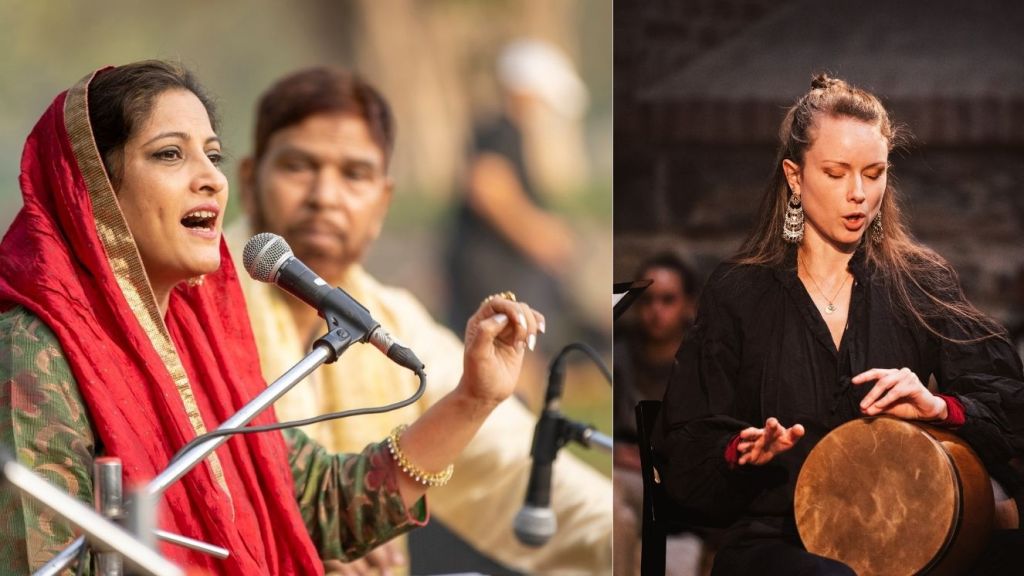
Last month, Bordet travelled to Jodhpur to meet with Hindustani vocalist Smita Bellur and Rajasthani kamaicha maestro Kode Khan Manganiyar, who would go on to become part of the project’s ensemble cast along with Iranian-Canadian drummer Hamin Honari, a specialist on the Persian tombak and daf, Canadian string instrumentalist Madeleine Owen, Iranian-Canadian musician and Persian kamanche specialist Saeed Kamjoo and Montreal-based Iranian tar player Maryam Tazhdeh.
Texts and music adapted from the works of the forgotten female poets and composers and extracts from Shahnameh form the repertoire of the 90-minute-long The Book of Queens concert, performed in Brussels, Belgium in December last year and Oslo, Norway in March this year following the world premiere in Dijon. The Book of Queens will return to its original Europe-Iran project for three more concerts in India this month, in Jaipur, Mumbai and Bengaluru.
“I left the choice of Indian poetry entirely to Smita Bellur, who is a fine connoisseur of female repertoire. The idea was to find poems that could match or mirror the existing pieces,” says Bordet, adding: “It is the first time The Book of Queens is played outside Europe, in a new shape, with a new team, with new colours.”
Faizal Khan is a freelancer