


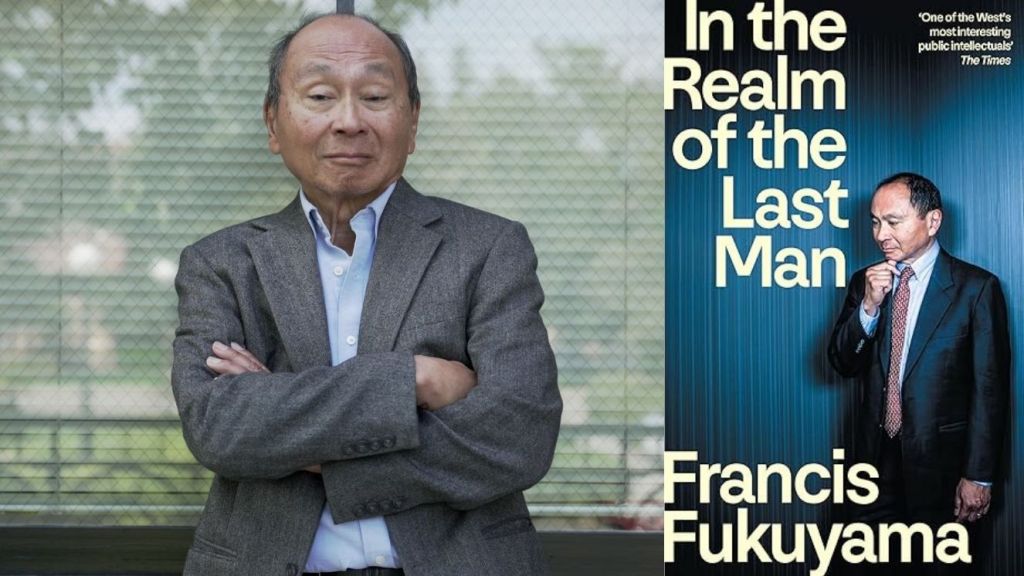

Some books deserve to be regarded as works of enduring significance not because of their length or encyclopaedic scope, but because of their extraordinary capacity to capture an entire intellectual age through the life of a single, remarkable individual. Francis Fukuyama’s In the Realm of the Last Man is such a book, a dazzling fusion of memoir, intellectual biography, family chronicle and political history that offers a mesmerising journey into the life and mind of one of the most fascinating public intellectuals of our time. More significantly, it is an evocative and searing exploration of the maladies afflicting liberal democracy.
Composed of 35 miniature portraits, each chapter an imagistic vignette on a larger intellectual and personal canvas, the book’s form is as intriguing as its protagonist. Part autobiography, part historical recollection and part meditation on the making and unmaking of political convictions, it defies the conventional boundaries of any single literary genre. In a voice marked by quiet restraint and austere tone, Fukuyama traverses a remarkable intellectual and historical landscape, moving from family memories, particularly those of the suffering and dislocation wrought by the internment of Japanese Americans during the Second World War to philosophical debates; from university classrooms to the corridors of power in Washington; and from the intellectual legacies of such towering figures as Leo Strauss, Allan Bloom, Samuel Huntington and Seymour Martin Lipset to the evolution of American neoconservatism, the global resurgence of authoritarianism and the dismantling of the very idea of ‘American exceptionalism’.
Among the portraits I found most compelling is that of Allan Bloom, the charismatic philosopher and teacher whom Fukuyama encountered during his first semester at Cornell. Bloom emerges as a figure of extraordinary intellectual magnetism, possessed of expansive tastes and a studied indifference to the mundane conventions of everyday life. Money seemed scarcely to concern him, and even cigarette ashes falling upon his immaculately tailored suits while he lectured appeared almost an extension of his cultivated eccentricity, as though the ordinary codes of propriety held little authority in his world. His mannerisms, and social idiosyncrasies, including his near-obsessive passion for vinyl records and CDs, lend the portrait an almost theatrical vividness, revealing a personality as arresting as the philosophical convictions he espoused. Fukuyama also alludes to Bloom’s homosexuality, lending an especially poignant dimension to the contradictions between the freedom of the intellect and the constraints imposed by the social and moral conventions of his time.
Equally evocative are Fukuyama’s recollections of encountering the French intellectual world at the height of its global prestige. He remembers Michel Foucault disappearing upstairs to his room at Cornell University’s Telluride House, surrounded by admirers, a fleeting but revealing image of the philosopher’s extraordinary magnetism and the almost cult-like fascination he inspired. Fukuyama also recounts attending a seminar by Roland Barthes as part of a Johns Hopkins University overseas programme and listening to Jacques Derrida lecture at the École Normale Supérieure in Paris. These encounters transport us to an era when French structuralism and post-structuralism held the humanities in their intellectual thrall. Yet Fukuyama’s initial fascination gradually gives way to disenchantment, particularly with what he regards as the fundamental hypocrisies of French postmodernism.
Also particularly engaging are Fukuyama’s reflections on Leo Strauss, whom he never met, yet whose thought became one of the most important influences on his intellectual life. His fascinating account of how Strauss’s second-generation students divided into the ‘East Coast’ Straussians, associated with Allan Bloom and Harvey Mansfield, and the ‘West Coast’ acolytes of Harry Jaffa, whose intellectual legacy has been invoked in debates surrounding Trumpism, illustrates how even the most formidable philosophical traditions can become entangled in contemporary political struggles and subjected to the perverse politicisation of ideas in the pursuit of power.
The book’s intellectual and philosophical excursions are matched by vivid encounters with the rougher realities of political power. Fukuyama’s meeting and conversation with Colonel Muammar Qaddafi in his legendary tent, and his encounter with Wang Qishan, nicknamed ‘the Surgeon’, a philosophically minded tyrant and widely regarded as one of the most powerful leaders after Xi Jinping, offer fascinating glimpses into the minds and methods of those who wield power, where intellectual sophistication can coexist uneasily with authoritarian instincts. Fukuyama’s travels through Latin America provide a similarly revealing panorama of political life, exposing the region’s varied experiments with democracy, authoritarianism, ideological conviction and economic transformation.
Though I would personally have preferred a much larger canvas than this slim volume affords, this autobiographical account offers, in miniature, a panorama of Fukuyama’s intellectual oeuvre, distilling the central concerns of works such as Trust (1995), The Great Disruption (1999), America at the Crossroads (2006), his monumental two-volume study of Political Order, Identity (2018) and Liberalism and Its Discontents (2022). Through elliptical mode of recollection, Fukuyama not only revisits the serendipitous encounters that shaped his life, but also recounts the painful ruptures that accompanied his intellectual journey. His estrangement from neoconservative allies, his broken friendships with Bill Kristol, Paul Wolfowitz and Norman Podhoretz, and his public dispute with Charles Krauthammer expose the deeply personal costs of intellectual dissent.
Yet the book’s appeal lies as much in its quieter, more intimate passages as in its sweeping intellectual and political panoramas. Amid reflections on political philosophy, ideological struggles and the shifting currents of world history, Fukuyama makes room for the private satisfactions of woodworking and his love of tools and cameras. Particularly poignant memory is his recollection of his uncle Hiroo’s affection for Soon Ching-ling, the widow of the founder of the Chinese nationalist movement or Kuomintang Dr Sun Yat-sen. Working as an interpreter for Japanese prisoners of war under the US army, his uncle somehow found himself in Chongqing in southwestern China, where he met Madam Sun Yat-sen as she was then known. Their relationship, as remembered by Fukuyama, seems to hover at the tender, unspoken edge of a rare love story, a private emotional history unfolding in the most tumultuous times of the modern world.
It is this interplay between the intellectual and the personal, the historical and the intimate that lends the book its distinctive character. For someone like me who pursued graduate studies in Oklahoma in the 1990s, when Fukuyama was something of a reigning rock star in American academia, the book carries a deeply personal resonance. In those years, while studying with political theorist Donald Maletz, who translated Leo Strauss’s preface to Hobbes’ politische Wissenschaft into English, I found myself captivated by Nietzsche’s shadowy figure of the ‘Last Man’, refracted through Fukuyama’s vision of history, which cast an almost hypnotic spell over us. It stirred something existential within me, a sort of metaphysical awakening an awareness of the inseparability of politics and poetry in the city of tornadoes.
I must confess that the spectre of the ‘Last Man’ has never quite loosened its grip on my imagination. At times, I feel trapped in Gabriel García Márquez’s Macondo, where the familiar order of things unravels amid the surreal. That is why In the Realm of the Last Man deserves to be read not merely as Francis Fukuyama’s personal memoir, but as a chronicle of an intellectual age and of the hopes, anxieties and disillusionments confronting us. Perhaps no intellectual prophecy, however dazzling, can ultimately deliver us from the uncertainties of being human.
Ashwani Kumar is a poet, political scientist and senior visiting fellow at CPR. His forthcoming book is titled Loss of Ordinary Things. He is also member of the governing council at the KR Narayanan National Institute of Visual Science and Arts, Kerala. Views are personal
In the Realm of the Last Man: A Memoir
Francis Fukuyama
Hachette
Pp 256, Rs 699