



By Sakoon Singh
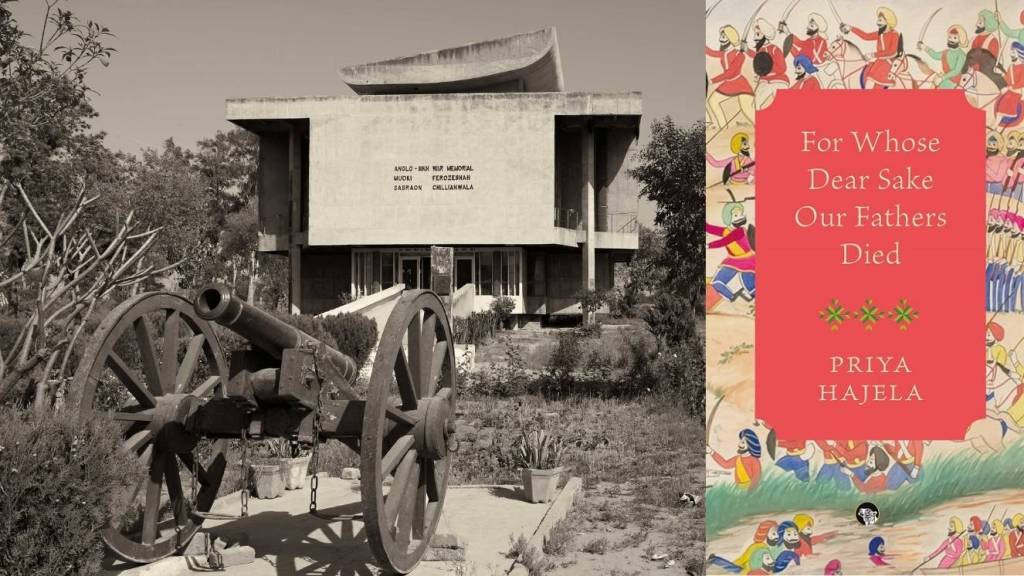
The title of Priya Hajela’s new novel For Whose Dear Sake Our Fathers Died is gleaned from Rudyard Kipling’s patriotic poem The Children’s Song. Kipling’s own location in colonial India makes the idea of ‘patriotic’ complex and layered. A thorough imperialist on one hand, he drew a slew of beloved literary characters from the Indian soil, amongst which Mowgli, the wolf child, as a paean to the Indian jungle, and Kim, the intrepid traveller of GT Road. His father, John Lockwood Kipling, had served as principal of the Mayo School of Industrial Art, Lahore, and it is his own childhood in the bylanes of Lahore that he mimics when Kim opens with street urchins roughhousing around the Zamzama cannons outside Lahore museum. In a flash, the erstwhile power of the great Maharaja Ranjit Singh in the guise of the mighty cannon marks its attendance, only to be reduced to a memento in colonial Punjab, a mute installation on which street urchins playfully ride and tumble.
“Who holds Zam-Zammah, that ‘fire-breathing dragon’, holds the Punjab, for the great green-bronze piece is always first of the conqueror’s loot.”
In Hajelas’s novel, too, this is the milieu and the point of departure — the downfall of the Khalsa empire after the second Anglo-Sikh war. The subsequent years saw large-scale enrollment of Sikh soldiers in the British army. The Sikhs, apart from being considered ‘martial’, were also believed to be inherently good soldiers owing to their rugged physique and ingrained values of courage and loyalty. Fairly early on in the narrative, the author acknowledges this fraught relationship that Punjab has had with the British Empire, starting with loyalty to the crown as enrolled soldiers in the British army to a later move towards staunch rebelliousness.
Hajela attempts to outline the history of colonial Punjab through the space of family stories. We are introduced to grandmother Beant Kaur spinning the yarn for her grandchildren. She goes on a rambling journey, telling stories of the family’s ancestors who found themselves in the thick of monumental historical events of Punjab — the Anglo-Sikh wars, the Mutiny of 1857, the Anglo-Afghan wars and the Komagata Maru incident in 1914. Somewhere by presenting history through family lore, Hajela effectively explores the complicated idea of love and loyalty, both at the level of family as well as nation. The book is dedicated to Henry Lawrence, the first resident of Punjab, and the founder of the Lawrence School Sanawar, further pointing to these complex dynamics.
Through the trope of storytelling, the author plots pivotal events along a span of more than half a century, beginning with the disastrous routing of Khalsa army in the Anglo-Sikh wars in which their ancestor Iqbal Singh is a prime protagonist. And then the mutiny of 1857, by which time Punjab had been taken over by the British and the Sikhs were being recruited in big numbers into the British army. Sikhs, despite the then recent memory of the exile of their boy king Duleep Singh and his mother, Rani Jind Kaur (the widow of Ranjit Singh), joined the British forces against their rebellious countrymen. The idea of a nation was still not formed in the way we can think of from today’s standpoint. Balwant Singh, in these circumstances, beholden to two officers, joins the British forces. In highlighting Balwant’s loyalty to Jeremiah Brasyer and his subsequent siding with the British, the author takes on the old debate about Sikhs’ controversial participation that did not suit the nationalist narrative of 1857. She problematises the personal circumstances to comment on the larger political currents. Similarly, Balwant’s son Harjit fights from the British side at the forefront in the Anglo-Afghan wars. However, decades later, Avtar takes on a rebellious mantle. At the sidelines is their relationship to interesting women Harsharan, Sindhu and Khushi, who are domineering and statuesque.
Avtar is the youngest kin whose story plays out in Calcutta where he is training to be a barrister and eventually becomes part of the Komagata Maru ship voyage to Canada in a bid to challenge their racist ‘continuous journey’ rule.
His budding love affair with Khushi, who is the daughter of Gurdit Singh, the businessman who charters the ship, is intriguing and eventually ends happily. In hindsight, they might not again fit in neatly with the idea of the revolutionaries but they have their own rationale for embracing some complex truths.
The novel has an intriguing narrative structure and plots an inter-generational family saga along pivotal points in Sikh history under British rule. Grandmother Beant Kaur repeatedly emphasises the importance of passing on family lore to the younger generation, and that also is the rationale of all history writing — whether for individuals, community or nation. Using family as a thread, she brings these important events in Sikh history spread out in time where the Sikhs had an important interface with the British. As Amitav Ghosh says, while history focuses on monumental events, historical fiction focuses on the lives caught in the malestream, and in this the book abundantly succeeds.
Sakoon Singh is a novelist and academic based in Chandigarh
For Whose Dear Sake Our Fathers Died
Priya Hajela
Speaking Tiger Books
Pp 336, Rs 599