



Hiring the right person for the right role is a tough task, and for enterprises, the complexity is manifold. The day-to-day reality for most recruiters today is less strategy and more juggling between applicant tracking systems (ATS), CRM, candidate databases, interview platforms, and a separate messaging tool to actually talk to candidates. LinkedIn believes agentic AI could help bring greater efficiency to this process.
At a recent media event in LinkedIn’s Bengaluru office, Prashanthi Padmanabhan, Vice President, LinkedIn Talent Solutions Engineering, shared with Financial Express how AI is transforming recruitment. Padmanabhan offered a walkthrough of LinkedIn Hiring Assistant (LIHA), the company’s agentic AI tool designed to assist recruiters. LinkedIn announced Hiring Assistant about two years ago and made it publicly available in October 2025.
LIHA is not a standalone AI feature built into existing workflows; it has been designed to sit inside the recruiting process itself. According to LinkedIn, the AI system is capable of understanding recruiter intent, learning from feedback, and improving its recommendations over time. Padmanabhan shared that LIHA emerged from the belief that recruiting was particularly suited to an agentic experience. Since the product could not be built simply by applying the technology to an existing workflow, the executive revealed that understanding what recruiters and enterprises actually needed was vital.
During a demonstration, Padmanabhan explained how LIHA can take a specific job requirement, refine it with the recruiter, look up candidates, and explain why they match. Later, the system can draft an outreach message and even conduct an initial screening conversation. It needs to be noted that the larger ambition here is not to replace recruiters. “Recruiting is a human job,” Padmanabhan said. “The decision of who to reach out to and when to do the outreach is still made by the human – the recruiter.”
According to the executive, this human-in-the-loop approach is one of the key principles around which LIHA has been built. The other two are a skills-first approach to hiring and evidence-backed reasoning.
From job description to shortlisting candidates
Padmanabhan’s demonstration began with the recruiter inputting a job description or the kind of candidate they are looking for. LIHA then turns this information into a detailed and structured hiring requirement. The system also allows the recruiter to modify details such as level of experience, employment type, location and qualifications directly within the interface. In case something is amiss, the assistant asks for clarification or makes suggestions depending on the context available to it. For less experienced recruiters, Padmanabhan believes this can also become a learning tool.
“If you are a novice recruiter who doesn’t have a great experience, and you’re starting to source for a role, LIHA should teach you,” she said. “It teaches you, if you’re looking for this kind of role, this is how you write the qualifications.”
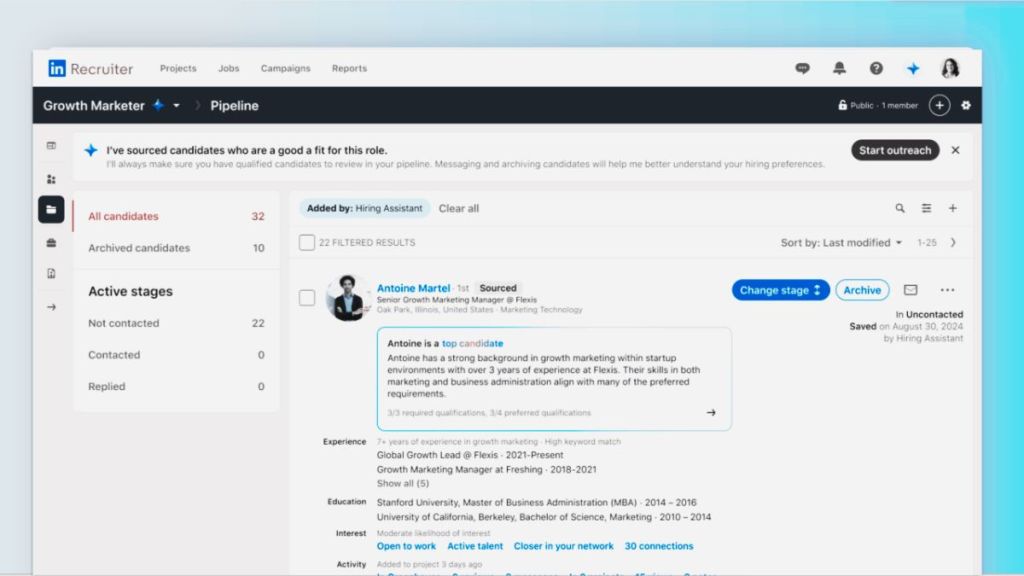
After the hiring criteria are determined, LIHA initiates candidate sourcing. Instead of simply producing a list of names, the tool also offers its reasoning. During the demonstration, a candidate was shown as meeting seven required qualifications and four preferred qualifications. LIHA also showed evidence behind these matches, which was drawn from sources like the candidate’s LinkedIn profile and resume where available. According to Padmanabhan, this emphasis on evidence is deliberate. She said that the team does not want recruiters to simply accept an AI-generated recommendation. Depending on the requirement, the recruiter can accept or reject candidates and provide feedback, which becomes part of the system’s ongoing understanding of what the recruiter considers an ideal match.
AI in the background
Perhaps one of the most distinguishing features in the LIHA workflow is that recruiters need not sit and monitor the system’s work. Once the candidate sourcing begins, the system can operate separately in the background, allowing the recruiter to move on to other tasks. Based on the demonstration, candidates are delivered in batches with notifications indicating when they are ready for review. This, according to LinkedIn, is where efficiency gains become measurable. “When you use LIHA, you’re seeing you’re having to review 80 per cent fewer profiles. That’s directly equivalent to the amount of time saved,” Padmanabhan said.
The platform has also observed a 66 per cent higher InMail acceptance rate among customers using Hiring Assistant, according to Padmanabhan. However, efficiency is not the sole objective here, as the company also wants the system to show candidates who may otherwise have been missed. “We also want Hiring Assistant to find candidates who are difficult to find otherwise,” she said, describing these as the “rare gems” in a candidate pool.
After sourcing comes outreach, LIHA generates a candidate-specific message based on the role and the candidate, instead of relying on a generic template. The recruiter can later decide to send, edit, or proceed to pre-screening, which is the initial filter in recruitment to check candidate eligibility.
Pre-screening is also another area that LinkedIn sees as especially suitable for AI. Simply put, instead of recruiters repeatedly asking every candidate the same initial questions, LIHA can conduct the preliminary conversation. The recruiter decides what to screen for, such as location, workplace requirements or other criteria, while the system handles the repetitive interaction. Padmanabhan showed that candidates are explicitly informed that they are interacting with the hiring assistant instead of the recruiter. This distinction is part of the platform’s wider effort to maintain trust when it comes to AI-mediated hiring.
What about the risk of AI errors?
AI is becoming increasingly deployed in hiring processes worldwide, and this has also triggered some obvious questions about false positives, inaccurate information, and even candidates optimising resumes specifically to circumvent certain automated systems. Padmanabhan said that LinkedIn is addressing this by expanding the sources of information available to its systems and adding authenticity signals. “We try and expand the sources of data that we can look at to make sure that we can validate the credibility of the data in the profile and resume,” she said.
Verified profiles are another part of that effort. “We have a lot of attention to bringing in authenticity verification hooks, both for recruiters and the candidates, because it works both ways,” she said, describing it as an ongoing effort rather than a solved problem.
When asked how AI will impact recruiting in the coming years, Padmanabhan shared that she expects AI to move deeper into recruitment, particularly in sourcing and pre-screening. Interviews, however, are likely to remain fundamentally human, even as AI begins extracting useful signals from those conversations. “Recruiting as an end-to-end flow is very, very prime for an agenting experience,” she said.
For recruiters, this could mean spending less time searching through thousands of profiles and more time doing what AI cannot easily replicate, such as talking to candidates, understanding hiring managers, and making the decisions that determine who gets the job.