


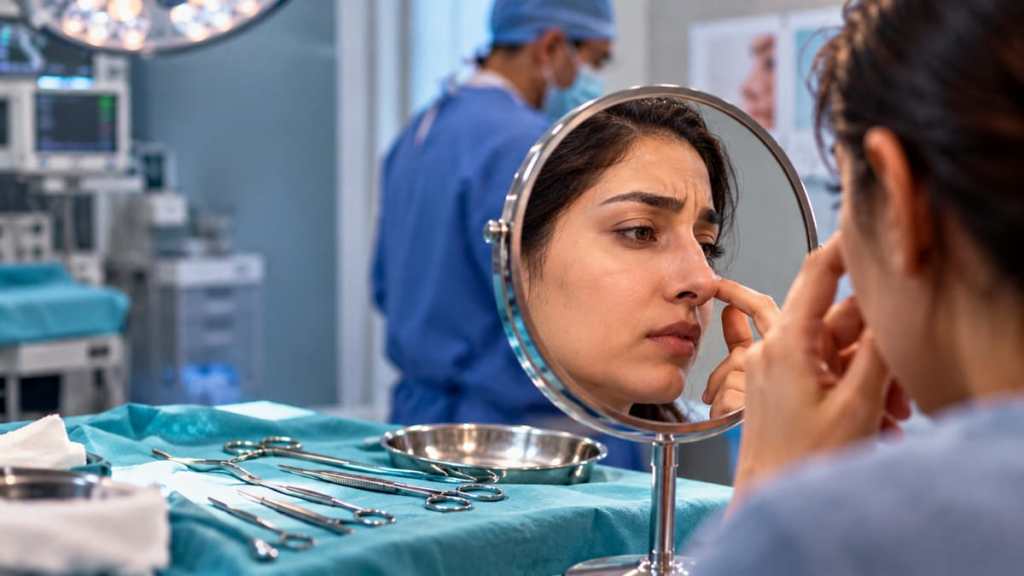

A Delhi consumer commission has directed a doctor to pay Rs 65,000 to a woman who complained that her nose appeared crooked and the tip had turned upwards after she underwent cosmetic rhinoplasty.
According to The Indian Express report, the commission said that while dissatisfaction with the aesthetic result of a cosmetic procedure does not, by itself, amount to medical negligence, the appearance of the outcome cannot be completely ignored when improving appearance is the primary purpose of the surgery.
The bench of president Monika Aggarwal Srivastava and members Rajender Dhar and Ritu Garodia made the observations in its September 25 order, holding that there were shortcomings in the service provided to the complainant.
“The primary objective of cosmetic surgery is to make individuals appear beautiful,” The Indian Express quoted the commission as saying. The commission also stressed that aesthetic dissatisfaction and medical negligence are separate issues.
Woman challenges outcome of nose surgery
The case involved a woman who approached the consumer commission alleging deficiency in service over the outcome of a cosmetic rhinoplasty performed in January 2023.
Medical records showed that a CT scan had detected a deviation of her nasal septum towards the right. She was subsequently advised open rhinoplasty with functional tip plasty and septoplasty. The woman paid Rs 1.30 lakh for the procedure.
After the surgery, she alleged that the tip of her nose had been turned upwards and that the nose remained crooked. She also complained of continuing breathing difficulties and alleged that the nasal packs had not been properly fixed.
She eventually underwent revision rhinoplasty with septal reconstruction by another doctor, for which she incurred an additional Rs 4.60 lakh.
The woman approached the consumer commission, alleging that the original procedure had failed to deliver the desired result and that she had suffered because of the shortcomings.
Doctor said patient wanted a sharper nose
The Indian Express reported that the doctor denied the allegations and maintained that the woman had been informed about the possible risks and had given informed consent before the procedure.
In doctor’s defence, the woman had approached him with a bulbous nose and specifically wanted refinement of the nasal tip to achieve a more defined and sharper appearance.
The doctor also contended that she had been informed that the shape of the nose could change during the healing process.
Commission examines photographs
The consumer commission noted that the woman had undergone the surgery after paying Rs 1.30 lakh and that her medical records confirmed the presence of a deviated nasal septum.
However, the commission also examined photographs submitted by the complainant. It observed that the tip of her nose appeared to have turned slightly upwards and that the nose appeared somewhat crooked.
The fact that she subsequently underwent revision surgery by another doctor was also taken into consideration.
The commission said that an unsuccessful aesthetic result should not automatically be equated with medical negligence. At the same time, in a case involving cosmetic surgery, the aesthetic outcome remains relevant because improvement in appearance is central to the procedure.
Doctor directed to pay Rs 65,000
Considering the shortcomings in the service, the commission directed the doctor to pay Rs 65,000, equivalent to 50% of the Rs 1.30 lakh paid by the woman for the original surgery.
The order recognised that consumers undergoing cosmetic procedures cannot be denied a remedy merely because dissatisfaction with the result does not fit neatly into a conventional claim of medical negligence.
Takeaway
The case draws a distinction between medical negligence and failure to achieve the intended aesthetic result. A patient being unhappy with the appearance after surgery is not, on its own, proof that a doctor was negligent. However, the commission made it clear that the cosmetic result cannot be entirely disregarded where appearance is the central objective of the procedure.