


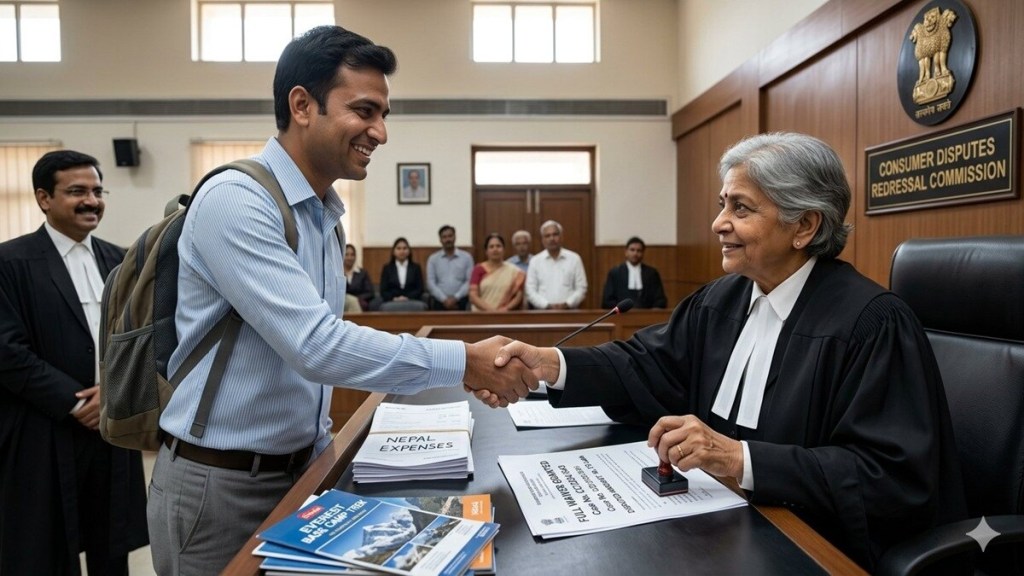

A man who received a shocking Rs 1.75 lakh mobile bill after a week-long trip to Nepal won full relief from the National Consumer Disputes Redressal Commission (NCDRC), which upheld orders directing the telecom company to withdraw the bill and pay him Rs 25,000 compensation, according to The Indian Express news report.
The top consumer court said the service provider failed to prove the charges with proper evidence, reinforcing that customers cannot be forced to pay huge, unexplained bills without clear call details and supporting records.
A week in Nepal, a bill of Rs 1,75,427
The case dates back to January 2018, when a consumer travelled to Nepal from January 12 to January 18. During that week, he used his mobile connection, but when the postpaid bill arrived, it showed an amount of Rs 1,75,427—far beyond what any normal user would expect for a short foreign trip.
He alleged that the amount was excessive and unsubstantiated, so he approached the District Consumer Disputes Redressal Commission in Namchi, Sikkim, claiming deficiency in service and seeking relief against the disputed bill.
District forum: Withdraw the bill, pay Rs 25,000
The district commission allowed man’s complaint. It directed the telecom company to:
- Withdraw the disputed Rs 1,75,427 bill
- Issue a fresh bill with proper details
- Activate his mobile number
- Pay Rs 25,000 as compensation
The service provider challenged this order before the State Consumer Disputes Redressal Commission, Sikkim. The state commission dismissed the appeal after examining the matter and confirmed the district forum’s order.
A key observation by the state commission was that the call detail records (CDRs) relating to the January 2018 postpaid bill had not been furnished to him when he received the bill. It noted that “a customer receiving a bill of Rs 1,75,427 for one month would be shocked” and held that a consumer was entitled to know the basis of such a bill.
The state commission also pointed out that the CDRs relied upon by the service provider were produced only when the company filed its written objections. Further, those records were presented through a person who had no personal knowledge of how they were prepared or what they contained, weakening the company’s case.
National consumer court: No proof, no bill
The telecom company and a senior divisional engineer of the service provider then filed a revision petition before the NCDRC, challenging the state commission’s order. A bench comprising NCDRC president Justice AP Sahi and member Bharatkumar Pandya heard the matter.
On September 9, the national commission dismissed the revision petition, saying there was “no perversity in the findings recorded either by the District Commission or by the State Commission.” It held, “The Petitioners have failed to substantiate the correctness of the bill raised by them by the corroborative evidence. In these circumstances, no ground is made out for interference in a Revision Petition.”
During the hearing, the bench specifically examined the statement of the senior divisional engineer, who had been produced as a witness by the service provider. The commission found that the officer could not support or explain the assessment of the call detail records, despite being called by the company itself. This further weakened the provider’s claim that the Rs 1.75 lakh bill was correct.
As a result, the relief granted to the man (complainant) remained intact as the disputed bill must be withdrawn, a fresh itemised bill with details must be issued, his mobile number must be activated, and Rs 25,000 must be paid as compensation.
The judgment underlines a basic consumer right that if a bill looks abnormally high, the service provider must be able to justify it with clear, verifiable records.
In this case:
- The company did not give the man the call details when he first questioned the bill.
- The CDRs were produced late, through a witness with no direct knowledge of their preparation.
- The senior engineer could not explain how the charges were computed.
- Given these gaps, the consumer forums at all three levels—district, state and national—found that the company had not discharged its burden of proof.
Consumers should not accept unusually high or disputed telecom bills without checking the details. They should ask for an itemised bill, raise disputes in writing and keep all records. If the issue is not resolved, they can approach a consumer forum or call the National Consumer Helpline at 1915.