


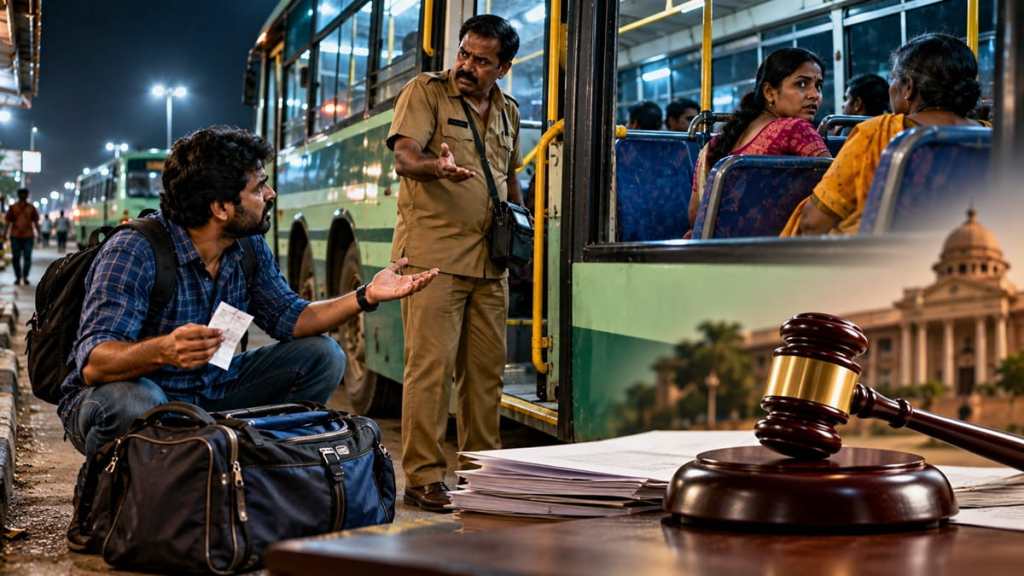

A Tamil Nadu consumer commission has directed the state transport corporation to pay Rs 60,000 to a passenger after finding deficiency in service over the handling of his complaint against a bus conductor and driver.
The Indian Express reported that the conductor allegedly chewed and spat out his bus ticket and threw his bag out of the vehicle after he complained that another passenger was occupying his reserved seat.
It also reported that the District Consumer Disputes Redressal Commission, Perambalur, criticised the transport corporation for failing to conduct an inquiry into the allegations despite their seriousness.
The commission awarded Rs 50,000 as compensation and Rs 10,000 towards litigation costs.
President D Jawahar and members P Thilaka and M Muthukamaran passed the order on September 2.
Passenger complained after losing his seat
According to the case details reported by The Indian Express, the passenger had travelled to Vellore to purchase medicines for his son.
At around 9 pm, he boarded a state transport corporation bus for Perambalur. He claimed that he handed over Rs 500 to the conductor for the journey but was issued a ticket worth Rs 200, with the conductor allegedly saying that the remaining Rs 300 would be returned when they reached the destination. The bus later stopped at Tiruvannamalai for a tea break.
When the passenger returned to the bus, he alleged that another woman had occupied his seat while a second woman was sitting in the adjacent seat.
He claimed that he complained to the time-keeper at the bus stand after suspecting that the conductor had allowed the women to occupy the seats in exchange for illegal gratification.
The passenger then alleged that the conductor took his ticket, put it in his mouth, chewed it and spat it out. His bag was also allegedly thrown out of the bus.
Transport corporation disputes complaint
The transport corporation reportedly denied the allegations. It said tickets were issued through electronic ticketing machines and that its digital records did not show any ticket having been issued for travel between Vellore and Perambalur on the date in question.
The corporation also argued that there were no independent witnesses to support the passenger’s allegations.
Commission questions lack of inquiry
The consumer commission focused on the transport corporation’s failure to investigate the passenger’s complaint. It observed that once such a complaint had been made, the concerned officials were required to verify the allegations and take appropriate action.
The commission said the corporation could have obtained a report from the time-keeper or branch manager to determine what had happened.
Instead, it found that the corporation remained silent on the allegations and did not even specifically deny the incident in its written version.
Although affidavits had been filed by the conductor and driver, the commission noted that no supporting report or affidavit was obtained from the time-keeper, who was central to the passenger’s account.
‘Ignoring serious allegations is not proper’
The commission held that the allegations against the conductor and driver were serious and should not have been brushed aside without an inquiry.
“Whenever a complaint has been made by a consumer, it is the duty of the transport corporation to enquire into it and take action according to law,” The Indian Express reported as the commission observed.
It added that “ignoring them or burying them under the carpet is not proper.”
The commission also referred to the Consumer Protection Act, 2019, observing that consumers have a basic right to protection against unscrupulous exploitation.
The commission held the regional and zonal managers of the transport corporation liable for deficiency in service and ordered the corporation to pay Rs 50,000 in compensation and Rs 10,000 towards litigation expenses.
Takeaway
The case shows that transport authorities are expected to properly investigate passenger complaints involving alleged misconduct by their employees. For passengers, the ruling also noted the importance of preserving tickets, payment records, complaint details and other evidence when a dispute arises during a journey.
Where a passenger makes a serious allegation against transport staff, the commission’s order indicates that simply ignoring the complaint without conducting an inquiry may itself become a consumer-law issue.