


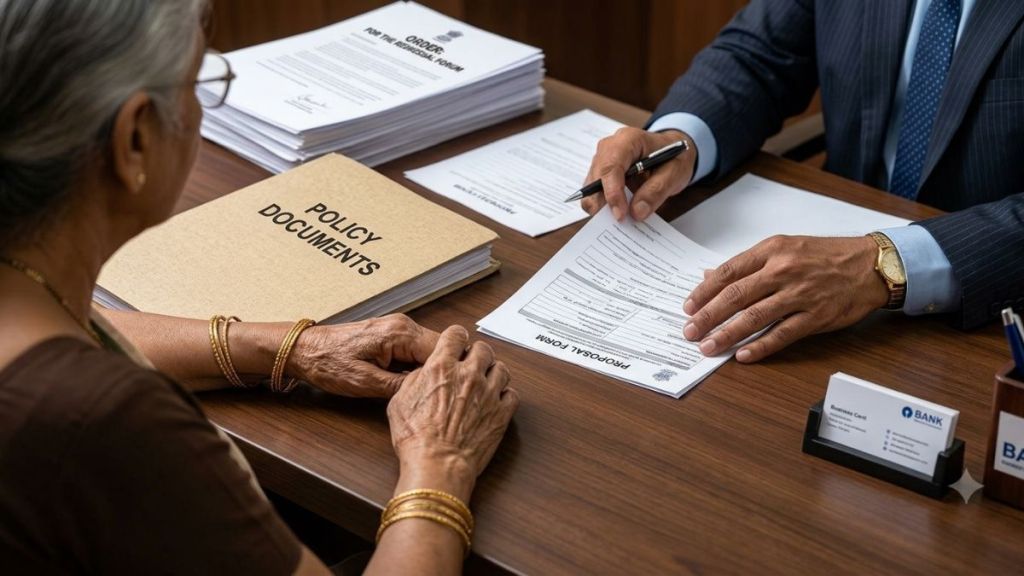

A 73-year-old retired associate professor has won a consumer dispute against an insurance company accused of selling her a policy without her free and informed consent. The Telangana consumer commission held the bank and insurer guilty of unfair trade practice and directed the insurance company to refund Rs 10 lakh, the Indian Express reported.
The Hyderabad District Consumer Disputes Redressal Commission also directed them to pay Rs 50,000 as compensation and Rs 10,000 towards costs.
The August 27 order — passed by President B Uma Venkata Subba Lakshmi along with members C Lakshmi Prasanna and B Raji Reddy — noted that the policy documents had allegedly been sent to the woman’s permanent address while she was abroad. As a result, she lost a meaningful opportunity to exercise the free-look period, a 10-15 day window during which a policyholder can cancel a new policy and receive a refund, it said.
“This commission is of the opinion that the insurance policy was not obtained with free will and informed consent; the conduct of opposite parties number 1 to 3 (bank and insurance company) amounts to deficiency of service and unfair trade practice,” the August 27 order read, according to the Indian Express report.
What happened to the 73-year-old woman?
The complainant claimed that when she visited the bank branch on September 4, 2023, to transfer money to her son in the US, the bank officials introduced her to two agents who allegedly made her believe that she was investing Rs 10 lakh in their insurance policy and assured her that she would receive a return of Rs 2.67 lakh per year after four years, the report said.
The woman told the commission that she was a retired associate professor drawing a monthly pension of about Rs 57,000. She alleged that the agents nevertheless mentioned her salary as Rs 1 crore while explaining the product.
She claimed that she had no intention of purchasing insurance and that bank officials instead took her signatures on loan-related papers before the Rs 10 lakh was invested in the insurance policy.
The complainant further alleged that the transaction was presented as a one-time investment when it actually required annual payments, the report said.
When she sought cancellation in 2023, she said bank officials told her that the policy could be cancelled only in September 2024. After she returned from the US in March 2024, she was allegedly told that cancellation would be possible only in September 2025, The Indian Express reported.
The bank denied obtaining signatures on blank papers and argued that the insurance transaction was between the complainant and the insurer.
The insurance company maintained that the policy had been issued at her request and with her approval. It also said the physical policy pack had been dispatched and delivered to her address on September 18, 2023, and that it had complied with applicable regulatory requirements.
Why did the consumer commission reject that defence?
The crucial issue was informed consent.
The commission noted that the proposal form contained both the woman’s permanent and current addresses. The insurer, however, sent the welcome letter to her permanent address even though she was abroad at the relevant time.
The commission held that simply sending the policy documents was not enough if the consumer did not have a genuine opportunity to examine them and exercise the statutory cancellation option.
It observed that a statutory opportunity cannot be considered meaningfully provided when the policy document is sent to an address where the complainant was not residing and when she was outside the country.
The commission also took into account her age and status as a retired person, observing that a senior citizen cannot automatically be presumed to understand complex insurance terms and conditions.
It said the bank and insurer should have explained the relevant terms and requirements to her.
The commission consequently concluded that the policy was not obtained with her “free will and informed consent” and that the conduct of the bank and insurer amounted to deficiency in service and unfair trade practice.
What is the legal issue here?
The case is not simply about whether the woman signed the insurance documents. The key question was whether the transaction amounted to a properly informed consumer decision.
The commission examined the circumstances surrounding the transaction — including what was allegedly represented to the consumer, whether important terms were explained and whether she had a genuine opportunity to review the policy.
That is why the Hyderabad commission looked beyond the existence of the policy documents.
The insurer argued that the policy had been issued and delivered and that the consumer had not cancelled it during the free-look period.
Rejecting the defence, the commission reasoned that the existence of a free-look period does not necessarily establish that the right was meaningfully available in the circumstances of the case.
What is the free-look period?
The free-look period is intended to allow a new policyholder to examine the policy after receiving the relevant documents and cancel it if the terms are not acceptable, subject to applicable regulatory conditions.
The facility has become particularly important in the context of insurance mis-selling.
In February 2025, the Indian Express reported that the government had asked private insurers to extend the free-look period to one year. The facility allows a new policyholder to review the policy and cancel it if its terms are not acceptable.
The Hyderabad ruling therefore raises an important consumer question: Can an insurer rely on the free-look period if the policyholder did not have a meaningful opportunity to access and review the policy documents during that period?
In this case, the commission answered that question against the bank and insurer, based on the particular facts before it.
A signed policy does not automatically end the dispute
One of the key lessons from the order is that signing an insurance document does not necessarily end the legal inquiry.
That does not mean a consumer can sign a policy and later cancel it simply by claiming that they did not understand it.
Instead, the commission considered the surrounding circumstances — the woman’s age, her stated intention when she visited the bank, the alleged misrepresentation about the investment, the premium obligation and the circumstances in which the policy documents were delivered.
The finding was therefore fact-specific.
For consumers, the takeaway is straightforward: before signing an insurance policy, go through the terms and conditions of the product, premium, and the tenure of the policy.
For insurers and banks, the order underlines the importance of ensuring that consumers understand the product being sold to them, rather than relying solely on signed paperwork as evidence of consent.