


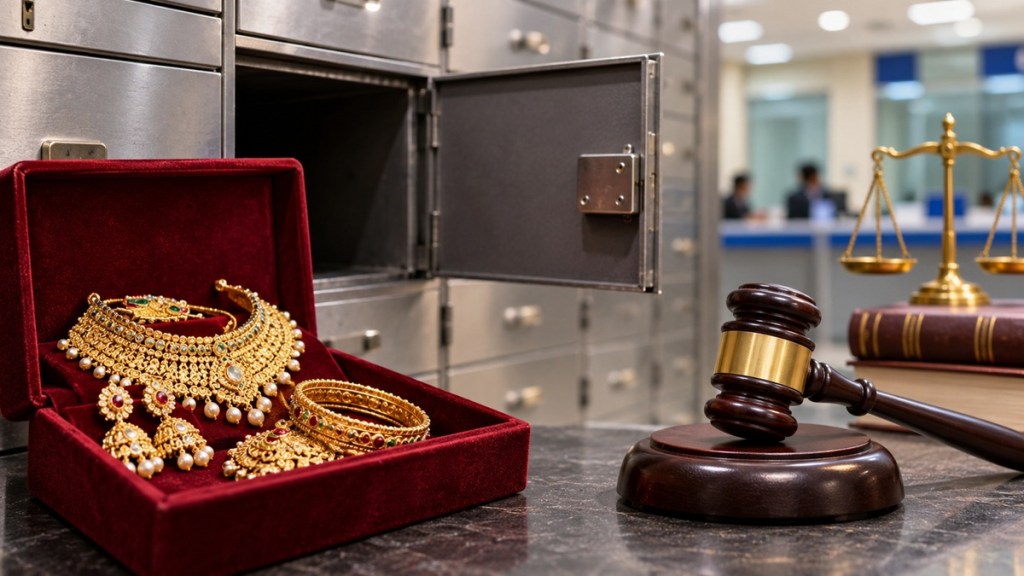

A woman has won a consumer dispute against a bank after jewellery worth Rs 47 lakh allegedly went missing from a joint locker she held with her late father-in-law, Indian Express reported. The Delhi State Consumer Disputes Redressal Commission has directed the bank to pay Rs 50.5 lakh, along with simple interest at 6% per annum, after finding that it failed to establish that the locker had been surrendered or that its contents had been returned.
According to Indian Express, the award comprises Rs 47 lakh towards the value of the missing jewellery, Rs 3 lakh for mental agony and Rs 50,000 towards litigation costs. The bank has also been directed to pay 6% simple interest on the amount from September 1, 2018, to October 27, 2026, making the interest an additional component of the payout.
The commission, headed by president Justice Sangita Dhingra Sehgal and member Bimla Kumari, was hearing a complaint filed by Monica Marwah, who alleged that the bank had wrongly treated her joint locker as surrendered without her consent and failed to account for the jewellery kept inside it.
In its October 27 order, the commission noted that the bank had not produced a surrender receipt or any document showing that the locker’s contents had been handed back to the complainant.
“There is no receipt of the items in the locker of the Complainant and her deceased father-in-law provided by the Opposite Party (the bank) at the time of the alleged surrender of the said locker,” the commission observed. It concluded that the complainant had not surrendered the locker and that her belongings had been misappropriated.
Woman says jewellery worth Rs 47 lakh missing from joint locker
According to IE, Marwah had held a joint locker with her father-in-law at the bank since 1998. Following his death on August 29, 2010, the bank continued to debit locker rent from the account.
When she approached the bank’s branch on September 1, 2018, she was allegedly informed that the locker had already been surrendered on January 22, 2015. Marwah disputed the claim, maintaining that she had never requested the closure of the locker and that jewellery worth Rs 47 lakh kept inside it had not been returned.
The account statement showed that locker rent continued to be deducted, including a debit recorded on September 25, 2018.
Marwah alleged that the bank had neither obtained her consent to surrender the locker nor provided any acknowledgement or proof that the jewellery had been handed back. She subsequently approached the consumer commission seeking reimbursement of the jewellery’s value, interest, compensation for mental agony and litigation expenses.
Bank claims locker was surrendered in 2005
The bank disputed the complaint, claiming that the locker had actually been surrendered on May 21, 2005. It described subsequent locker-rent deductions as a bona fide mistake and offered to refund the charges.
The bank also argued that lockers were accepted for surrender only after being emptied and denied responsibility for belongings allegedly left inside. It challenged the commission’s jurisdiction and contended that the complaint was barred by limitation.
The commission, however, found that the bank had failed to substantiate its version. It noted that despite claiming the locker had been surrendered in 2005, the bank could not produce a surrender receipt or any communication from Marwah requesting its closure.
It also failed to provide documentary evidence showing that the jewellery had been returned to her.
The commission observed that the continued deduction of locker rent, including the September 25, 2018, entry, further raised questions about the bank’s claim that the locker had been surrendered years earlier.
Rejecting the bank’s defence, the bench held that the complainant had never surrendered the locker and that the bank was responsible for the missing belongings. It concluded that the bank was deficient in providing its services.
Commission rejects bank’s jurisdiction objection
The bank had also challenged the consumer commission’s jurisdiction to hear the dispute. The commission rejected the objection, noting that the complainant had sought compensation of Rs 48 lakh, bringing the matter within its pecuniary jurisdiction under the Consumer Protection Act, 1986, which applied to the complaint.
It also noted that the bank’s Naraina Vihar branch was located within Delhi, giving the commission territorial jurisdiction to hear the case.
The bench observed that the bank had raised objections without producing cogent evidence to support them, describing its submissions as “bald averments”.
The commission directed the bank to pay Rs 47 lakh towards the value of the missing jewellery, Rs 3 lakh for mental agony and Rs 50,000 towards litigation costs. The total principal award stands at Rs 50.5 lakh, with simple interest at 6% per annum from September 1, 2018, until October 27, 2026.
Takeaway
A bank should be able to establish not only that the locker was surrendered but also that its contents were handed back to the customer. Customers closing a locker should insist on a written surrender acknowledgement and a receipt or inventory documenting the return of their belongings. Retaining bank statements, locker-related correspondence and other records can also help resolve disputes if questions arise later.