


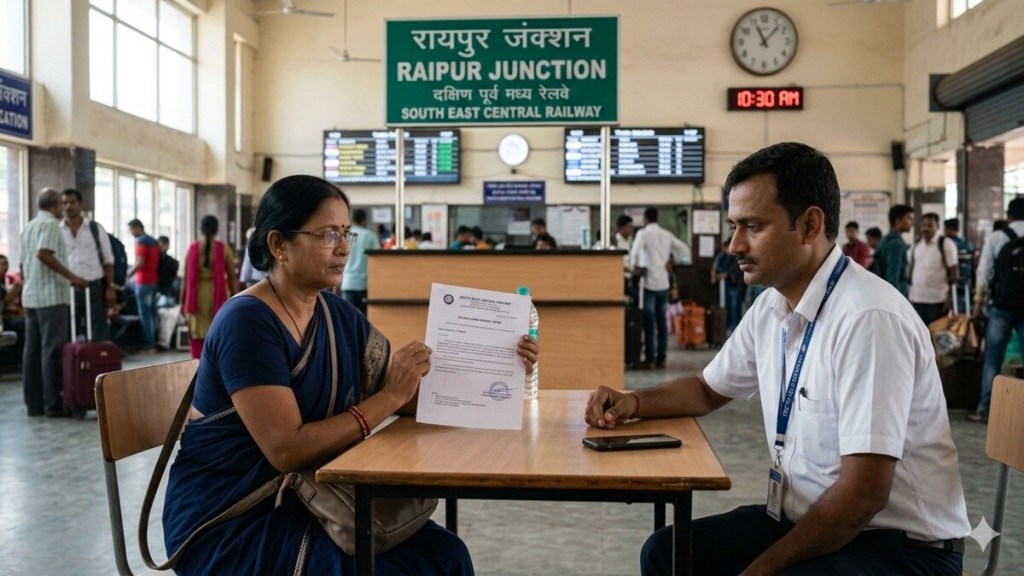

A Chhattisgarh consumer commission ordered Indian Railways to pay around Rs 15,000 in compensation to a woman who reached Raipur station for a Delhi-bound Rajdhani Express, only to find her train had been cancelled and diverted following a fire near Itarsi. According to an Indian Express report, the panel held that the Railways’ failure to inform her in advance amounted to deficiency in service and an unfair trade practice.
On June 18, 2016, the complainant booked a third-AC ticket on the Bilaspur–New Delhi Rajdhani Express for Rs 1,980, planning to travel from Raipur to Delhi. When she arrived at Raipur railway station, she learned that the train would not operate on its usual route because of a fire in the route relay interlocking system near Itarsi in Madhya Pradesh.
The disruption forced the Rajdhani to bypass its scheduled Raipur–Nagpur routing and travel to Delhi through Katni and Bina instead. The passenger, who had no advance warning, had to cancel her ticket at the station and take a full refund.
Why the commission faulted Railways?
The Raipur District Consumer Disputes Redressal Commission, presided over by Dakeshwar Prasad Sharma and comprising members Nirupma Pradhan and Anil Kumar Agnihotri, said the real issue was not the diversion itself but the absence of communication. The passenger had shared her mobile number while booking, yet received no SMS, call, or other alert about the cancellation or route change.
“Providing information is an essential service, and the opposite party could have informed the complainant about the cancellation of the train through other means as well,” the commission said in its September 30 order. It added that the Railways made “no effort whatsoever” to ensure that she learned of the cancellation before reaching the station.
Fire was a valid reason, but not a full defence
The commission accepted that a fire affecting the route relay interlocking system could justify cancelling or rerouting services, an Indian Express report added. However, it ruled that an operational emergency did not relieve the Railways of its basic duty to communicate with a passenger who had paid for a confirmed journey.
“Since the train was diverted due to a route-relay interlocking failure at Itarsi, the Bilaspur–New Delhi Rajdhani Express, which was supposed to travel via Raipur–Nagpur, was sent to Delhi via the Katni–Bina route instead,” the order noted. The panel said the Railways could not use that operational problem to avoid providing the service or informing affected passengers.
Railways’ argument rejected
Indian Railways denied any service deficiency, saying the diversion arose from an unavoidable technical fire and that formal rules requiring SMS alerts for cancellations were introduced only on December 12, 2017. It also argued that the passenger had already received a full refund of Rs 1,980, leaving no basis for compensation.
Indian Express report further stated that the commission rejected both arguments as insufficient. It held that the lack of a formal SMS rule at the time did not excuse the Railways from using other available means to notify a passenger whose contact details were already on record. The refund, too, did not undo the inconvenience, confusion, and mental distress caused by the sudden cancellation.
The ruling makes clear that collecting a passenger’s mobile number at the time of booking creates a reasonable obligation to use that information when a journey is cancelled or materially altered. A technical failure may explain the disruption, but it does not exempt the transporter from informing passengers and arranging communication.
For travellers facing comparable problems, the commission’s order points to consumer remedies: affected passengers can approach their state consumer commission, contact the Chhattisgarh consumer helpline at 1800-233-3663, or call the National Consumer Helpline at 1915.