


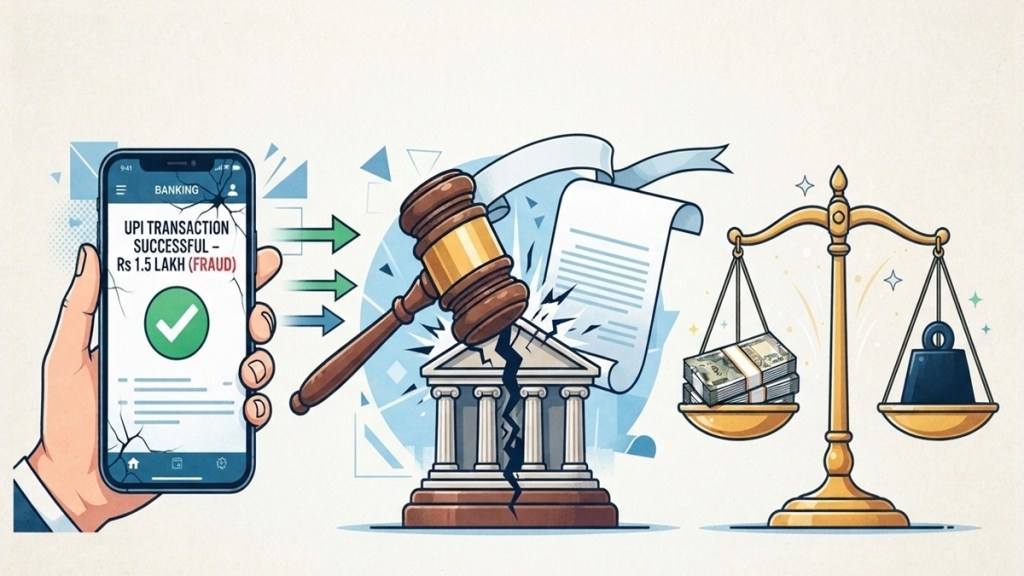

A Chandigarh man is set to receive an estimated payout exceeding Rs 1.5 lakh after the state consumer commission upheld an order requiring the bank to refund money lost through unauthorised UPI transactions. The ruling brings relief more than five years after Rs 99,940 was withdrawn from his account in July 2021, despite his claim that he refused to share his PIN and reported the fraud within two hours.
According to Indian Express report, the Chandigarh State Consumer Disputes Redressal Commission dismissed the bank’s appeal on October 21, 2026. It upheld the direction to refund Rs 99,940 with nine per cent annual interest from July 21, 2021, along with Rs 10,000 towards compensation and litigation expenses. The final amount payable will depend on the interest calculation; the order did not specify a consolidated payout.
A wrongly delivered parcel preceded the withdrawals
According to the complainant, a delivery agent visited him on July 20, 2021, to collect a parcel that had been delivered incorrectly. The agent asked for his bank details, saying they were needed to process a refund. The man maintained that he refused to share his PIN.
The following afternoon, he received alerts about five transactions from his account. He denied making or authorising the payments and said he had not shared his UPI PIN or a one-time password. The account given in the complaint places the parcel incident before the withdrawals, but does not establish precisely how the unauthorised transactions were carried out.
Five transactions took nearly Rs 1 lakh
At around 2.50 pm on July 21, 2021, the customer received alerts for five debits: three transactions of Rs 25,060 each, one of Rs 24,560 and another of Rs 200. Together, they amounted to Rs 99,940.
He said he blocked his account and mobile number, informed bank within two hours and lodged a complaint with the Chandigarh Police/Cyber Cell. He submitted a written complaint to the bank the next day, July 22.
According to his account, the bank indicated that a refund would be processed within 15 days of approval from its head office. However, repeated visits and a reminder dated February 9, 2022, did not resolve the matter. He subsequently pursued relief before the consumer commission.
Bank argued that UPI payments required his PIN
Indian Express report added that the bank acknowledged that Rs 99,940 had been debited through five UPI transactions, but disputed its responsibility to reimburse the customer. The bank argued that the payments required a self-generated six-digit UPI PIN rather than an OTP.
Its defence was that the customer had either carried out the transactions himself, shared his PIN or failed to keep it confidential. On that basis, bank denied any deficiency in service.
The commission, however, found that an allegation about the customer’s handling of his PIN was not enough to establish that he was responsible for the loss.
Bank could not blame the customer without sufficient evidence
While dismissing bank’s appeal, the state commission emphasised that the bank had to prove the customer’s liability rather than assume it from the fact that a PIN-based transaction had occurred.
“In the absence of sufficient evidence establishing the Complainant’s liability, the bank cannot avoid its responsibility merely on the basis of an allegation that the UPI PIN was either shared or not kept secure,” the commission said.
It added, “The burden of proving customer liability in case of unauthorised electronic banking transaction shall lie on the bank.”
The finding was central to the outcome because bank had not provided sufficient evidence to establish that the complainant was liable for the disputed transactions.
What RBI’s customer-protection rules say
The Reserve Bank of India’s July 6, 2017, directions on unauthorised electronic banking transactions place the burden of proving customer liability on the bank. They also provide for zero customer liability in specified circumstances—not automatically in every fraud complaint.
For example, a customer has zero liability where the loss results from fraud, negligence or a deficiency attributable to the bank. Zero liability can also apply to a third-party breach, where neither the bank nor the customer is responsible, if the customer informs the bank within three working days of receiving the transaction communication.
The position differs where the loss results from customer negligence, such as sharing payment credentials. In those cases, the customer bears the loss incurred before reporting the incident, while losses occurring after the report are borne by the bank. These distinctions make both the evidence and the timing of the complaint important.
District commission’s refund order upheld
Indian Express report further stated that the district consumer commission had directed bank to return the Rs 99,940, pay nine per cent annual interest from July 21, 2021, and provide Rs 10,000 for harassment, mental agony and litigation expenses. Bank challenged that decision before the state commission.
The appeal was filed on May 25, 2026. A procedural question arose over when the bank had received the district commission’s order. Because delivery of the free copy sent in December 2025 was not proved, the state commission calculated the appeal period from the paid copy received on April 15, 2026, and treated the appeal as timely.
The appeal nevertheless failed on its merits. On October 21, the state commission found no reason to interfere with the district commission’s decision.
Why the payout exceeds Rs 1.5 lakh
The amount due comprises three components: the Rs 99,940 refund, nine per cent annual interest running from July 21, 2021, and Rs 10,000 towards compensation and litigation expenses. The accumulated interest takes the estimated total beyond Rs 1.5 lakh, although the order does not give a final calculated figure.
Bank had deposited Rs 1,54,200 during the appeal. The state commission directed that this money be transferred to the district commission for disbursement in accordance with the original order. That deposit should not be confused with a separately quantified final award.
What the ruling means for customers
The decision does not mean that banks must refund every disputed UPI payment regardless of the circumstances. In this case, the customer reported the transactions promptly, denied sharing his credentials and successfully challenged the bank’s attempt to hold him responsible without sufficient supporting evidence.
The broader principle is that a bank cannot rely solely on an allegation that a customer shared or failed to protect a PIN. Under RBI’s framework, it must establish customer liability, while the applicable protection depends on the cause of the loss and when the transaction was reported.
For consumer-related grievances, individuals may contact the consumer helpline in their respective states and union territories (Chandigarh:0172-270-0183) or call the National Consumer Helpline at 1915 for assistance.