


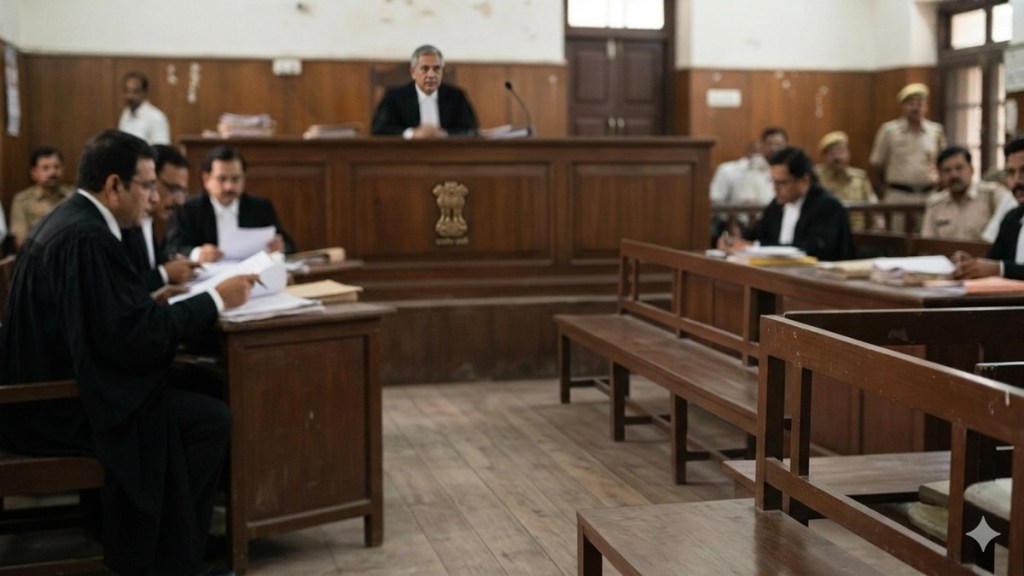

The Jammu and Kashmir and Ladakh High Court upheld an order to recover around Rs 6 lakh from a Border Security Force (BSF) personnel after holding that he fraudulently claimed ex-gratia relief by falsely stating that six of his family members were killed by militants in 1993.
According to an Indian Express report, the court found that the relatives had actually migrated to Pakistan-occupied Kashmir (PoK) and were alive, and that retaining the money would amount to “unjust enrichment”.
Justice Rajnesh Oswal, in a order dated September 30, dismissed the BSF personnel’s plea against the recovery from his salary, noting serious contradictions in his version and a complete failure to prove that the six family members had died at the onset of militancy in the Valley.
Claim of six militant killings leads to Rs 6 lakh relief
The BSF personnel, from Kupwara’s Shalla Bathu village, had claimed that six of his family members were killed in militant violence in 1993. Following a police inquiry, death certificates were issued and the district screening-cum-coordination committee sanctioned ex-gratia relief of Rs 1 lakh per deceased, totalling Rs 6 lakh, which was paid to him in 1997, the IE report stated.
The matter came under scrutiny after a 1999 newspaper report alleged that relief had been paid to families whose members had not died but had instead crossed over to PoK. A subsequent inquiry by the authorities concluded that the BSF personnel’s six relatives had migrated to PoK and were alive, and that the relief had been obtained fraudulently.
Based on these findings, recovery proceedings were initiated. In 2022, authorities directed recovery of the Rs 6 lakh from his salary, and the BSF later ordered recovery in 30 monthly instalments from August 2023, according to the Express report. The man challenged this before the High Court, arguing that the relief had been sanctioned after official verification and that recovery after more than 25 years was without proper basis.
Court flags shifting claims and 4-year delay
The court found multiple inconsistencies in the petitioner’s narrative. While one document referred to a 1990 firing incident, his writ petition stated that the family members went missing in militant violence in 1993. The police daily diary entry recording the incident was made only in March 1997, nearly four years after the alleged killings, and the death certificates were also issued much later, IE reported.
Announcing the order, Justice Oswal wrote, “The petitioner’s lack of candor is clear from his repeatedly shifting claims. Intriguingly, while the report dated May 5, 1997, initiated solely on the petitioner’s application, states that all family members except one sister were killed, the record fails to explain why compensation was paid exclusively to the petitioner to the exclusion of his surviving sister.”
“Furthermore, it is improbable that a person whose six family members perished in 1993 would remain dormant for four long years before seeking redress,” the order further stated.
No bodies recovered, no proof of deaths
A key factor in the court’s reasoning was the complete absence of physical evidence. It noted that not a single body of the allegedly deceased family members was ever handed over to the petitioner, nor was there any credible proof that they had died in the manner claimed. The judgment observed, “The petitioner has utterly failed to prove that six of his family members died in 1993.”
The Indian Express report further noted that the record indicated the relief had been procured in collusion with police and revenue officials, raising questions about how the death certificates and verification reports were issued in the first place.
Recovery after 25 years: ‘Not illegal,’ says court
The BSF personnel’s counsel, advocate Dar Khurshid, argued that the recovery proceedings were based solely on the assertion that his family members were alive in PoK, a claim that could not be investigated by any Indian agency because they had no jurisdiction in PoK. He contended that the recovery was therefore illegal.
The state, however, maintained that an inquiry had established that the six relatives had migrated to PoK and that the petitioner had been given a proper opportunity to appear before the inquiry officer, with his statement and those of other witnesses recorded, the report noted.
On the argument that he was not given a hearing before recovery, the court noted that he had been called before the additional deputy commissioner, his statement was recorded, and he had not challenged this process in his response. The court held that due process had been followed.
‘Unjust enrichment’ if money is retained
The High Court concluded that since the basis on which the ex-gratia relief was granted had been proved false, allowing the man to retain the Rs 6 lakh would amount to unjust enrichment.
The order underscored, “It appears that a verification exercise was triggered following a 1999 news report exposing fraudulent compensation claims for persons alive in PoK.”
With the inquiry findings holding that the six family members were alive in PoK and the petitioner failing to substantiate his claim of their deaths, the court upheld the recovery order and dismissed the plea.
The case highlights how long-pending frauds in conflict-related relief schemes can be revisited when documentary and factual inconsistencies surface, and how courts are likely to treat retention of such funds once the underlying claim is shown to be false.