


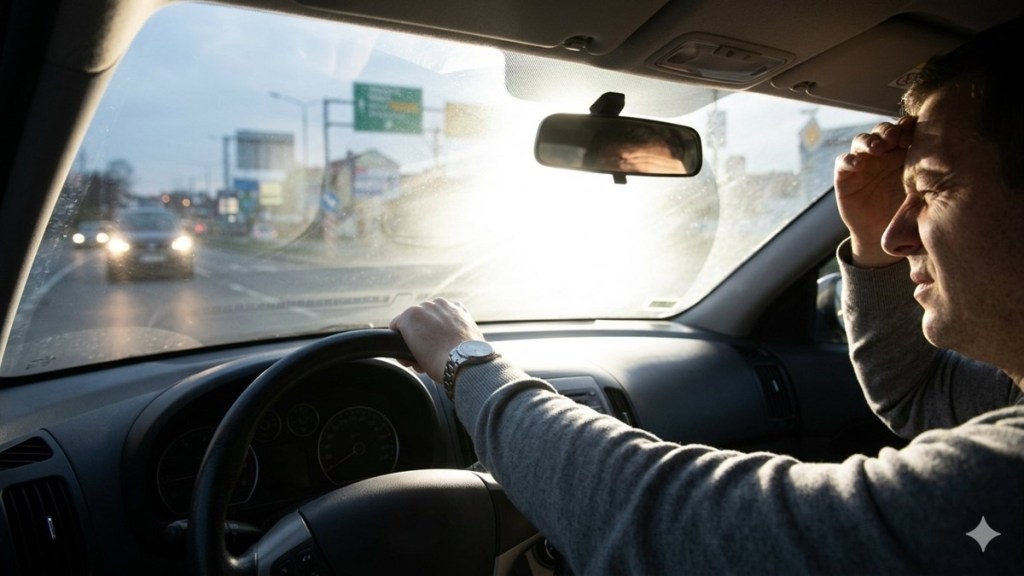

A Delhi consumer commission ordered a car manufacturer and its authorised dealer to pay around Rs 5 lakh to a vehicle owner for the mental agony and harassment caused by persistent windshield glare and dashboard reflections. According to The Indian Express news report, the commission held them guilty of unfair trade practice, though it stopped short of declaring the car’s design defective.
The order, passed on October 6 by the District Consumer Disputes Redressal Commission-II, New Delhi, is important because it treats a visibility problem as more than a cosmetic complaint. The bench found that the company dismissed the issue as “natural” while simultaneously selling a remedy for it in other markets—an approach it described as discriminatory toward Indian consumers.
What the owner alleged
The complainant bought a car in April 2025. He said reflections from the dashboard appeared on the windshield while driving, obstructing his view during both day and night and creating a possible safety risk for himself, his passengers and other road users.
He approached the manufacturer and dealer seeking a refund, compensation for safety risks and mental distress, and litigation costs. According to his complaint, the company treated the reflections as a normal feature rather than a defect or a service failure.
Company’s defence
The manufacturer denied that the vehicle was defective. It said the car passed quality checks and complied with applicable standards, and argued that the owner had not produced an independent expert report proving a manufacturing defect.
Inspections carried out on the vehicle found no abnormality in the reflections, the company said. Its position was that the glare was a natural phenomenon rather than evidence of poor design, faulty glass or deficient service.
Why the commission found unfair trade practice
The bench—President Monika A Srivastava and Member Kiran Kaushal—acknowledged that glare and dashboard reflections were noticeable during inspection. But instead of accepting the company’s explanation at face value, it focused on how the manufacturer responded to the owner’s safety concern.
“This commission holds the opposition party guilty of unfair trade practice since it terms the phenomenon relating to windshield glare in the present case as ‘natural’ but is selling a product on its website to provide the cure for it,” the order said.
The commission added that the conduct was discriminatory because the corrective product was available in some countries but not offered to consumers in India.
Safety concerns and research
The commission referred to a 2003 University of Michigan study, Daytime Veiling Luminance from Windshield: Effects of Scattering and Reflection, by ML Mefford, M Flannagan and Go Adachi. It noted that light scattered or reflected from a windshield can create “veiling luminance,” which a driver must look through to see the road ahead.
According to the findings cited by the commission, reflection was the major contributor to this veiling effect under the conditions studied. Measures such as glass treatments that reduce reflection and non-reflective dashboard materials could therefore offer substantial safety benefits.
The commission also referred to earlier litigation involving dashboard glare and windshield reflections in a luxury car, indicating that the issue has appeared in consumer disputes before.
No finding of design defect
Despite holding the company liable for unfair trade practice, the commission did not rule that the car’s design or windshield glass was defective. It relied on a response from the Bureau of Indian Standards (BIS), which said reflection-control requirements were not specified under IS 2553 (Part 2): 2019 or required by international automotive glazing safety standards.
That distinction mattered legally: the owner argued that the problem stemmed from design rather than a manufacturing flaw, but the commission said it could not make a finding on the design of the car or its windshield glass without the necessary standard or expert evidence.
What the company must pay and why it matters
The commission directed the manufacturer and dealer to pay Rs 5,00,000 as compensation for mental agony and harassment within two months of the order. If they fail to comply, the amount will attract interest at 6% per annum from the date the complaint was filed until it is realised.
The ruling does not order a vehicle refund or declare the car unsafe. Its core finding is narrower as the company’s handling of a customer’s glare complaint amounted to an unfair trade practice.
The case shows that consumer forums may examine not only whether a product has a technical defect but also whether a company’s response to a safety complaint is fair and consistent. A manufacturer cannot, in the commission’s view, call a problem “natural” while selling a solution for the same problem elsewhere.
For car owners, it also underlines the importance of documenting repeated complaints, inspection reports and any safety impact. For manufacturers, it signals that dismissing visibility-related complaints without offering an India-specific remedy can carry legal consequences.
Consumers facing similar problems can approach their state consumer helpline or the National Consumer Helpline at 1915; Delhi’s helpline number is 011-23379146.