


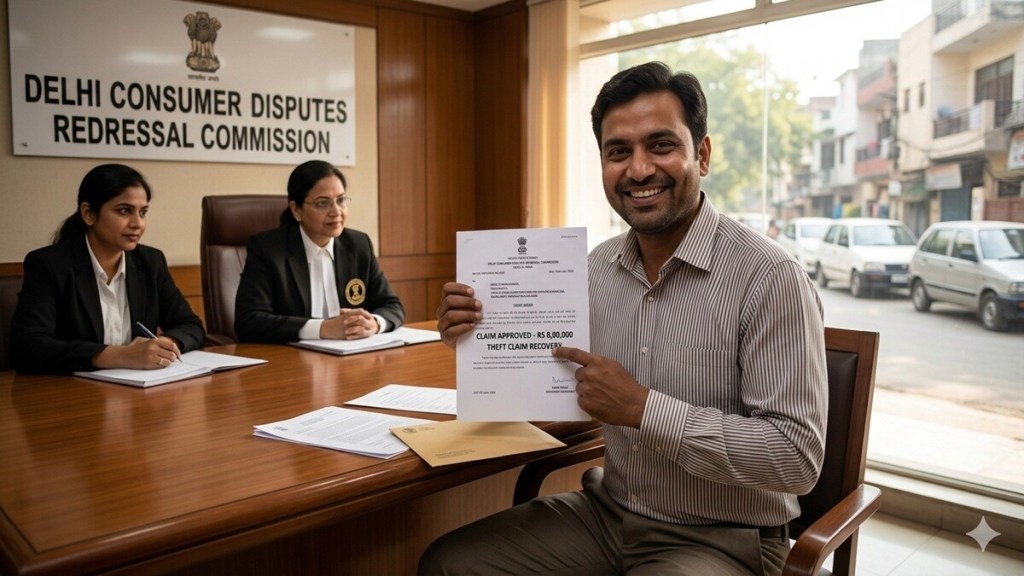

A Delhi car owner has been awarded nearly Rs 8 lakh after an insurance company rejected his theft claim, arguing his vehicle’s high mileage hinted at commercial use and that parking it about 500 metres from home amounted to negligence, according to The Indian Express news report.
The District Consumer Disputes Redressal Commission in North Delhi directed the insurance company to pay Rs 7,74,005 for the stolen car, plus Rs 30,000 for mental agony and litigation costs, calling the insurer’s reasons “baseless and arbitrary”.
The complainant’s car was insured for an Insured Declared Value (IDV) of Rs 7,74,005 under a policy valid from December 21, 2019 to December 20, 2020, for which he paid a premium of Rs 34,004. On the evening of February 3, 2020, he parked the vehicle overnight. When his driver checked the next morning, the car was missing.
He later noticed a Paytm toll deduction showing the car had crossed the Shambhu Border near Ambala at around 2:17 am on February 4, confirming it had been driven away. He immediately lodged a theft report (FIR) with the police. By August 20, 2020, the police filed an untraced report before the court, meaning the vehicle had not been recovered.
The man then submitted all required documents to the insurer: policy copy, registration certificate, driving licence, FIR and the untraced report.
Insurer’s rejection: Commercial use and negligent parking
The insurance company rejected the claim on 2 main grounds:
- It alleged the car was being used for commercial purposes, even though it was insured as a private vehicle.
- It claimed the man had been negligent because he parked the car around 500 metres from his residence, failing to take reasonable steps to safeguard it.
To support the commercial-use allegation, the insurer pointed to the vehicle’s mileage. It said the car had run about 6,500 km in roughly two months after purchase, with the odometer reading 1,984 km at the first service and 6,114 km at the second. It also relied on toll data to argue the car had travelled through Haryana, Punjab, Rajasthan and Uttarakhand, suggesting extensive use.
On the parking issue, the insurer’s stand was that leaving the car so far from home showed a lack of care, making the theft easier.
Consumer court: Mere high mileage does not prove commercial use
A three-member bench—President Divya Jyoti Jaipuriar and members Harpreet Kaur Charya and Ashwani Kumar Mehta—heard the man’s complaint. In its September 14 order, the commission squarely rejected the insurer’s logic.
On the mileage argument, it held, “Mere high mileage, by itself, neither establishes nor even reasonably proves that the vehicle was being used for a commercial purpose.”
The commission noted that the insurer had produced no documentary evidence, independent material or substantive proof that the car was being used for hire, reward or any commercial activity. Without such “cogent and reliable” evidence, the allegation remained an assumption, not a valid reason to deny a theft claim.
The bench also flagged inconsistencies in how the insurer used the FASTag/toll information. While the insurer’s lawyer claimed these details came from its investigator, the repudiation letter said they were provided by the complainant. The commission said this contradiction was never satisfactorily explained.
Parking 500 metres away: Not negligence without proof
On the second key issue—parking distance—the commission was equally unsympathetic to the insurer. It observed that the company had not alleged that the car was left unlocked, or that the man had ignored basic security precautions.
“Merely parking the car 500 metres from the residence could not, by itself, establish negligence without evidence showing disregard for its security,” the order said.
The commission added that the insurer’s investigation report, which could have supported its claim about where and how the car was parked, was not duly proved in the proceedings. As a result, the negligence allegation stayed unsubstantiated.
The payout: Rs 7.74 lakh plus interest and compensation
Finding a clear deficiency in service and unfair trade practice, the commission said, “The rejection of the claim on baseless and arbitrary grounds without any substantial evidence amounts to deficiency in service and unfair trade practice.”
It directed the insurance company to pay:
- Rs 7,74,005 (the IDV of the car), with 7% annual interest from April 13, 2022—the date Delhi man filed the consumer complaint—until full payment
- Rs 30,000 towards harassment, mental agony and litigation expenses
Taken together, the relief works out to almost Rs 8 lakh in the man’s favour
What this means for policyholders and where consumers can seek help?
This ruling highlights that insurers cannot brush aside genuine theft claims on the basis of assumptions like:
“The car ran too many kilometres, so it must be commercial,” or “It was parked a bit far from home, so the owner was negligent.”
If such grounds are to be used, the insurer must back them with solid, verifiable evidence—not just mileage figures, toll records or unproven investigation reports. Otherwise, as in this case, the rejection itself can be treated as a service deficiency, attracting compensation.
For people facing similar disputes with insurers over vehicle theft or claim rejection:
- They can approach the consumer helpline in their state; in Delhi, the number is 1800-11-4000.
- They can also call the National Consumer Helpline at 1915 for guidance on filing a complaint.
Depending on the claim amount, cases can be filed before the appropriate District, State or National Consumer Commission.