


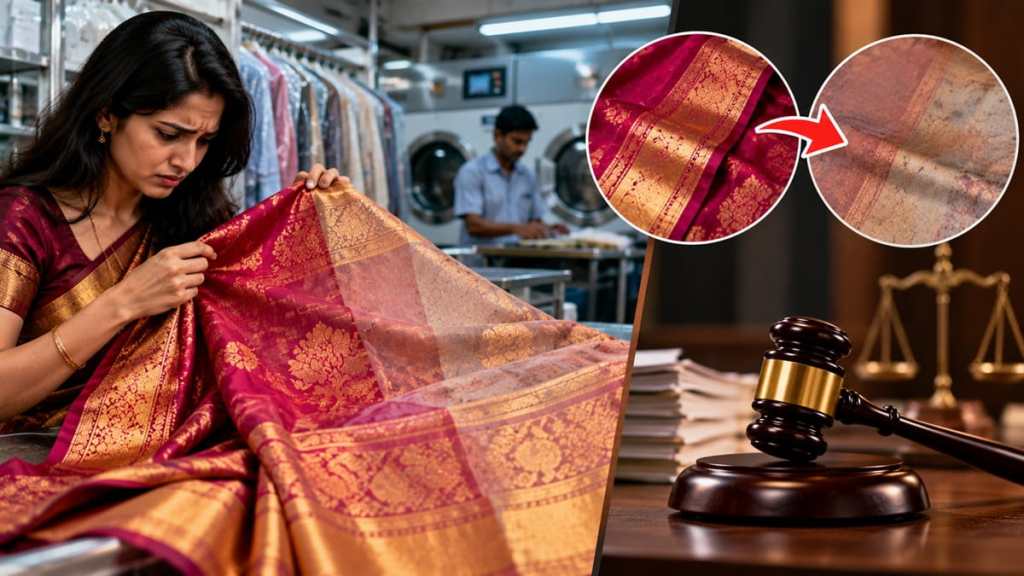

A woman who sent her recently purchased Kanjeevaram silk saree for dry cleaning and found its colour had faded when she went to collect it has been awarded Rs 48,015 by a consumer commission in Visakhapatnam.
The Visakhapatnam District Consumer Disputes Redressal Commission held the dry cleaner responsible for deficiency in service, directing it to reimburse the full cost of the saree and pay additional compensation for the mental agony and expense caused to the consumer.
The Indian Express reported that the commission ordered the dry cleaner to pay Rs 33,015 towards the cost of the saree, Rs 10,000 as compensation for mental agony and Rs 5,000 towards litigation costs.
The order was passed on September 16 by commission president Gudla Tanuja and member Varri Krishna Murthy.
Woman paid Rs 33,015 for saree
According to the case details reported by The Indian Express, the woman purchased the Kanjeevaram silk saree from a showroom on July 26, 2024, for Rs 33,015.
After using it, she handed the saree over to a dry-cleaning shop on March 22, 2025 and paid Rs 944 for the cleaning service. When she returned to collect the saree, she noticed that its original colour had faded.
She confronted the dry-cleaning staff, who, according to her complaint, agreed to reimburse the cost of the saree. However, she said the payment was never made.
The woman subsequently sent a legal notice to the dry cleaner on June 28, 2025, seeking the cost of the saree along with interest. After receiving no response, she approached the consumer commission alleging deficiency in service.
Dry cleaner denies damaging saree
The dry cleaner disputed the woman’s allegations. Its counsel, advocate P Appa Rao, said the woman had handed over two sarees for dry cleaning and that they had been processed using scientific methods.
The shop claimed that the woman accepted one saree but refused to take the other, alleging that its colour had faded and demanding a replacement. The dry cleaner maintained that there had been no colour fading.
It also alleged that the woman refused to produce the saree’s purchase bill, used harsh words with its employees and subsequently issued a legal notice containing false allegations.
Showroom confirms purchase
The saree showroom was also made a party to the complaint. Its counsel, advocate K Narayana Murthy, argued that the showroom had been unnecessarily included because the woman had not sought any relief against it.
The commission, however, noted that the showroom had confirmed that the woman had purchased the saree from it for Rs 33,015. The showroom also produced a tax invoice generated in its system supporting the transaction.
Commission finds deficiency in service
The consumer commission found that the evidence supported the woman’s claim regarding the saree and the service provided by the dry cleaner. The commission noted the dry cleaner’s admission regarding damage to the saree and held that this established deficiency in service.
“The opposite party no. 1’s admission of causing damage to the saree leads to the definite conclusion that their services are deficient in nature,” the commission observed.
It further held that the dry cleaner’s failure to reimburse the cost of the saree even after receiving the legal notice amounted to deficiency in service.
The commission said the negligent conduct had caused the woman mental agony, making her entitled to compensation in addition to the cost of the saree.
Rs 48,015 payout
The dry cleaner was directed to pay Rs 33,015 towards the cost of the saree, Rs 10,000 as compensation for mental agony and Rs 5,000 towards litigation costs. The total payout comes to Rs 48,015.
The commission held that the woman was entitled to recover the value of the damaged saree along with compensation and litigation expenses.
Takeaway
The case highlights that businesses handling consumers’ valuable personal belongings can be held responsible when their service results in damage and the resulting grievance is not properly addressed.
For expensive garments, consumers should preserve the original purchase invoice, service receipt and photographs of the garment’s condition before handing it over for cleaning or other services.
If the item is returned damaged, documenting the condition immediately and raising the complaint in writing can provide useful evidence in a consumer dispute.