


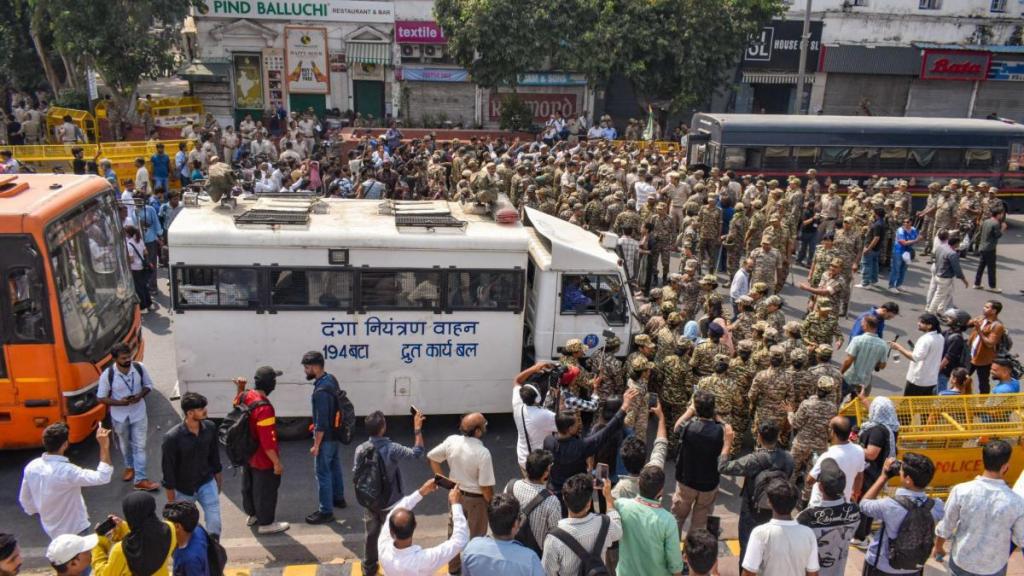

The Delhi High Court on Thursday refused to restrain the Cockroach Janta Party (CJP) and its founder, Abhijeet Dipke, from holding a protest at Connaught Place’s central park on October 16, reported PTI. The court, however, recorded the Delhi Police’s assurance that it would take all possible steps under the law to regulate and control the group’s activities.
A bench of Acting Chief Justice Nitin Wasudeo Sambre and Justice Sanjay Sharma heard a petition filed by Anil Kumar Gupta, a licensed street vendor who sells readymade garments at Palika Bazar.
The petitioner, Anil Kumar Gupta, has argued that the planned gathering under the banner ‘Lehra Do Tiranga’ could trigger traffic restrictions and disrupt access to Connaught Place and Palika Bazar, affecting the earnings of small traders, vendors and daily-wage workers, reported Live Law.
Vendor approaches Delhi High Court
Gupta, a licensed street vendor who has sold readymade garments at Palika Bazar since around 1995, filed a public interest litigation seeking directions to prevent the CJP gathering scheduled for 5 pm at Central Park.
The park is located directly above the underground Palika Bazar market. Gupta holds a certificate of vending issued by the New Delhi Municipal Council (NDMC).
The plea says protests and prolonged traffic blockades in central Delhi have repeatedly disrupted market access, causing vendors and small traders to lose daily earnings. It seeks enforcement of existing restrictions on demonstrations and asks authorities to keep public roads and pedestrian pathways accessible.
Court’s direction
The plea was mentioned before the Delhi High Court on Thursday. “This protest has to be stopped,” Senior Advocate Sacchin Puri, appearing for the petitioner, told the court. Acting Chief Justice Nitin Wasudeo Sambre asked the counsel to return at 2:30 pm, after the Supreme Court hears related protest matters, and said the High Court would consider the plea thereafter.
CJP’s October 16 call
The petition follows a social media appeal issued on October 14 by CJP founder Abhijeet Dipke for a gathering at Central Park under the banner ‘Lehra Do Tiranga’. Dipke had called on supporters to assemble at Central Park, Connaught Place, at 5 pm on October 16 and hoist the national flag. He made the call after CJP activists Saurav Das and Ashutosh Ranka were sent to five days of judicial custody in connection with a protest at Jantar Mantar.
Dipke had also urged people unable to come to Delhi to organise ‘Tiranga Marches’ in their own cities.
Petitioner’s arguments
The petitioner contends that Central Park is not among the venues designated for protests under a Delhi Police order issued on October 11, 2026, which de-notified Jantar Mantar as a designated protest site. The police order named Ramlila Ground, Burari Ground and CBD Ground in East Delhi as protest venues. Gupta argues that de-notifying Jantar Mantar alone will not solve the problem unless authorities prevent gatherings at unauthorised locations and ensure that traffic restrictions are proportionate and temporary.
The plea cites two Supreme Court judgments—Mazdoor Kisan Shakti Sangathan v. Union of India (2018) and Amit Sahni v. Commissioner of Police (2020)—to argue that the right to protest must be exercised at designated places and should not obstruct public roads indefinitely.
Alleged impact of past protests
The petition refers to the Delhi Police Standing Order dated November 22, 2018, which prescribed conditions for protests at Jantar Mantar, including limits on participant numbers, timings and restrictions on marches, structures and traffic obstruction.
According to Gupta, several demonstrations continued for extended periods despite these restrictions. The petition cites the 36-day wrestlers’ protest in 2023, a 36-day sit-in seeking examination reforms in 2026, and later demonstrations related to electoral rolls.
It also alleges that an agitation on or around July 20, 2026, spilled beyond the designated area, bringing roads around Jantar Mantar and Parliament Street to a standstill. The petitioner claims customers stopped visiting Connaught Place and Palika Bazar, preventing him from carrying on business.
Relief sought
The plea seeks directions to Delhi Police to prevent the proposed gathering at Central Park and similar demonstrations at locations not designated for protests. It also seeks a traffic and pedestrian access plan for Jantar Mantar, Parliament Street, Connaught Place and adjoining roads.
Further, the petitioner has urged the court to direct police to issue revised standard operating procedures for the newly designated protest venues within a time frame fixed by the court, with safeguards to prevent surrounding roads from being blocked.
Protection for street vendors
Gupta has also sought protection for street vendors against eviction or seizure of goods except in accordance with the Street Vendors (Protection of Livelihood and Regulation of Street Vending) Act, 2014. The petition argues that vendors should not face additional hardship through removal of stalls or seizure of goods when authorities clear areas affected by protests.
It invokes Articles 19(1)(g) and 21 of the Constitution, relating to the right to carry on a trade or occupation and the right to life and livelihood. The petitioner clarified that the plea is not against the right to peaceful protest. He said he seeks enforcement of existing laws so that demonstrations take place at designated venues without depriving other citizens of access to public spaces or their means of earning a living.
The petition names the Union of India, the Delhi government, the Delhi Police Commissioner, the Municipal Corporation of Delhi, the New Delhi Municipal Council and the Cockroach Janata Party as respondents. It also seeks compliance reports from the authorities.