


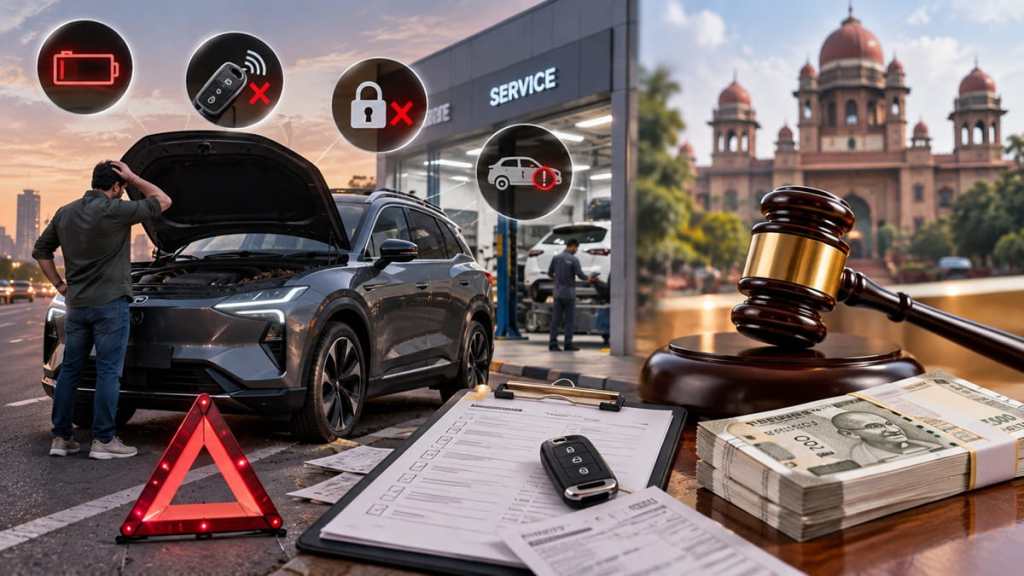

A Hyderabad-based business that purchased a premium electric SUV for nearly Rs 28 lakh was awarded a refund of Rs 23.98 lakh after the vehicle allegedly suffered repeated starting failures, smart-key and central-locking problems and even broke down while being driven.
The Hyderabad District Consumer Disputes Redressal Commission-I also awarded Rs 50,000 as compensation and Rs 15,000 towards litigation costs, taking the total relief to Rs 24.63 lakh.
The Indian Express reported that the consumer commission was hearing a complaint filed against the vehicle’s authorised dealer. The complaint alleged that the problems began within days of the SUV’s delivery on August 1, 2025, and continued despite multiple visits to the service centre.
The commission, headed by President B Uma Venkata Subba Lakshmi along with members C Lakshmi Prasanna and B Raji Reddy, passed its order on September 7.
SUV developed problems within days
According to The Indian Express, the business had purchased the electric SUV for Rs 27.98 lakh for daily commuting. A portion of the purchase price was financed through a loan.
The complainant alleged that the vehicle began failing to start almost immediately after delivery. It also developed problems with its smart key and central-locking system.
The complaint said the smart key would sometimes go out of range and the vehicle would fail to recognise it. The central locking system allegedly malfunctioned repeatedly, with the complainant claiming that the problem occurred four times within a month.
The vehicle was also allegedly left stranded on multiple occasions and stopped while in traffic.
Initially, the dealer attributed the starting problem to a “software glitch” and assured the consumer that the vehicle was otherwise fine, according to report.
After one breakdown, a supervisor was reportedly deputed to address the issue. The complainant, however, alleged that the problem continued and eventually sought replacement of the SUV.
Service records became key evidence
The authorised dealer opposed the complaint and sought its dismissal. It argued that no manufacturing defect had been established as the complainant had not produced an expert opinion, automobile engineer’s report or laboratory report.
The dealer also contended that it was only an authorised dealer and service centre and that the vehicle manufacturer had not been made a party to the proceedings.
It maintained that it had responded whenever the consumer reported a problem. According to its submission, the software-related issue had been resolved through an update, while the locking problem had been addressed by replacing the relevant component under warranty.
However, the commission relied on the vehicle’s service records.
According to The Indian Express, a service history dated August 1, 2025 recorded complaints relating to the inability to lock or unlock the vehicle as well as an earlier starting problem.
On September 5, the records again mentioned problems with locking and unlocking the SUV. A gate pass issued that day referred to checking the key fob and NFC card.
The complaints continued in subsequent service records.
A December 25, 2025 service history again recorded an inability to lock or unlock the vehicle. By February 23, 2026, the records mentioned an EV starting problem, drive-mode malfunction and non-functioning interior lights.
Consumer commission finds deficiency in service
The commission found that the service history and job cards supported the complainant’s allegations that the problems had continued despite repeated attempts at repairs.
“The service history/job card submitted by the opposite party and the complainant establishes that the reported issues of smart key out-of-range issue and the central locking system malfunction persist even after filing the consumer complaint and the vehicle of the complainant has stopped mid-way,” the commission observed.
It further noted that the service records described the problems as “old issues” and indicated that they had persisted despite the vehicle being taken in for repairs.
On this basis, the commission concluded that the complainant had established deficiency in service and that a defective vehicle had been delivered.
How much refund will the buyer get?
The consumer had sought a refund of Rs 29.29 lakh, besides Rs 10 lakh for mental agony and harassment and another Rs 10 lakh in punitive damages.
The commission did not grant the entire amount claimed. Instead, it directed the dealer to refund the vehicle’s value after allowing for 10% depreciation.
The refund was calculated on Rs 26,64,761.90, resulting in a refund of approximately Rs 23.98 lakh.
The commission additionally awarded Rs 50,000 as compensation and Rs 15,000 towards litigation costs. The total relief therefore comes to approximately Rs 24.63 lakh.
Takeaway
A new vehicle that continues to suffer serious defects despite repeated repairs may give consumers grounds to seek legal relief. Maintaining service records, job cards, emails and complaint correspondence can help establish that the defects persisted despite repeated attempts to fix them.