


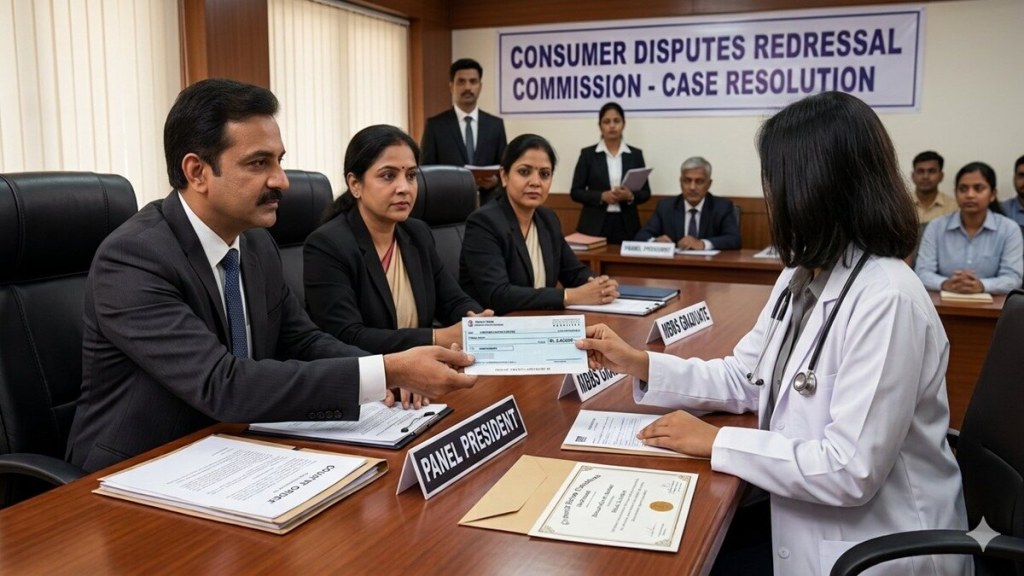

A Rohtak consumer commission has directed a private medical college to pay Rs 2.40 lakh to a former MBBS student whose refundable security and library deposits were withheld because he could not produce the original payment receipt.
According to The Indian Express report, the commission held that a lost receipt could not, by itself, be used to permanently deny a refund when the student had otherwise supported his claim with documents and the college failed to show that the money had been adjusted, refunded or used for any lawful liability.
The order was passed on September 24 by commission president Nagender Singh Kadian and members Dr Tripti Pannu and Dr Vijender Singh. Besides returning Rs 2.25 lakh, the panel awarded Rs 10,000 for mental agony and harassment and Rs 5,000 towards litigation costs.
Student’s claim
According to the complaint, the 26-year-old man took admission in a private medical college in 2012. On September 15 that year, he deposited Rs 2 lakh as refundable security and Rs 25,000 as refundable library security with the institute.
The college was later closed for administrative reasons, and its students were shifted to different medical colleges in Haryana. The Indian Express report stated that the complainant was moved to a college in Hisar in 2017, where he completed his MBBS degree and internship in January 2019.
He said the security amount remained with the original college. In 2019, he wrote to the principal seeking refund of Rs 2.25 lakh and enclosed a copy of the receipt. The college, however, insisted on the original receipt, which he said had been lost and could not be traced.
After repeated requests failed and the college refused to release the money, the former student approached the consumer commission, seeking refund as well as compensation for deficiency in service.
College’s defence
The college argued that the complainant had not furnished the original receipt for the security deposit and that, in its absence, the amount could not be refunded—particularly as the institution was non-functional. It also said candidates across batches had been instructed to submit original fee receipts, and claimed the student had not complied with that direction.
What the commission found and why it matters
The Indian Express report added that the commission noted that it was an admitted fact that the complainant had studied at the erstwhile college and was later shifted to another institution. It also recorded that the colleges had admitted that security amounts of similarly placed students had been refunded following a government decision.
“The documents placed on record further show that even some students who subsequently submitted their receipts were thereafter granted refund,” the commission observed.
The panel found that the record established the deposits were refundable and that the university had already undertaken refunds for students in a similar position. It said withholding the money merely because the original receipt was missing—despite a copy of the receipt and an affidavit explaining its loss—amounted to deficiency in service.
“The mere non-production of the original receipt, in the peculiar facts and circumstances of the present case, cannot by itself be treated as sufficient ground to permanently deny the complainant the refundable security amount, particularly when the payment is otherwise supported by documentary evidence and the respondents (colleges) have not established that the said amount was adjusted, refunded or otherwise utilised towards any lawful liability of the complainant,” the order said.
The ruling makes clear that educational institutions cannot treat an original receipt as the only acceptable proof of a refundable deposit when other documentary evidence supports the payment. The burden also lies on the institution to establish that the money was already refunded, adjusted or lawfully utilised.
For students and parents, the case is a reminder to retain fee and security-deposit receipts, but also that a lost original need not automatically extinguish a legitimate refund claim if copies, affidavits and institutional records establish the payment.
Consumers facing similar issues can approach their state consumer helpline—1800-180-2087 in Haryana—or the National Consumer Helpline at 1915.