


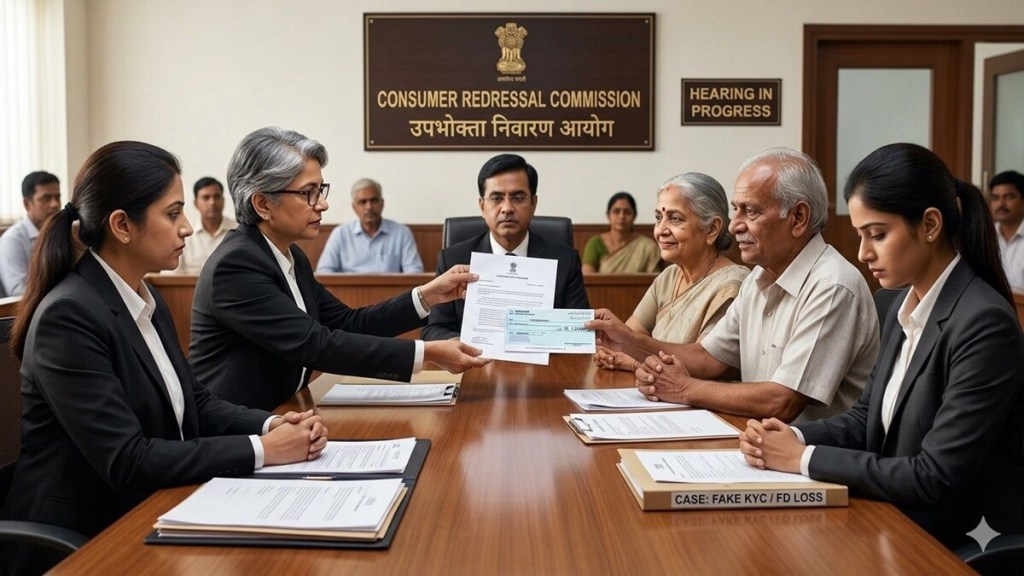

Bank has been ordered to pay a Kerala couple about Rs 1.35 lakh after a consumer commission found deficiency in service regarding an unauthorised transaction from their fixed deposit account, allegedly carried out through a fake KYC-update message.
According to The Indian Express report, the Pathanamthitta District Consumer Disputes Redressal Commission directed the bank to refund the remaining Rs 99,874, pay Rs 25,000 as compensation for mental agony and distress, and pay Rs 10,000 towards litigation costs. The bank had already returned Rs 2.23 lakh following an internal Banking Ombudsman decision but withheld the balance.
The order was passed on September 30 by commission president George Baby and member Nishad Thankappan.
How the money was debited
According to the complaint, the couple maintained a savings account with the bank. On October 28, the husband deposited Rs 10 lakh in a three-month fixed deposit.
The complainant said that on January 7, 2023, he attempted to pay his bank credit card dues through the mobile application, but the payment failed. He then received a message stating that his account had been blocked and asking him to update his KYC.
He said he followed the instructions and entered his details through the link. Immediately afterwards, Rs 3.28 lakh was allegedly withdrawn from his fixed deposit in four instalments.
The husband said he informed the bank without delay. While the bank later refunded Rs 2.23 lakh, it did not return the remaining Rs 99,874. The couple then approached the commission, alleging that greater vigilance by the bank could have prevented the withdrawal and that the incident caused them financial loss and distress.
Bank’s defence
Bank told the commission that it does not ask customers to update KYC through such links. The Indian Express report added that the bank also argued the husband had wilfully shared his account details with another entity after receiving a fake message. It said he entered the OTP on the fraudulent link, allowing a fraudster to access his payment credentials and complete the transactions.
According to the bank, the disputed transactions could not have gone through without the OTP being shared.
What the commission held
The commission found that the transactions were unauthorised electronic banking transactions and that the husband had promptly reported the fraud, The Indian Express report further stated.
It noted that the bank “absolutely failed” to produce evidence proving that the customer had authorised the transactions or shared his credentials with fraudsters.
“The opposite party (bank) must establish through its system or audit records and other evidence that the complainant himself disclosed the credentials and thereby contributed to the fraud. In the absence of such proof, the complainants cannot be saddled with the balance loss of Rs 99,874,” the commission said.
The ruling makes clear that a bank cannot escape liability for unauthorised digital transactions merely by alleging that the customer shared an OTP or other credentials. It must back that claim with system logs, audit records or other evidence.
For account holders, the case is a reminder to avoid clicking on unsolicited KYC-update links and to report fraudulent transactions immediately. It also shows that prompt reporting and documented communication with the bank can strengthen a consumer complaint.
Consumers facing similar issues can contact the Kerala consumer helpline at 1800-425-1550 or the National Consumer Helpline at 1915.