


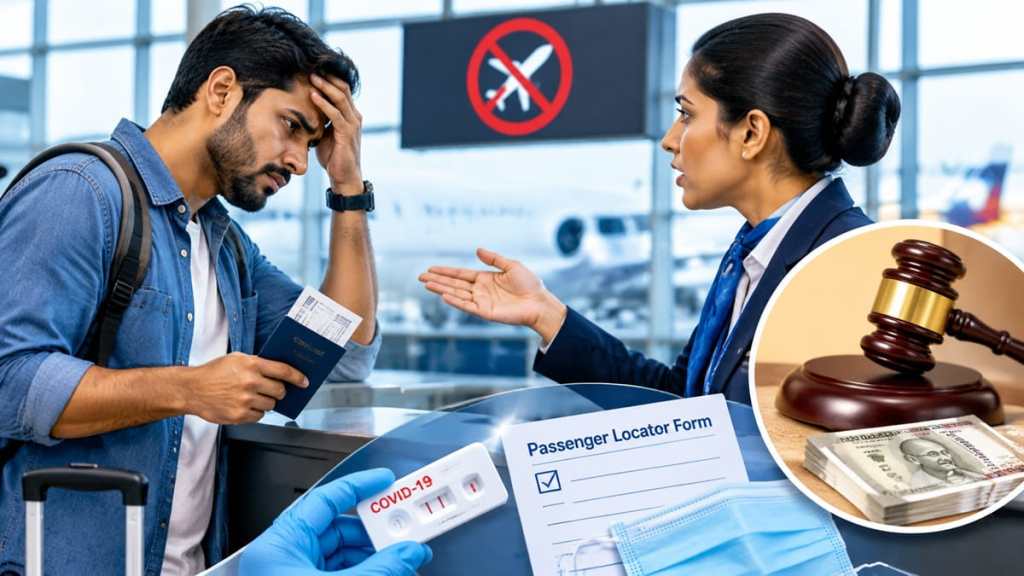

A Punjab consumer commission has directed an airline to pay Rs 50,000 to a passenger who missed his London-bound flight during the Covid-19 pandemic after finding that the airline failed to properly explain the travel-document requirements and provide adequate assistance, The Indian Express reported.
The Amritsar District Consumer Disputes Redressal Commission awarded Rs 40,000 as compensation for mental agony, inconvenience, embarrassment and harassment, along with Rs 10,000 towards litigation costs. However, it rejected the passenger’s request for a refund of his Rs 28,919 airfare, holding that the evidence did not establish that he had been completely and unjustifiably denied the opportunity to travel.
According to The Indian Express, the commission passed the order on October 6. The bench comprised president Jagdishwar Kumar Chopra and member Mandeep Kaur.
“The opposite parties have also failed to place sufficient material before the Commission to show that the complainant was given a clear written explanation of the precise deficiency in his documentation or that he was provided reasonable assistance to complete the formalities,” The Indian Express quoted the commission as saying.
Passenger denied boarding on London-bound journey
According to The Indian Express, the passenger had booked a ticket for Rs 28,919 to travel from Amritsar to Heathrow, London, via Mumbai on March 19, 2021.
At the time, international travel was subject to Covid-19-related restrictions, including the requirement for a negative RT-PCR test report obtained within 72 hours before departure. The passenger claimed that he had obtained a negative test report before his journey.
According to his complaint, he reached Amritsar airport well before departure and presented his passport, visa and RT-PCR report. However, airline staff allegedly refused to let him board without satisfactorily explaining the reason.
He also claimed that the staff failed to provide adequate assistance despite his requests for clarification about the applicable requirements.
Airline cites missing test details, Passenger Locator Form
The airline argued that the passenger had failed to establish that his RT-PCR test complied with the requirements for international travel.
It said the report did not mention the exact date and time of sample collection, making it difficult for staff to determine whether the test had been conducted within the prescribed 72-hour window.
The airline also contended that the passenger had not submitted the UK Passenger Locator Form (PLF), which passengers were required to complete under the applicable UK guidelines.
It further submitted that the passenger had been advised to travel from Amritsar to Mumbai on a domestic flight and complete the necessary formalities there before boarding the international flight to London.
Commission finds deficiency in service
The commission found that the airline had failed to produce sufficient evidence showing that the passenger had received a clear written explanation of the deficiencies in his documents or reasonable assistance to complete the required formalities.
“The officials of opposite parties no. 1 and 2 (airline) failed to exercise the requisite assistance in dealing with the complainant and failed to properly guide and assist him regarding the applicable travel requirements. Such failure amounts to deficiency in service,” the order stated.
The commission observed that the passenger had not been treated in the manner expected from a professional airline service provider.
However, it declined to order a refund of the ticket price, noting that the evidence did not establish that the airline had completely and unjustifiably denied him the opportunity to travel.
Rs 50,000 awarded, but no ticket refund
The commission directed the airline to pay Rs 40,000 as compensation and Rs 10,000 towards litigation costs, taking the total award to Rs 50,000. The passenger’s original airfare of Rs 28,919 was not ordered to be refunded.
Takeaway
The ruling addresses the importance of clear communication when airlines identify deficiencies in travel documents. Passengers should check applicable entry and testing requirements before departure and retain copies of test reports, travel forms, booking confirmations and communications with airline staff.