


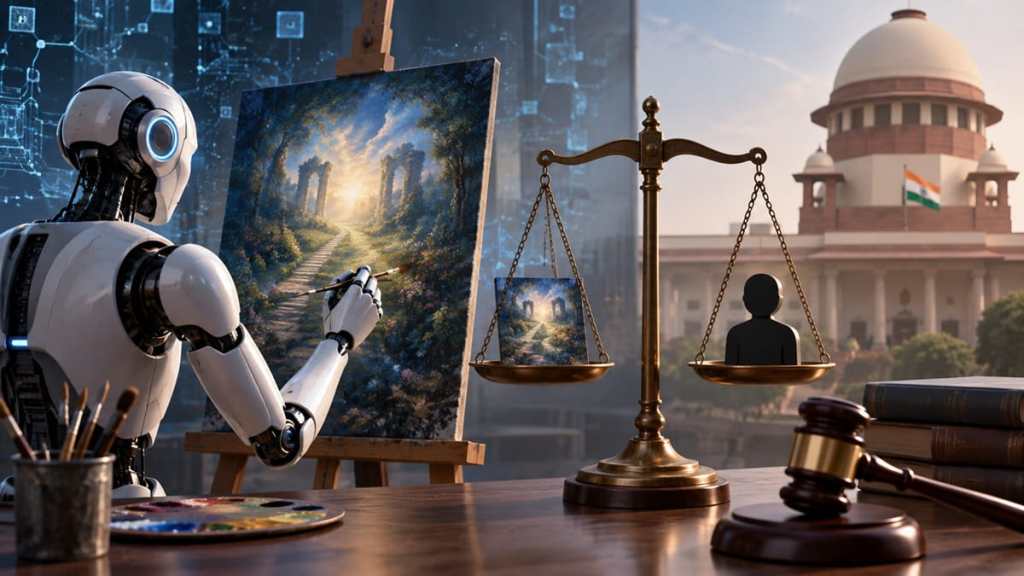

Artificial intelligence (AI) may be capable of generating an original work, but under India’s current copyright law, it cannot itself be recognised as the author.
The Copyright Office reportedly rejected an application by American computer scientist Stephen Thaler seeking copyright registration for an artwork generated by his AI system, DABUS. At the same time, it found that the artwork itself was original and could meet the threshold for copyright protection.
The ruling, reported by The Indian Express, draws a distinction between the “originality of an AI-generated work and the legal identity of its author”.
The decision could have implications for creators, media companies, technology firms and other businesses increasingly using AI to generate content.
What was the case?
The dispute concerned an artwork titled “A Recent Entrance to Paradise”, which Thaler said had been generated autonomously by DABUS – Device for the Autonomous Bootstrapping of Unified Sentience.
The Indian Express reported that Thaler applied for the registration of copyright in 2022 and identified DABUS as the author while naming himself as the copyright owner.
The Copyright Office questioned whether an AI system could legally be recognised as an author under the Copyright Act.
Thaler was subsequently allowed to amend his application and identify himself as the author. He declined, maintaining that DABUS itself should be recognised as the author as the system had generated the final artwork without real-time human intervention.
What did the Copyright Office decide?
The Office drew a line between “creating an original work and being its legal author”.
It found that the artwork was original as there was no clear evidence that it had been copied from a specific existing work. The fact that AI had generated it did not, by itself, make the work unoriginal.
However, the Office said copyright law still requires a legally recognised author.
Under Section 2(d)(vi) of the Copyright Act, the author of a computer-generated work is the “person who causes the work to be created.”
Why wasn’t DABUS treated as the author?
The Indian Express reported that the Copyright Office held that the law focuses on the person responsible for bringing the work into existence, rather than simply the technology that produces its final expression.
Although DABUS generated the artwork, the system had been developed and configured by Thaler. He created the system, determined how it would operate and initiated the process that resulted in the artwork.
Therefore, the Office treated DABUS as the “technological tool through which the work was produced”, rather than its legal author.
It also relied on principles emerging from US copyright cases, including Burrow-Giles and Aalmuhammed v Lee, which distinguish between the instrument used to produce a work and the person exercising creative responsibility or overall control.
What does the Copyright Act say about originality?
Section 13 of the Copyright Act protects original literary, dramatic, musical and artistic works.
The Act does not specifically define “originality”. The Copyright Office therefore considered the Supreme Court’s ruling in “Eastern Book Company v D.B. Modak”.
The test is not whether a work is completely novel or revolutionary. It must, however, contain at least a minimum degree of creativity and cannot simply reproduce existing material mechanically.
The Office found that the DABUS-generated artwork met this limited threshold.
This is significant as the ruling does “not” establish that AI-generated works are automatically excluded from copyright protection.
Instead, it says that the work may qualify, but the law still needs a legally recognised person who can be identified as its author, The Indian Express reported.
Why does authorship matter?
Authorship is not merely a label. Under the Copyright Act, it is linked to legal rights and responsibilities.
Section 17 generally makes the author the first owner of copyright, while Sections 18 and 19 provide for assignment and transfer of copyright. That framework assumes that the author is a legal person capable of holding rights, entering into agreements and enforcing those rights.
The Copyright Office held that DABUS, which has no legal personality under Indian law, cannot occupy that position.
Thaler, on the other hand, was a legally recognised person who had created and configured the system and initiated the process that resulted in the artwork.
The application nevertheless failed as Thaler had specifically sought to have DABUS recorded as the author.