


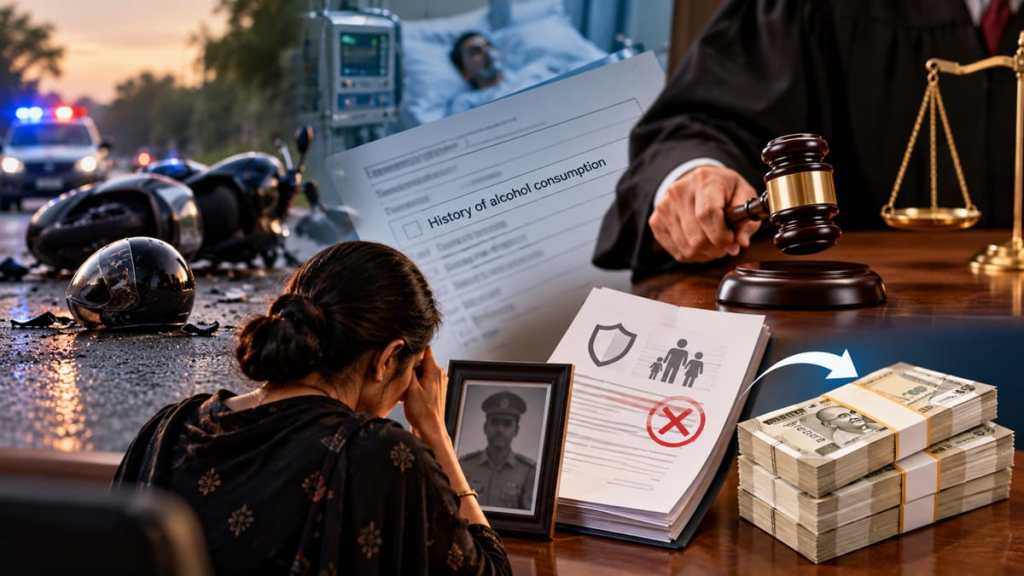

A hospital record mentioning a man’s “history of alcohol consumption” cannot by itself prove that he was drunk at the time of a road accident, a Chandigarh consumer commission has held while directing a private insurer and a bank to pay Rs 60 lakh to the widow of a deceased police head constable.
The Chandigarh District Consumer Disputes Redressal Commission found that the insurer had rejected the accidental death claim without producing medical or scientific evidence to establish that the insured was under the influence of alcohol when the accident occurred.
According to The Indian Express, the commission said that a history of consuming alcohol and being intoxicated at the time of an accident were two different things and could not be treated as interchangeable for invoking an insurance-policy exclusion.
The commission, comprising president Pawanjit Singh and member Mohan Sharma, also awarded Rs 20,000 towards compensation for mental agony and harassment as well as litigation costs.
Head constable dies after scooter accident
The deceased was a head constable with the Chandigarh Police and maintained his salary account with a private bank.
Under a Memorandum of Understanding dated October 30, 2021, Chandigarh Police personnel holding salary accounts with the bank were covered by a personal accidental death insurance policy.
The head constable met with a road accident while travelling on his scooter on July 2, 2022 and suffered serious injuries.
He was initially admitted to a hospital in Ludhiana and was subsequently referred to a government medical college and hospital in Chandigarh. He died from his injuries on July 18, 2022.
His widow then sought the accidental death insurance benefit available under the arrangement.
Claim rejected over alleged intoxication
The insurer repudiated the claim in October 2022, relying on hospital records which, according to the company, indicated that the head constable was under the influence of alcohol at the time of the accident.
It argued before the commission that although the deceased was insured, the cover was governed by the policy’s terms and exclusions. According to the insurer, his alleged intoxication brought the death within an exclusion and consequently disentitled the nominee from the insurance benefit.
The company also raised objections over the maintainability of the complaint, locus standi, concealment of facts and cause of action.
The bank maintained that its role was limited to facilitating the insurance arrangement and forwarding the necessary documents. The decision to accept or reject the claim, it argued, rested with the insurer.
What did the hospital record actually say?
The commission found a crucial distinction between what the insurer alleged and what the medical record actually recorded.
The hospital summary referred to a “history of alcohol consumption”. It did not, however, state that the head constable was intoxicated when the accident occurred.
“Needless to mention here that ‘history of alcohol consumption’ and being ‘under the influence of liquor’ are not akin to each other,” the commission observed in its September 22 order.
Relying on precedents of the National Consumer Disputes Redressal Commission, the district commission held that a reference to alcohol consumption, without supporting scientific or medical evidence, was insufficient to prove intoxication at the relevant time.
No blood-alcohol or breathalyser evidence
The commission noted the absence of evidence such as a blood-alcohol test or breathalyser report that could establish that the deceased was under the influence of liquor when the accident happened.
Two facts were otherwise undisputed: the head constable was covered under the personal accidental death insurance policy and his death followed the July 2022 road accident.
The insurer, therefore, had to establish that the alcohol-related exclusion it relied upon actually applied to the circumstances of the accident. The commission found that it had failed to do so.
It held that rejecting the claim merely on the basis of a medical record mentioning a history of alcohol consumption was unjustified and amounted to deficiency in service and unfair trade practice.
“The insurer was unjustified in repudiating the claim of the complainant on the ground of the deceased/insured being under the influence of alcohol at the time of the accident,” The Indian Express quoted the commission as saying.
Widow gets Rs 60 lakh accidental death benefit
The commission consequently directed the insurance company and the bank to pay the widow Rs 60 lakh under the accidental death insurance cover. It further awarded her Rs 20,000 towards compensation for mental agony and harassment as well as litigation costs.
What policyholders should know
The ruling highlights the evidentiary threshold an insurer may have to meet before rejecting an accidental death claim by invoking an intoxication-related exclusion.
A medical record showing that a person had a history of consuming alcohol is not necessarily evidence that the person was intoxicated when an accident occurred. In this case, the commission specifically noted the absence of a blood-alcohol test, breathalyser result or comparable medical or scientific evidence establishing intoxication at the relevant time.
For nominees challenging such a repudiation, the distinction between an insured person’s medical history and evidence concerning their condition at the precise time of an accident can therefore become central to the claim.