


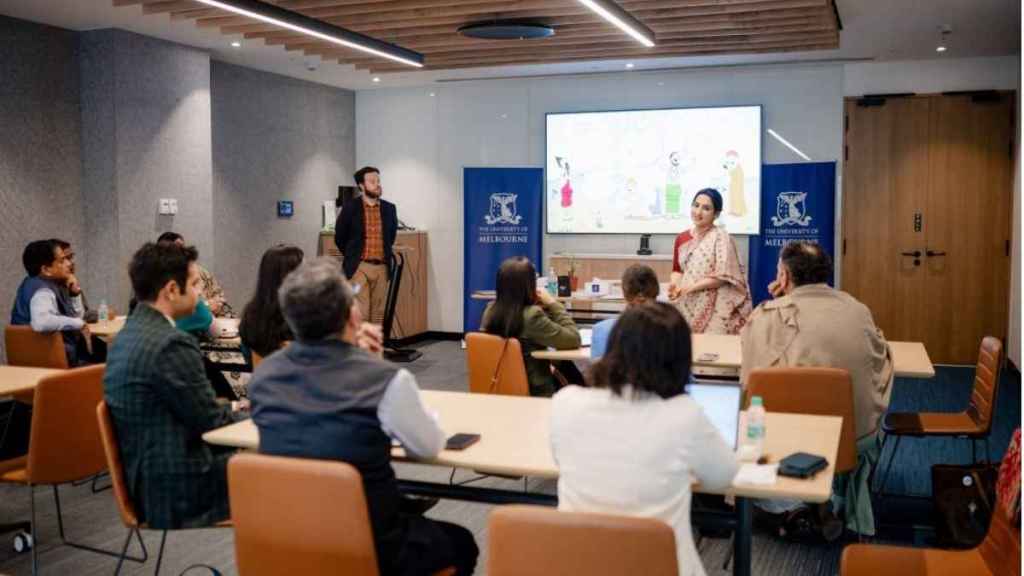

Two years after opening a centre in New Delhi – its first outside Australia – the University of Melbourne (UniMelb) has made its stance on foreign campuses clear: there are no plans to build a branch campus. This comes as Australian universities are on a campus-opening drive, with five already in India: Deakin University, University of New South Wales, Victoria University, University of Western Australia, and University of Wollongong.
Prof Frank Vetere, pro vice-chancellor global, told this newspaper that UniMelb is doubling down on a strategy of collaboration over competition. In India to deepen a partnership with the Indian Institute of Science Education and Research (IISER) Tirupati, Prof Vetere said that UniMelb is building on foundations laid in 2024—when it opened the Melbourne Global Centre Delhi—and the subsequent blueprint positioning the hub as a nucleus for academic synergy.
An education sector expert noted that while it is natural for foreign universities to open campuses on the invitation of the Indian government, expecting top-tier global institutions – like the UniMelb, or an Oxford or a Harvard – to open teaching campuses is uncommon.
“Most of the top-ranked universities of the world – in the top 50 – have a single-campus policy, or they have multiple campuses in the home country, because they believe that to attract the best faculty and students, it makes sense to concentrate everything on one physical location,” the expert said. “Instead of a teaching campus, they would invest in a centre that facilitates partnerships, like the UniMelb has done.” She added that universities outside the global top tier are often more flexible, viewing foreign campuses as a practical expansion tool, while elite institutions maintain a more measured approach.
A centrepiece of UniMelb’s expanded collaboration is a new Bachelor of Science Integrated (Honours) 2+2 dual degree, which allows students to complete two years at IISER Tirupati before finishing their degrees in Melbourne across disciplines ranging from biotechnology and chemistry to genetics and physics.
“The programme exemplifies how international institutions can leverage India’s robust scientific talent pool without duplicating domestic infrastructure,” Prof Vetere said, adding that graduates will gain advanced standing opportunities to progress to a master’s degree and join the Science Global Scholars Program.
Looking ahead
The roadmap for the next two years moves past introductory academic mixers towards structured, high-impact engagement. Prof Vetere noted that the Delhi centre will increasingly feature intensive masterclasses, multi-day collaborative workshops pairing leading Indian and Australian minds, and increased student integration. Alongside these, joint public lecture series such as ‘Frontiers of Science for Global Advances’ will bring researchers directly to academic communities across India.
By positioning the Melbourne Global Centre Delhi as a convenor rather than a competitor, UniMelb is demonstrating that long-term academic integration does not require building isolated brick-and-mortar campuses. Instead, by co-creating dual pathways and joint research initiatives with premier institutions, Melbourne is advancing a model for cross-border education that focuses on shared expertise.