



When the latest QS Business Master’s Rankings were released on September 16, most coverage celebrated the fact that while more Indian business schools featured on the list, the top IIMs slipped a few spots. But beyond these headline numbers lies another story – that Indian B-schools are nowhere to be seen when it comes to specialised master’s programmes.
“Indian B-schools continue to treat the traditional two-year MBA — or Master’s in Management (MiM) as the QS calls it — as their holy grail, but are getting completely outclassed in specialised business master’s programmes,” a former IIM director told this newspaper.
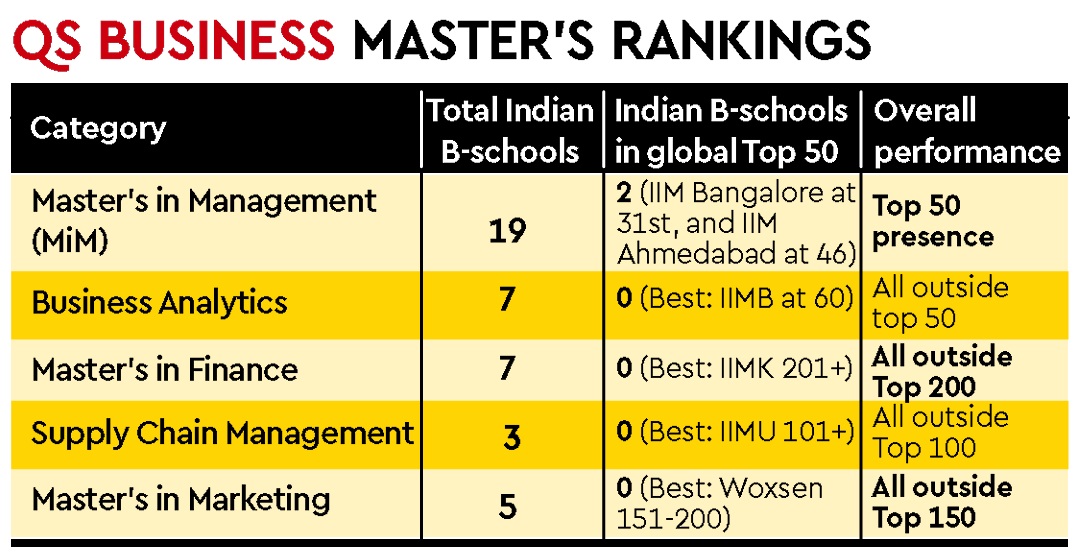
Looking closely at the data, we found that of the 41 Indian master’s degree programme entries featured in the QS rankings across 28 institutions, nearly half (19) belong to the generalist MiM category. Here, India has respectable presence: IIM Bangalore ranks 31st globally, followed by IIM Ahmedabad at 46th, and IIM Calcutta at 57th.
But turn to the specialised master’s programmes, and the picture turns grim.
In Master’s in Finance, the seven Indian B-schools on the list are all outside the global top 200. In Supply Chain Management, all three Indian B-schools are outside the global top 100. In Business Analytics and Marketing, top Indian institutions fail to break into the global top 50.
The IIM director added that, globally, the B-school landscape has shifted. “European powerhouses like HEC Paris, ESSEC, and London Business School treat specialised master’s degrees as premier talent pipelines. HEC Paris, for instance, holds the number-one spot globally across Finance, Management, and Marketing,” he said. “These programmes are not general management courses with a few electives added, but are intensive degrees that train students in quantitative finance, predictive analytics, algorithmic trading, and global supply chain risk modelling.”
He said that most Indian B-schools, in contrast, treat specialised master’s as secondary offerings. The top faculty, corporate relations, and infrastructure remain monopolised by two-year generalist PGPs.
“Indian business education was built for a different era — at a time when corporate India needed general managers to oversee expanding operations,” he said. “Today, global capability centres and top financial firms setting up shop in India don’t just need general managers, but also specialists who can build financial models, optimise supply chains using AI, and manage cross-border risk.”
This comes at a time when India is lauded as a technology and fintech powerhouse, and yet our B-schools fail to break into the global top 50 in Business Analytics, Finance, or Supply Chain Management.
As global corporate hubs in India mature, the demand for specialised talent will only accelerate. Alongside the reliance on general MBAs – because India also needs a lot of general managers – Indian B-schools must also start building world-class specialised master’s programmes, so that they can remain globally relevant.