


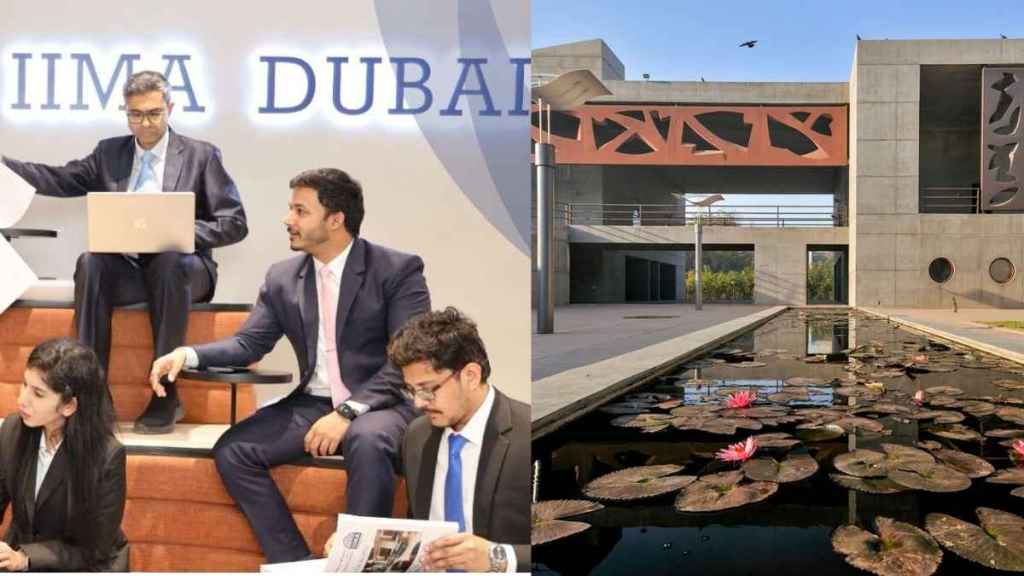

When Indian Institute of Management Ahmedabad (IIMA) launched a two-year Executive MBA at its Dubai campus earlier this month, it was not just another programme, but a structural shift in Indian higher education. A year after it opened the Dubai campus, the institution is proving that India’s educational soft power is no longer just about exporting individual talent – such as CXOs to the West – but also about tapping high-value corridors in the Global South.
The Global South pivot
IIMA director Prof Bharat Bhasker told this newspaper that the Dubai campus isn’t merely an offshore outpost for the local diaspora and people of Indian origin, but has set its sights higher. “The aim is to become the premier management school for the Global South, encompassing the Middle East, Africa, and CIS countries,” he said. “By training corporate executives and engaging with regional economic hubs, IIMA is acting as a vital bridge, reinforcing bilateral trade ties that have recently seen India-UAE commerce cross the pivotal $100 billion mark.”
The anti-western strategy
Why focus on the Global South and not on Europe or the US? Prof Bhasker said that launching from scratch in western markets would mean fighting an uphill battle for brand equity against legacy Ivy League institutions, as well as some of the oldest schools in the world. “Instead, by anchoring itself in the Middle East, IIMA leverages a formidable, high-value global brand name to capture high-potential emerging markets where the demand for world-class executive talent is skyrocketing,” he said.
Capitalising on strong initial traction, where over 400 executives were trained in its debut year, IIMA’s new two-year Executive MBA is designed for senior professionals navigating the India-Gulf corridor. “The curriculum integrates AI-led business strategies, cross-functional decision-making, and case-based pedagogy to prepare leaders for an AI-first economy,” Prof Bhasker said.
STEM versus humanities
IIMA’s initial success in Dubai mirrors a broader trend. From IIT Madras setting up a campus in Zanzibar and IIT Delhi expanding to Abu Dhabi, to IIM Bangalore’s upcoming campus in Indonesia, it shows they are projecting India’s educational soft power abroad.
But it also shows that while STEM powerhouses like the IITs and IIMs—and private flagships like BITS Pilani and SP Jain—are going global, India’s traditional public universities remain at home. Data from global metrics like the QS World University Rankings show why there’s a difference: while IITs feature in global top tiers for engineering and technology, India’s premier liberal arts and humanities centres lag behind in international visibility.
Education analysts point out that while technical and management institutions have the financial agility, governance autonomy, and market-driven curriculum needed to scale globally, traditional universities suffer from rigid domestic regulatory frameworks. This means that while our STEM and management institutes will likely continue expanding abroad, it’s difficult to imagine a Delhi University or a JNU having an autonomous offshore campus.