


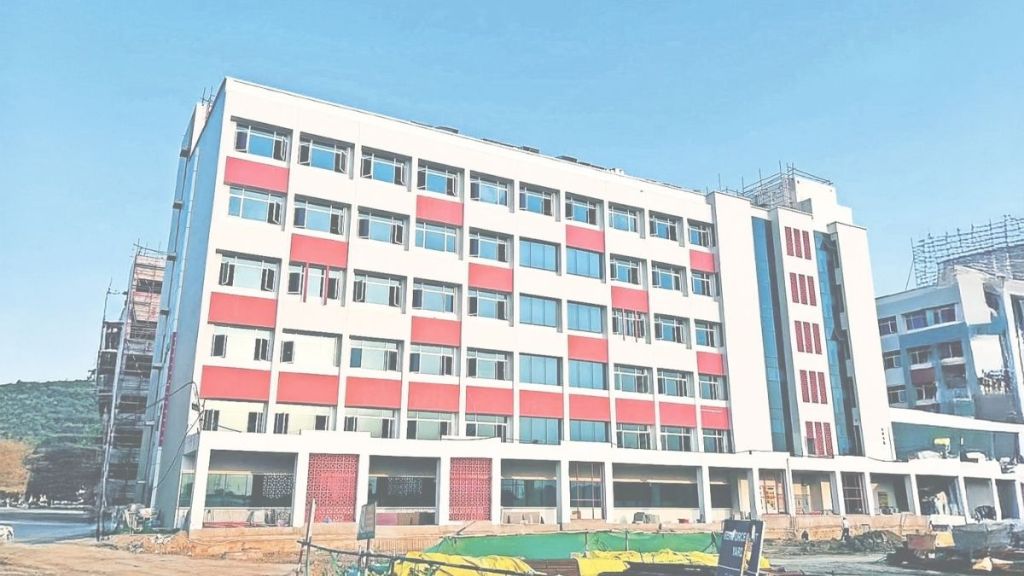

India has no shortage of doctors, engineers or scientists. What it has lacked is a place where these capabilities can come together around the same healthcare problem. That is the gap IIT Kanpur is trying to address through the Gangwal School of Medical Sciences and Technology, a medical school and research institution located on the campus.
The timing is significant. IndiGo co-founder Rakesh Gangwal, who committed ₹100 crore to the school in 2022, has now pledged another ₹300 crore, taking his total commitment to ₹400 crore. The latest contribution is meant to attract matching support from other donors. But the bigger question is whether IIT Kanpur can use this capital to build a system that consistently turns clinical needs into products and solutions.
The institute has now added another piece to that ecosystem. The Wadhwani Innovation Centre for Life Sciences and Medical Technologies, launched recently, will receive $5 million over five years to help develop, validate and commercialise research in areas including medical devices, diagnostics, therapeutics and healthcare technology. The centre will also help researchers navigate intellectual property, regulatory processes, industry partnerships and technology transfer.
That focus on taking research beyond the lab is central to IIT Kanpur’s medtech ambition. The Gangwal School is not being planned as a conventional medical college. The idea is to bring medical education, clinical care, research and technology together on one campus. A 500-plus-bed Yadupati Singhania Super Speciality Hospital and 11 centres of excellence in areas such as medical imaging, robotics, point-of-care diagnostics and healthcare technology are central to that plan.
“The missing piece is the ability to turn ideas into practice,” says Anil K. Lalwani, dean of the Gangwal School. India has the talent and capability, he says, but the education, research and clinical landscape remains fragmented. The school’s bet is that bringing these capabilities together can shorten the distance between identifying a problem and solving it.
That distance matters. A doctor may understand why a patient needs a better diagnostic tool, implant or rehabilitation device, but may not know how to build it. An engineer may be able to develop the technology, but without understanding the clinical setting, the result may be too expensive, difficult to use or simply solve the wrong problem.
“Instead of a doctor identifying a problem and then looking for technology elsewhere, or an engineer developing technology and then looking for its medical application, both can start with the problem itself,” Lalwani says. The objective is to bring the clinical need, technical possibility and practical constraints into the same conversation from the beginning.
The school’s work with the Uttar Pradesh government and ICICI Foundation offers an early example. It is developing a digital health stack combining telemedicine, diagnostics and health data, while its Health Information Exchange has been piloted at public health centres in Lucknow.
There are also more hardware-heavy projects. Hridyantra, an implantable left ventricular assist device for heart-failure patients, is now in animal testing. The school is also developing a smart wheelchair that can navigate stairs and escalators, portable X-ray technology for tuberculosis and point-of-care devices for remote testing.
These projects illustrate the model IIT Kanpur wants to institutionalise: start with a real healthcare problem, bring the right disciplines together and build around the needs of the patient. The harder part begins after the prototype. A technology still has to survive clinical testing, regulation, manufacturing and the realities of the market.
That is where global examples such as Harvard-MIT’s Health Sciences and Technology programme and Stanford’s Biodesign offer useful benchmarks. Their experience shows that medical innovation needs more than collaboration between doctors and engineers; it needs structures that support discovery, validation, entrepreneurship and clinical adoption. IIT Kanpur will have to build much of that ecosystem around its own research and hospital infrastructure.
Lalwani sees commercialisation as part of the process, rather than something that starts after the research is complete. “A technology still has to be clinically validated, meet regulatory requirements, be manufactured and eventually reach the market,” he says. The school’s Startup Incubation and Innovation Centre can help researchers with intellectual property and industry connections.
The other constraint is talent. The school wants to produce what Lalwani calls a physician-scientist – someone who understands medicine but is also comfortable with engineering, computer science, AI or bio-design. Such people remain relatively uncommon, which is why the school is starting with interdisciplinary MS and PhD programmes and advanced clinical-engineering programmes.
A broader MBBS programme incorporating science and engineering will come later, once the faculty and hospital infrastructure are in place. That sequencing is important: building a medtech ecosystem requires people who can work across disciplines, not simply specialists from different fields working next to each other.
The opportunity is bigger than the school itself. Healthcare needs are vast, but medical technology remains heavily dependent on imports. IIT Kanpur director Manindra Agrawal argues that the long-standing separation between engineering and clinical expertise has limited the ability to turn technological capabilities into solutions suited to local healthcare needs.
That is the real bet behind the Gangwal School: not just to train doctors or build prototypes, but to create a working pipeline from clinical problem to research, product and patient. If IIT Kanpur can make that pipeline work repeatedly, it could offer a new model for building and commercialising medical technology at scale.