


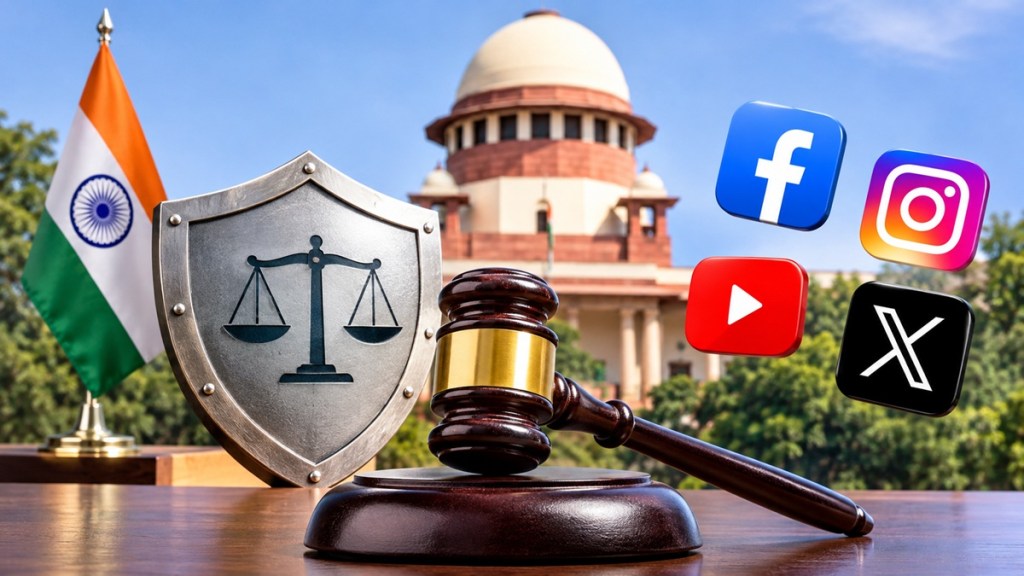

India’s IT Ministry is quietly exploring a major rewrite of the rules governing social media platforms. One of the most consequential ideas on the table is removing the legal immunity that currently shields companies like Facebook, Instagram, YouTube and X from liability for content posted by their users, reported The Indian Express.
If the proposal moves forward, it would fundamentally change how these platforms operate in the country. The existing protection has long been a cornerstone of their business models and withdrawing it is expected to trigger a sharp clash between the government and the global tech industry.
Should social media platforms still get ‘safe harbour’ protection?
At the centre of the discussion is “safe harbour”—a legal protection that currently shields internet intermediaries from liability for third-party content. The government is now examining whether this protection should continue for social media companies, or be limited only to services that simply carry information, such as internet service providers, telecom companies and peer-to-peer messaging apps.
Safe harbour is provided under Section 79 of the Information Technology Act, 2000. It protects platforms from legal responsibility for posts, videos, comments and other material uploaded by users, provided they meet certain due-diligence requirements, reported IE.
This protection has been crucial for companies such as Meta, Google and X. It has allowed them to build large businesses around user-generated content without facing legal liability for every individual post or video published on their platforms.
If the government decides to dilute or withdraw this protection for social media companies, it would likely require an amendment to the IT Act. Such a change would need Parliament’s approval.
Why is India rethinking this?
Senior government officials told The Indian Express that social media platforms can no longer be treated as passive carriers of information. Platforms use algorithms to rank, recommend and amplify content and they also moderate posts under their own community guidelines, which may not always match Indian laws.
“Intermediaries were supposed to be simply carriers of content, and safe harbour in that sense made sense. When you receive a message from someone, the platform’s only responsibility is to carry that message and deliver it to you without making any changes to it. But with social media platforms deploying complex algorithms to boost engagement and virality, the boundaries have been blurred. They definitely determine what gets shown to users, and are no longer simple carriers of content,” a senior government official said.
The emerging government view is that because these platforms influence what users see, they exercise a form of editorial control. This raises the question of whether they should continue receiving the same legal protection as traditional intermediaries.
The rethink has been driven by concerns that social media algorithms can amplify certain narratives more than others, including content critical of the government. Officials are also examining how platforms decide the visibility and reach of different kinds of content.
The role of Instagram during the students’ protests in July 2026, when the platform became an important tool for online mobilisation, is understood to have influenced these discussions. The government wants to know whether recommendation systems can shape public debate while platforms remain legally insulated from the material they amplify.
No final decision yet
The discussions are still at an exploratory stage, and no final decision has been taken on the exact shape of the proposed changes. The Indian Express reported that queries sent to the IT Ministry, Meta and Google did not receive a response until publication.
Any move to remove safe harbour is expected to trigger strong opposition from technology companies and civil society groups. The protection is considered one of the most important legal foundations of the modern internet economy.
Growing friction with big tech
Tensions between the government and social media companies have increased in recent months. In July, the IT Ministry summoned Meta’s global policy executives, including global affairs president Joel Kaplan, after a video uploaded by Prime Minister Narendra Modi was briefly withheld by Facebook in India during the students’ protests. The government also raised concerns over deepfakes and compliance with Indian laws.
The dispute is not limited to Meta. Elon Musk-owned X has challenged the Centre’s content-blocking and takedown framework, including the use of the ‘Sahyog portal’ to issue removal notices. In September 2025, the Karnataka High Court dismissed X’s challenge, after which the company filed an appeal.
Supreme Court’s observations
The government’s thinking has also been influenced by recent observations of the Supreme Court in the Just Rights for Children Alliance vs S Harish case. The court expressed concern that social media companies were not doing enough to prevent the circulation of child sexual exploitation and abuse material.
In its October 15 order, the court said Section 79 was inadequate to deal with repeated regulatory failures. It described the loss of safe harbour as too severe a punishment for routine non-compliance, but said it was not enough by itself to deter violations. The court suggested a separate system of proportionate penalties, including monetary fines, while keeping loss of safe harbour as a last resort for serious violations.
Parliamentary Committee’s push
The Parliamentary Standing Committee on Communications and Information Technology, chaired by BJP MP Nishikant Dubey, has also sought stronger action against social media companies. In August, Dubey warned that Meta could lose safe harbour protection after the temporary removal of PM Modi’s video.
He said the committee had recommended withdrawing such protections from platforms that fail to comply with Indian laws. This has added momentum to the government’s broader review of platform accountability.
Advance notice for key changes
Beyond safe harbour, the government is considering whether social media and messaging platforms should inform authorities before introducing major product changes that could affect user safety.
The idea follows the government’s confrontation with WhatsApp earlier this year over its planned username feature. The feature would have allowed users to contact each other without sharing phone numbers. In July, the IT Ministry asked WhatsApp to pause the rollout pending consultations, citing concerns about impersonation, phishing and financial fraud.
“The episode has prompted discussions on whether a formal mechanism should be established for platforms to provide advance intimation about potentially consequential changes to their services,” another official told The Indian Express.
Stronger grievance system planned
The government is also looking at overhauling the grievance redressal system for social media users. It wants platforms to create stronger mechanisms that allow ordinary users to seek removal of harmful content, especially deepfakes, sexually explicit material shared without consent and other non-consensual imagery.
Officials are concerned that existing reporting systems do not adequately help people whose images or identities are misused online. The government may direct platforms to respond more actively to complaints from affected users, instead of leaving removal decisions mainly to internal moderation teams.