


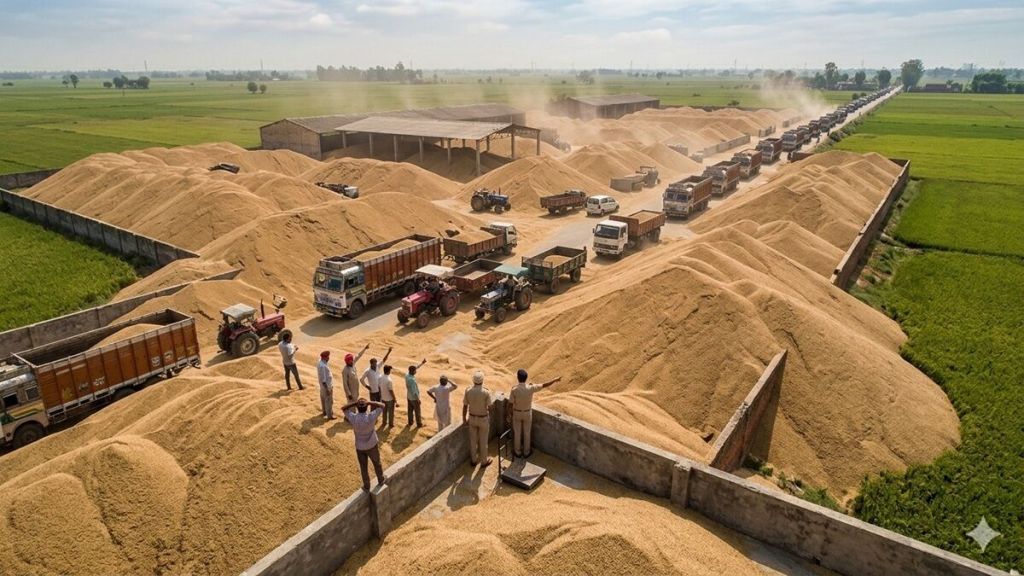

Punjab is among India’s leading grain-producing states, supplying a large share of wheat and paddy to the central pool. Yet, as the new paddy harvesting season begins, the state is again struggling to find space for fresh arrivals because stocks from the previous procurement cycle have not been fully cleared. With around 6 lakh tonnes (LT) of old rice still awaiting delivery and 17 LT of wheat occupying mills and mandi yards, Punjab faces the prospect of managing two procurement cycles at once, reported The Indian Express.
The report further says that the core issue is a mismatch between the volume of grain Punjab produces and the storage space available within the state. Punjab has about 175 LT of covered storage capacity across the Food Corporation of India (FCI), state procurement agencies and private facilities, along with 75 LT of plinth storage—an open-air platform mainly used for wheat, where rice cannot be stored in the same way.
Rice from earlier kharif cycles continues to occupy much of the covered space. As a result, 17 LT of wheat from the previous rabi season remains in rice mills and mandi yards, while 6 LT of rice from the earlier cycle is still pending delivery by mills.
Punjab handles roughly 300–320 LT of paddy and wheat annually. Without regular movement of grain to other states, the state cannot create enough room for the next procurement season.
2 procurement cycles overlap
Normally, government agencies procure paddy, which is stored in rice mills for custom milling before being delivered to the central pool as Custom Milled Rice (CMR). This year, the Centre has extended the CMR delivery deadline for the 2025–26 crop season to November 30, after the 2026–27 procurement season would have already begun.
This has created an overlap i.e, old paddy is still being milled and rice delivered to the government, even as fresh paddy arrives in mandis and is being allotted to mills. The backlog means mills and storage yards are handling both old and new stock simultaneously.
Punjab Chief Minister Bhagwant Mann has sought faster transportation of grain out of the state to create space, warning of possible law and order issues if the situation worsens. The state is targeting 180 LT of paddy procurement this season, compared with 156 LT last year, adding further pressure on an already strained system.
How much grain needs to move?
Rice millers and procurement agencies generally prefer to complete paddy milling by March 31, since prolonged storage through summer and monsoon increases the risk of infestation and deterioration. The Centre’s prescribed milling period usually runs from December 1 to June 30, though extensions are granted when stocks remain pending.
Even by June 30, Punjab would need to deliver about 120.6 LT of rice if it procures the targeted 180 LT of paddy. Over seven months, that works out to roughly 17 LT a month.
Against this requirement, the officials say current grain movement out of Punjab averages 11–12 LT a month, comprising both rice and wheat. The mix varies—sometimes roughly 50:50, at other times one-third rice—meaning the state is consistently falling short of the pace needed to clear stocks.
Why the crisis could worsen?
The immediate concern is that the backlog is carrying forward rather than being resolved. Old stocks are not moving out fast enough, while new paddy continues to arrive, creating a compounding overlap between seasons, The Indian Express report added.
Last year, milling continued until September. This year, the problem is more visible, with around 6 LT of previous-season rice still pending delivery and 17 LT of wheat occupying rice mills and mandi yards. Officials warn that if this trend continues, the overlap could double or triple in the coming years.
Both inadequate storage capacity and slow movement of grain are being blamed by FCI and state procurement officials. Building additional storage in Punjab is expensive because land rates are high, even though the state already has a substantial storage network.
“When both the Centre and state governments are aware of the amount of grain procured from Punjab, why not create additional storage capacity—if not in Punjab, then outside Punjab?” said a senior FCI official to The Indian Express. “Even if storage capacity is available in any part of the country, wheat can be transported directly from mandis to those locations. In the case of paddy, which is entirely housed by rice mills, the rice can be transported directly from mills to storage facilities elsewhere after milling.”
Officials point to Uttar Pradesh and Bihar, where land rates are comparatively lower and more storage facilities can be built. They argue that since Punjab produces largely for the national pool—around 80% of its wheat and almost all of its paddy goes to the central pool—the storage burden need not be concentrated in Punjab alone.
The suggested solution from the officials is to move grain faster to storage facilities outside Punjab, mill it on time and ensure timely delivery. This can help avoid storage problems from repeating during every procurement season.