


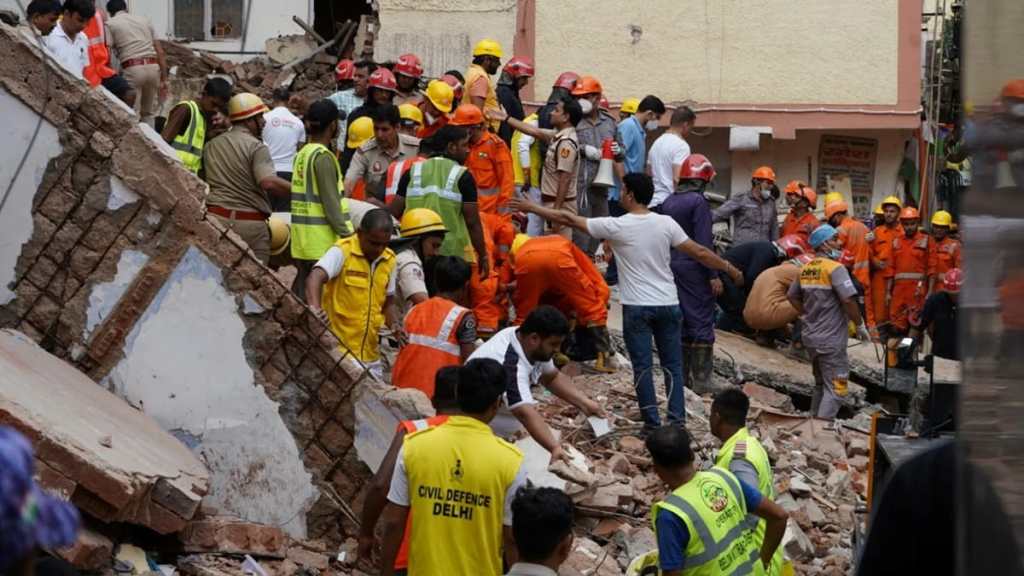

The collapse of a five-storey building in Delhi’s Satya Niketan has brought the city’s building enforcement and safety regime under scrutiny. Preliminary information has pointed out a combination of the structure’s age, unauthorised construction and work being carried out in its basement.
At least seven people have been confirmed dead, and more toll is feared as rescue teams continued searching the debris amid concerns that another labourer could still be trapped, The Indian Express reported.
The Delhi government has responded with a magisterial inquiry, an FIR against the building owner and directions to seal illegal five-storey buildings across the city. The Municipal Corporation of Delhi (MCD) has also begun identifying neighbouring structures considered dangerous, including issuing a three-day demolition notice for an adjacent property, The Indian Express reported.
Expressing deep concern over the safety of students living in PGs and hostels, the Delhi High Court on Monday directed MCD to conduct an audit of PGs and hostels within one week.
The responsibility for students’ safety lies not only with building owners but also with concerned authorities, the court said, observing that had the authorities properly discharged their statutory duties, such incidents may have been avoided.
What led to the collapse?
So far, there is no official determination of the precise cause of the collapse. However, preliminary statements from Delhi government officials have placed the spotlight on work reportedly being undertaken in the basement of the ageing structure, news agency ANI reported.
Delhi Environment Minister Manjinder Singh Sirsa said the building was around 40-50 years old and that attempts to carry out work in its basement may have triggered the collapse.
Speaking to reporters, Sirsa said, “The information received so far indicates that while this building was 40-50 years old, attempts were made to carry out work in its basement, which triggered this accident.”
Work involving excavation or alterations beneath an existing multi-storey structure can affect its foundations and the surrounding soil. If undertaken without appropriate structural assessment, engineering support and approvals, such work can potentially compromise the stability of an ageing building.
However, authorities have not yet established publicly what exactly was being done in the basement, who was carrying out the work, whether it had been authorised or whether it directly caused the structural failure.
Delhi Mayor flags negligence and construction quality
Delhi Mayor Pravesh Wahi also pointed towards possible negligence and structural weakness.
Speaking to ANI, Wahi said the building was old and that the incident appeared to be an accident. He said possible negligence or structural failure during the work, along with construction materials that may not have been of the required quality, could have caused the collapse.
This raises questions over whether the building had undergone additions or modifications over the years and whether its structural capacity was reassessed when its use or built-up area changed.
G+4 building, but permission was reportedly only for G+1
The MCD’s preliminary assessment raises a more fundamental issue. According to MCD officials, the collapsed structure was Property No. 14, a G+4 building constructed on around 55 square yards in a resettlement colony.
News agency PTI reported that the erstwhile permission for the property was only for a G+1 unit and that no building plan had been approved for the structure that ultimately stood there.
A lesson learnt from this incident is that a building, that is originally sanctioned for fewer floors, is not structurally capable of supporting additional levels. Additional construction changes the load carried by foundations, columns, beams and other structural elements.
The investigation will have to establish when the additional floors were constructed, who authorised them, whether any structural assessment was carried out and what role civic officials played in permitting or overlooking the construction.
Why the neighbouring building was served a demolition notice
The Satya Niketan building collapse has triggered scrutiny of other buildings in the immediate vicinity. On September 6, the MCD issued an order against Property No. 13 in Satya Niketan, directing its owner or occupier to demolish the structure within three days after it was found to be in a “ruinous and dangerous condition,” PTI reported.
The notice was issued under Section 348 read with Section 491 of the Delhi Municipal Corporation Act, 1957, by the Executive Engineer (Building)-I of the MCD’s South Zone.
The MCD warned that if the owner or occupier failed to comply within three days, the civic body would demolish the building itself and recover the cost from the owner as arrears of tax, ANI reported.
It should be noted that Property No. 13 is the neighbouring structure. The building that collapsed was Property No. 14, according to the MCD statement cited by PTI.
The demolition order represents one of the first tangible signs that officials are moving from investigating the collapsed building to removing other structures considered dangerous.
A girls’ PG also evacuated
The MCD had already evacuated occupants from another nearby building being used as a girls’ PG, after declaring it dilapidated. According to ANI, the tenants were moved to a nearby community hall, with the civic body also announcing plans to demolish the structure.
The bigger issue here is whether such buildings are being periodically assessed for structural safety after changes in occupancy, construction, floor area or internal layout.
Delhi orders crackdown on illegal five-storey buildings
The government has now ordered an enforcement drive.
The Delhi government has directed officials to immediately seal illegal five-storey buildings across the city.
Mayor Wahi said strict instructions had been issued to the MCD Commissioner and that any house found to have been constructed without an approved plan would be sealed.
Sirsa said officials in the chain of command would face action, while Chief Minister Rekha Gupta said government officials found responsible for negligence or lapses would not be spared.
Owner faces FIR and Look Out Circular
The response has also entered the criminal-investigation phase. An FIR has been registered against the owner of the collapsed building, while Delhi Police have issued a Look Out Circular against Hariram, the owner, who remains untraceable, according to ANI.
Police teams are conducting searches at multiple locations to trace and apprehend him. The investigation could potentially widen beyond the owner to examine the roles of contractors, builders, architects, structural engineers and workers involved in any construction or renovation.
The Delhi High Court PIL filed in connection with the incident has specifically sought an examination of these roles.
Delhi plans mandatory structural audits for PGs and other public-use buildings
The Satya Niketan collapse has also pushed the government towards a bigger policy response.
CM Rekha Gupta said the Delhi government is formulating a policy requiring periodic structural audits and safety certifications for buildings used for public activities, including PGs, nursing homes, schools and other facilities.
“Any building intended for public use-be it a PG, nursing home, school, or any other facility-must undergo periodic structural audits and safety certifications: otherwise, no public activity will be permitted there,” Gupta said, according to ANI.
She also said the government would not allow people to live in unsafe PGs and that students evacuated from the building had been provided alternative accommodation in college hostels.
Delhi High Court PIL seeks city-wide safety audit
On Monday, the issue reached the Delhi High Court. A PIL filed by Delhi University law student Aniket Kumar Gupta through advocate Umesh Kumar is seeking an independent inquiry into the collapse, a comprehensive safety audit of PGs and hostels and compensation for the victims, ANI reported.
The petition asks officials to examine whether the building complied with sanctioned plans and structural safety requirements and whether any unauthorised construction, additional floors, excavation, alteration of load-bearing structures or renovation work contributed to the collapse.
It also seeks a safety audit of PGs and hostels in major student hubs including Vijay Nagar, Kamla Nagar, Mukherjee Nagar, Gandhi Vihar, Nehru Vihar, Hudson Lane, Gurmandi, Karol Bagh, Old Rajendra Nagar and Laxmi Nagar.
Further, the petition is seeking Rs 1 crore compensation for the family of each deceased student, compensation for injured victims and job security for students who may have suffered disabilities.
Another proposed measure is a publicly accessible database listing inspected PGs and hostels, their structural safety certification and permitted use.
At present, the official data on buildings inspected by authorities, including those that have been sealed or demolished, is not publicly available.