


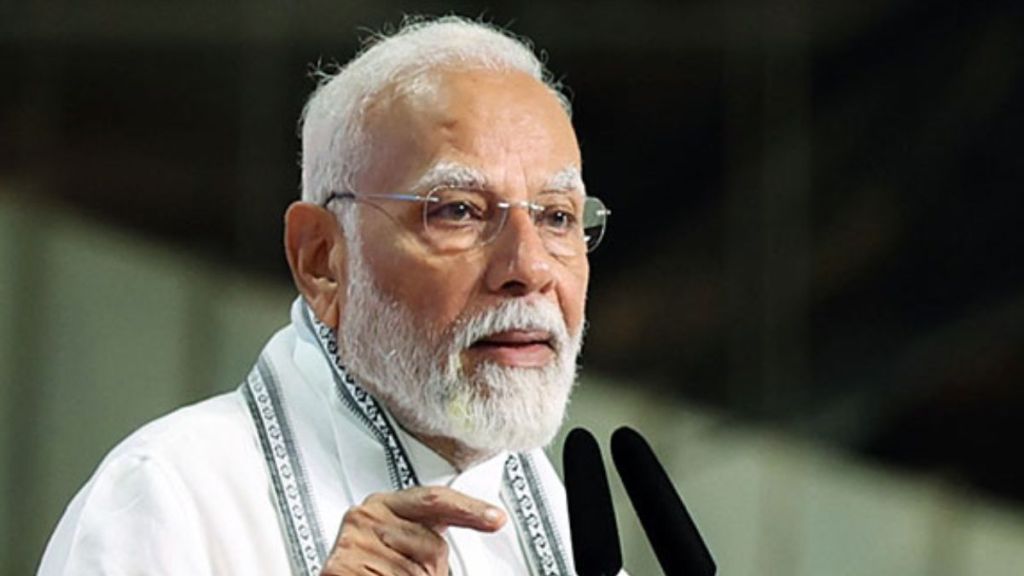

Prime Minister Narendra Modi on Wednesday marked 25 years in public office by setting out a series of ambitious goals for India, from becoming one of the world’s top three economies to hosting the Olympics and sending Indians deeper into space.
Addressing the ‘Seva Jyoti’ programme at the Indira Gandhi Indoor Stadium in New Delhi, Modi repeatedly used one phrase while listing the country’s future targets: “We will do it.”
“Viksit Bharat at 2047: We Will Do It. Top 3 Economy: We Will Do It. Atmanirbhar Bharat: We Will Do It. Global Manufacturing Hub: We Will Do It. Hosting the Olympics: We Will Do It. Footsteps in space: We Will Do It. This energy, this enthusiasm, this self-confidence is extraordinary,” he said.
The crowd also joined in the chant. The event marked 25 years since Modi first took oath as the Chief Minister of Gujarat on October 7, 2001. Senior leaders, dignitaries and thousands of party workers attended the programme.
‘This is not the time to rest’
Modi said India’s confidence and collective effort would be key to achieving its future goals. Referring to his call for “Sabka Prayas”, or collective effort, from the Red Fort, he said the confidence of the people itself had become a force.
“The enthusiasm and zeal needed to take India to new heights conveys just one message: we will do it, We Will Do It. No nation whose people have such confidence coursing through their veins like blood can be stopped,” he said.
Modi also referred to the recent attention around Indian pilot Capt Machchhar and said India must aim for a future where aircraft made in the country are known across the world.
“Today there is a talk about the Indian pilot across the globe. A day will come and indeed it will, when the world will speak of ‘Made-in-India’ plane,” he said.
“These goals can only be achieved if we formulate visionary policies while also putting in the utmost hard work…This is not the time to rest; it is the time to move forward with zeal and dedicate ourselves fully to the nation,” he added.
The Prime Minister acknowledged that India still faces several problems but said the country has the people and the young population needed to deal with them.
“There are problems in our country, but we also have 140 crore solutions,” he said.
He added that India’s youth have “a huge opportunity” and said his efforts were aimed at ensuring that the hardships faced by earlier generations do not have to be faced by children today.
‘This is not about personal glory’
Despite completing 25 years at the top of government, Modi said he did not see the milestone as a personal achievement.
“As the head of the government, people regard this 25-year continuous journey as an achievement. But, for me, this is not a matter of personal glorification, nor is it the occasion for it,” he said.
Looking back at his journey, Modi recalled that 25 years ago, at the age of 50, he had been working among tribal communities in forests and living in the mountains before moving into organisational work in the Bharatiya Janata Party.
“25 years ago, at the age of 50, I had spent my time serving tribal communities in the forests and living amidst the mountains, eventually choosing the path of organisational work within the Bharatiya Janata Party. My political report card reflected only the work of an organisational worker. I had been involved in elections, yet I had never contested one myself,” he said.
Modi said electoral politics had never been his main ambition.
“Had I desired to shine in electoral politics, I could have entered the arena long ago; but that was not my temperament. I never even stopped to consider what I would become in life or what my future held,” he said.
Instead, he said the values he received while growing up taught him to work towards a larger purpose.
“The upbringing and values instilled in me since childhood taught me to live my life for a mission, not for personal ambition,” he said.
‘This experience belongs to the nation’
Modi described his 25 years in public life as a responsibility and a public trust rather than a personal accomplishment.
“The nation has given me a great deal. Therefore, my responsibility towards the nation is the greatest as well. And I sincerely believe that every citizen of the nation has the foremost claim on me,” he said.
“This 25 years of public trust, this 25 years of experience is a tremendous asset. And this asset does not belong to Modi alone; this asset belongs to the nation. Every child of Mother India is entitled to this asset,” he added.
He also credited grassroots workers for supporting him throughout his journey.
“I have never felt that I am alone. There are countless swayamsevaks who are guardians of India’s cultural soul, with one sole purpose: to serve Bharat,” Modi said.
“They live by this spirit and remind themselves every moment: ‘We are sevaks. We are servants of humanity.’ I respectfully salute every Swayamsevak and Karyakarta who continues to serve the nation with commitment and devotion,” he added.
‘My critics taught me to look within’
Looking back at the people and experiences that shaped his journey, Modi said he was filled with gratitude, including towards those who criticised him.
“I am grateful to every person and every experience that taught me something. Those who taught me taught me humility. Those who brought me down taught me how to rise again. My supporters encouraged me, while my critics taught me to look within. Those who stood by me showed me the power of trust,” he said.
He said even opposition and difficult moments had played a role in his journey.
“Whoever supported me showed me the strength of belief; whoever opposed me, taught me the power of democracy. Every crisis was a test of my patience, every crisis expanded my sense of responsibility. Everything I accomplished gave me the strength, courage to move towards larger goals,” he said.
‘12 years later, the picture has changed’
Modi then looked back at 2014, when he became Prime Minister and took on the role of what he described as the country’s “Pradhan Sewak”.
He said India was facing serious economic and political challenges at the time, with people looking for a new direction.
“The nation was confronting immense challenges…all round, only problems were visible. Each citizen was seeking a new path. Regarding Bharat’s economy, the world had begun saying ‘it’s a gone case’…growth was nowhere to be seen,” he said.
“A nation facing severe disappointment needed a new confidence. I responded by doing the only thing that I know — I urged the janshakti, repeated to them: ‘we will do it’…and today, 12 years later, the picture has changed entirely,” he added.
Modi said India’s response to crises had also changed. “When a crisis used to emerge then, India’s economy used to face jolts. When a crisis comes now, Bharat’s perseverance is discussed. Its resilience is discussed,” he said.
“Back then, policy paralysis used to be discussed; now the reforms express is discussed. Back then, new avenues of imports used to be discussed; today records of exports are established,” he added.
He also pointed to India’s growing mobile phone manufacturing sector. “Back then, we used to import mobile phones even for our own use, now, there is jalwa of made in India mobile phones,” Modi said.
The Prime Minister ended his speech by highlighting his pride in India’s history and culture.
“That we have been born in this timeless land is Amrit itself…high office can be attained anywhere, but there is no sacred land such as Bharat,” he said.