


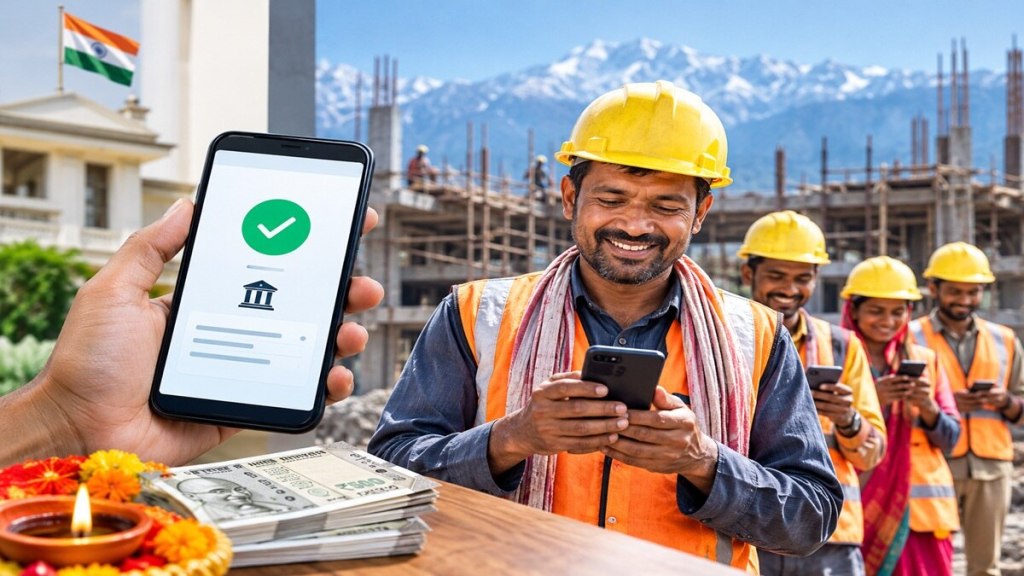

A total of Rs 18.49 crore has been transferred directly into the bank accounts of 10,709 eligible construction worker families in Uttarakhand under various welfare schemes of the Uttarakhand Building and Other Construction Workers Welfare Board.
The amount was disbursed through Direct Benefit Transfer (DBT) at a programme held at the Chief Minister’s residence in Dehradun, just ahead of the festive season.
Uttarakhand Chief Minister Pushkar Singh Dhami oversaw the transfer, with the state officials pitching the welfare move as a “festive gift” to registered building and other construction workers. The state government said the focus is on ensuring that funds reach eligible families in a simple, transparent and time-bound manner.
उत्तराखण्ड भवन एवं अन्य सन्निर्माण कर्मकार कल्याण बोर्ड द्वारा संचालित विभिन्न कल्याणकारी योजनाओं के अंतर्गत 10,709 पात्र लाभार्थियों के बैंक खातों में ₹18.49 करोड़ की सहायता राशि हस्तांतरित की।
साथ ही संबंधित अधिकारियों को निर्देश दिए कि श्रमिक कल्याण योजनाओं का व्यापक… pic.twitter.com/lRQsPde3qb
— Pushkar Singh Dhami (@pushkardhami) September 19, 2026
Who got what from the Rs 18.49 crore
The state government officials told the Chief Minister that the latest DBT round covered four main categories of support:
- 95 beneficiaries received maternity assistance.
- 177 beneficiaries received post-death assistance for families of workers who died.
- 2,354 beneficiaries got assistance for daughters’ marriage.
- 8,083 beneficiaries received educational assistance for their children.
Taken together, 10,709 workers’ families received financial help in this tranche, with the entire amount credited directly to their bank accounts.
‘Construction workers key to state’s development’
At the event, CM Dhami said construction workers play a crucial role in Uttarakhand’s development and that the government is committed to ensuring their families get benefits related to education, healthcare, nutrition and social security.
“Construction workers play an important role in the development of the state,” he said, adding that the administration must ensure that “benefits of welfare schemes reach every eligible worker family” in a simple and transparent way.
He directed officials to coordinate with the Health Department so that any worker found to be ill during health screenings gets proper treatment, and asked for regular monitoring of eligibility verification and district-wise coverage to ensure that even workers in remote areas are not left out.
Notably, an earlier audit highlighted gaps in Uttarakhand’s construction worker welfare system. The Comptroller and Auditor General (CAG), in a report covering 2017-22 and tabled in February 2025, found incomplete worker registration, wrongful inclusion and exclusion of beneficiaries, delays in delivering assistance and inadequate eligibility checks.
It also flagged shortcomings in inspections concerning wages, safety and working conditions at construction sites. These findings relate to an earlier period and do not establish problems with the latest transfer.
Beyond cash: Kits, health tests and an integrated welfare model
The meeting reviewed a broader integrated welfare model being run by the Uttarakhand Building and Other Construction Workers Welfare Board for construction worker families.
So far, the Board has distributed:
- 33,429 educational material kits
- 26,674 hygiene kits
- 23,216 nutrition kits
This takes the total number of kits distributed to 83,319.
On the health front, under the Shramik Health Scheme, the state has conducted:
- 20,527 health screenings of workers
- 2,32,281 health tests
CM Dhami said he was satisfied with the progress of the Mukhyamantri Shramik Health Scheme, noting that regular screenings have helped in the early detection of some serious illnesses.
Mobile medical units at work sites
A key part of the health push is the use of Mobile Medical Units that visit workplaces to provide health check-ups, consultations and referral services to workers.
This model was presented at the National Building and Other Construction Workers Conference in Mumbai, where it received appreciation at the national level. Representatives from West Bengal, Delhi, Madhya Pradesh and Chhattisgarh have expressed interest in adopting Uttarakhand’s approach in their own states.
The state government officials described the mobile unit initiative as a scalable and replicable model that other states can use to reach workers where they actually work, instead of expecting them to travel to hospitals or clinics.
LCCMS and a 47% jump in cess collection
Funding for these welfare measures comes largely from the Labour Cess Collection Management System (LCCMS), a digital platform that tracks construction projects and collects the 1% cess on construction cost mandated under the Building and Other Construction Workers Act.
Officials said 21,200 establishments have registered online through LCCMS, while cess collection has risen 47.21% since its rollout. The system also won the SKOCH Gold Award for e-Governance in 2025 and was featured in the Government of India’s Best Practices Compendium. It is now being promoted as a digital governance model that other states can adopt.
For thousands of construction worker families in Uttarakhand, the Rs 18.49 crore is more than just a number. It will be used to pay school fees, cover marriage costs, support families after a death, and help during maternity. By sending the money directly through DBT, the state government says it is removing middlemen and cutting delays and leakages.
At the same time, the state is building a wider support system. Cash help is being combined with education kits, hygiene and nutrition kits, regular health check-ups, and medical care at work sites.