


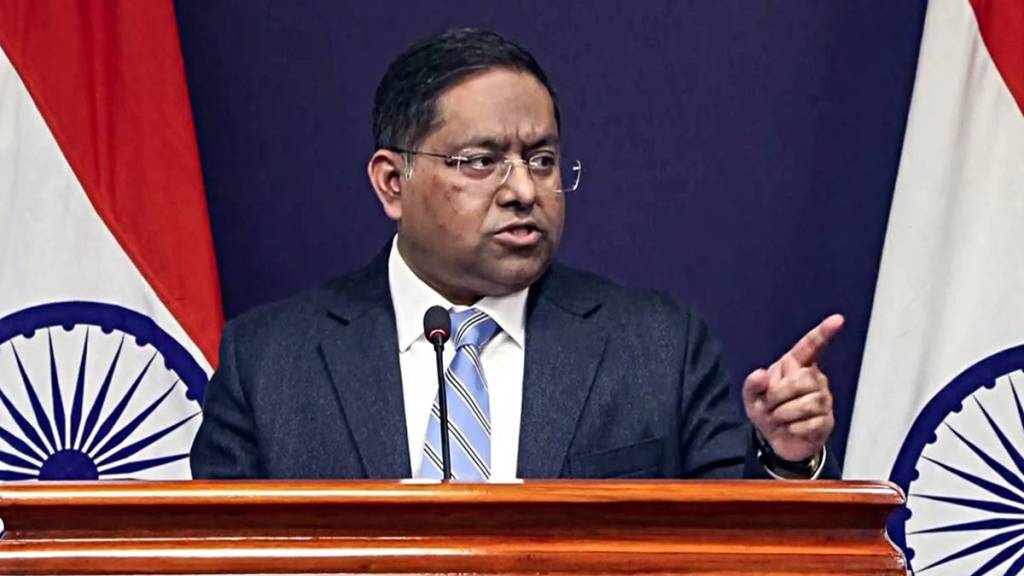

Ministry of External Affairs (MEA) spokesperson Randhir Jaiswal on Friday said the US suspension of the Permanent Labour Certification (PERM) programme for certain companies would not, by itself, affect the validity of existing H-1B visas or the status of their holders and dependents. However, he said that the move could affect the green card process for eligible employees of the companies concerned.
Jaiswal also called US Vice President JD Vance’s description of foreign workers “deeply offensive”, saying it ignored the contribution of Indian professionals to the American economy and innovation ecosystem.
“The suspension of PERM applications does not, by itself, affect the validity of H-1B visas or the status of H-1B visa holders and their dependents,” Jaiswal said during the MEA’s weekly media briefing.
He added that “there could be some impact on the permanent-residency or Green Card process of eligible employees of the affected companies”.
The remarks came a day after the US Department of Labor suspended Microsoft, Adobe and several major IT services companies from the PERM programme. US officials cited alleged misuse of foreign-worker programmes and said the action aimed to encourage companies to hire more American workers.
What did India say about PERM suspension?
Jaiswal said that PERM and the H-1B visa programme are separate. PERM is a labour certification process that employers generally need to complete before filing petitions for most employment-based green cards. The H-1B programme allows US employers to hire foreign professionals for specialised jobs.
The US Labor Department said it would not accept new or process pending permanent labour certification applications involving the companies covered by the decision. Labor Secretary Keith Sonderling named Cognizant, Infosys, Tata, Wipro, HCL and Capgemini, along with Microsoft and Adobe.
“We will not accept any new or process any pending permanent labor certification applications involving these companies,” Sonderling said, according to Reuters report.
Sonderling also claimed that the companies had collectively sought almost three million foreign workers since 2009. He said they had received more than 230,000 H-1B visa approvals and over 100,000 permanent labour certifications.
The MEA’s clarification means the suspension does not automatically invalidate existing H-1B visas or change the status of their holders and dependents. The ministry said the possible effect concerns the permanent-residency process for eligible employees of the affected companies.
What MEA said about Vance’s remarks
Jaiswal said Vance’s comments failed to recognise the contribution of Indian professionals to the United States. “We believe that such descriptions are unwarranted and ignore the fact that Indian professionals in the United States are highly educated and skilled contributors to its economy and innovation ecosystem,” he said.
Vance used the phrase “foreign indentured servants” while accusing Microsoft of laying off American workers while benefiting from H-1B visas and green cards. He argued that companies operating in the US should prioritise American employees.
The MEA also referred to the role immigrants have played in US economic development. “Indeed, the history of the United States itself has been shaped by generations of immigrants whose labour, enterprise, and innovation have contributed to its growth and prosperity,” Jaiswal said.
He added, “Resorting to terminology that carries painful historical and colonial legacy connotations is deeply offensive.”
India also argued that the movement of skilled professionals benefits both countries. Jaiswal said talent mobility supports innovation, research, productivity, competitiveness and job creation in the United States, while creating opportunities for Indian professionals. “Talent mobility adds value to both economies,” he said.
The MEA said the suspension did not advance the shared ambitions of India and the United States. It added that the government would continue to follow developments concerning the issue.