


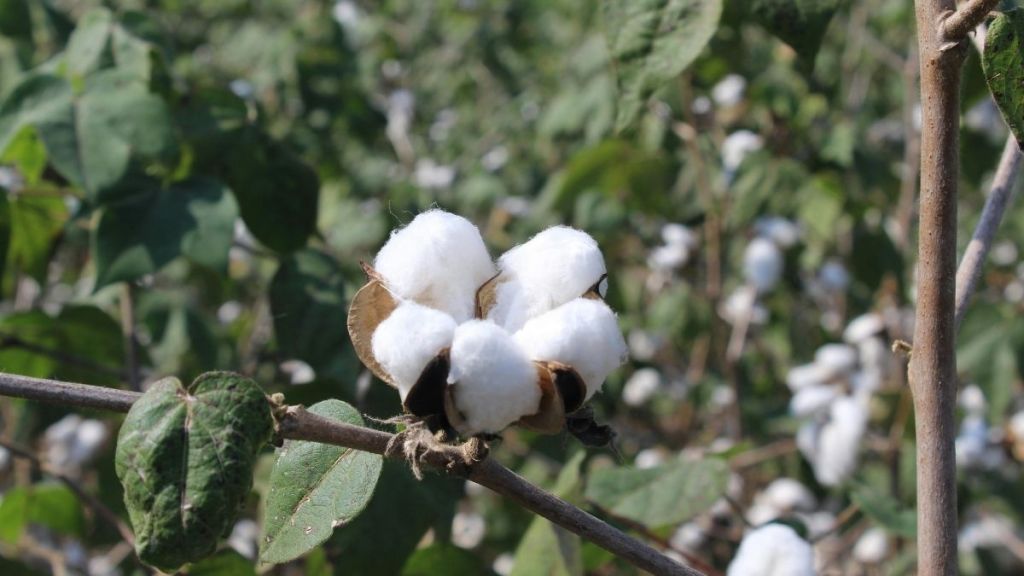

At least 30% of India’s cotton-growing area may have been planted with “illegal” genetically modified (GM) hybrids during the 2025-26 season, according to a new field-based study cited by Indian Express.
The study estimated that 26.2 lakh to 29 lakh hectares, or about 24% to 30% of India’s total cotton area, may have carried GM traits that have not been approved by the government. India had 114.8 lakh hectares under cotton cultivation in 2025-26.
The study was commissioned by the Federation of Seed Industry of India (FSII) and the National Seed Association of India (NSAI), with field research conducted by the Jodhpur-based South Asia Biotechnology Centre (SABC).
What did the cotton study find?
Researchers collected 227 geo-tagged seed and leaf samples from fields belonging to 984 farmers across 16 districts in Maharashtra, Telangana, Andhra Pradesh and Rajasthan, reported Indian Express.
The districts were selected as “hotspots” using indicators including glyphosate sales, farmer discussions and seed-market intelligence.
The samples were tested using dipstick or lateral-flow assays and ELISA tests to identify GM traits.
The most widespread trait was cp4-epsps, an herbicide-tolerance gene. It was detected in 72.69% of the 227 samples.
The figure was highest in Telangana at 88.64%, followed by Maharashtra at 70.92%, Andhra Pradesh at 62.86% and Rajasthan at 57.14%.
The study also detected Vip3A, an insect-resistance gene, in 53.74% of the samples. The state-wise figures were 58.16% in Maharashtra, 54.29% in Andhra Pradesh, 57.14% in Rajasthan and 38.64% in Telangana.
Bhagirath Choudhary, director of the South Asia Biotechnology Centre, said the results indicated widespread adoption of the technology for weed and pest management despite the lack of government approval, as reported by Indian Express.
Importantly, the 53.74% and 72.69% figures apply to the 227 targeted samples, not to all cotton fields in India.
Which GM cotton is legal in India?
India currently permits cotton hybrids containing two Bt genes – cry1Ac and cry2Ab. These genes come from “Bacillus thuringiensis” and produce proteins that help protect cotton plants against certain bollworm pests.
The study focuses on additional traits that have not received government approval, particularly cp4-epsps and Vip3A, reported Indian Express. The cp4-epsps gene gives cotton tolerance to glyphosate, a widely used herbicide.
Normally, spraying glyphosate across a cotton field can kill both weeds and cotton plants. Cotton carrying the herbicide-tolerance trait can survive the spraying, allowing farmers to control weeds without manually removing them.
Vip3A is an insect-resistance trait that the study associates with attempts to tackle pink bollworm, a pest that has become more difficult to control with some existing Bt cotton hybrids.
The Indian Express reported that neither cp4-epsps nor Vip3A has been approved by the government for use in cotton or other crops.
Why are farmers using unauthorised seeds?
Manual weeding can cost around Rs 12,000- Rs 15,000 per acre, according to the study.
Glyphosate spraying, by comparison, can cost farmers about Rs 750-Rs 850 per acre for two or three applications during a season, Choudhary said, as reported by Indian Express.
That creates a significant incentive for farmers to use herbicide-tolerant cotton. “Farmers have decisively shifted towards glyphosate-based weed management enabled by (illegal) HTBt cotton technology,” Choudhary said, as reported by Indian Express.
For farmers cultivating several acres, the difference can run into thousands of rupees. The attraction is therefore not simply the GM technology itself. The study links adoption to labour shortages, weed-control costs and pest pressure.
How large is the unauthorised seed market?
The study found several signs that the market for unauthorised HTBt cotton has expanded. Sales of approved Bt cotton hybrid seeds fell from 596 lakh packets in 2022-23 to 463 lakh packets in 2025-26, reported Indian Express.
Over the same period, glyphosate imports increased. The study said imports rose 29%, from 27,721 kilolitres in 2024-25 to 35,642 kilolitres in 2025-26, as reported by The Indian Express.
Researchers estimated that the unauthorised HTBt seed market increased from about 35 lakh packets in 2017-18 to 82-88 lakh packets in 2025-26.
At an average price of Rs 1,000 per packet, they estimated the market at around Rs 820 crore-Rs 880 crore, reported Indian Express.
The other major finding involves Vip3A, an insect-resistance gene. India’s approved Bt cotton traits have faced increasing pest-resistance concerns, particularly involving pink bollworm. The study links the demand for Vip3A-containing hybrids to this problem.
Vip3A works differently from the cry1Ac and cry2Ab genes used in India’s approved Bt cotton. The study detected Vip3A in more than half of its 227 samples.
However, this does not mean more than half of India’s cotton crop contains Vip3A. The samples were deliberately collected from districts identified as hotspots for unauthorised GM cotton.
The national estimate of 24%-30% comes from the researchers’ wider assessment using the field findings and other market information, as reported by Indian Express.