


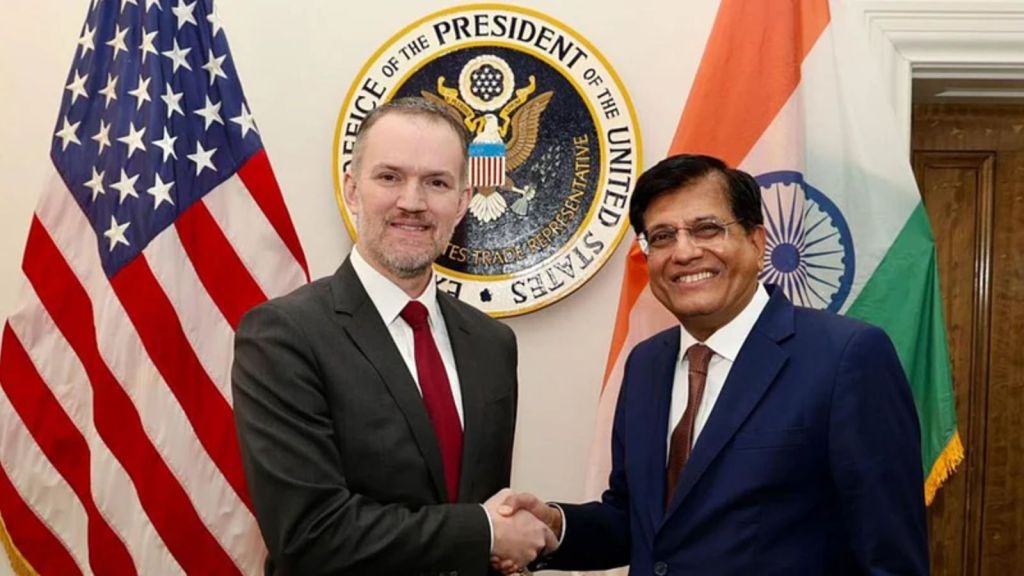

India and the United States may have reached the final stretch of their trade negotiations, but a formal agreement is unlikely to happen soon. On Thursday, the United States Trade Representative (USTR) Jamieson Greer said that the two countries were in the “final phase” of negotiations. However, he also said that the signing of the deal was “not imminent”, as both sides continued to work through a number of unresolved issues.
The comments came a day after Greer met Commerce and Industry Minister Piyush Goyal and appeared to contradict the earlier impression that the two countries had already settled most of the terms.
India and the US agreed on a framework for a bilateral trade agreement in February. Since then, Indian officials have maintained that negotiations progressed substantially, with New Delhi also seeking comparatively lower tariffs before the final deal is signed.
What did India and the US agree on in February?
The February framework was intended to provide the broad contours of a wider bilateral trade agreement.
Under the framework, India said it intended to purchase around $500 billion worth of US products over the next five years. These purchases could include energy products, aircraft and aircraft parts, precious metals, technology products and coking coal.
The two countries also agreed to work towards stronger economic-security cooperation, including measures related to supply-chain resilience, innovation, investment reviews and export controls.
However, the framework was not the same as a completed trade agreement.
Several politically and economically sensitive issues still needed resolution, including the tariff structure, market access and the broader commitments India would have to make.
Why US said a deal is ‘not imminent’?
Greer said the two sides had identified the “universe of items” that remained sticking points and were working to resolve them.
He also indicated that US President Donald Trump and Prime Minister Narendra Modi could speak soon to review progress.
For India, tariffs remain a key concern. New Delhi has been seeking better tariff treatment than some of its major Asian competitors, including ASEAN economies and China.
For Washington, the negotiations extend beyond simply reducing tariffs on goods. Issues such as digital trade, market access and economic-security alignment have also become part of the discussion.
The Russia factor complicates the negotiations
One of the biggest uncertainties comes from the US’ approach towards countries buying Russian energy.
In February, the US agreed to remove an additional 25% tariff imposed on Indian imports in recognition of India’s commitment to stop purchasing Russian oil.
But Washington has since introduced another potential source of tariff pressure.
Last month, US President Donald Trump signed into law the Lindsey O. Graham Sanctioning Russia and Iran Act of 2026, which provides for tariffs of up to 100% on imports from key buyers of Russian energy, including India.
This has created another layer of uncertainty for Indian exporters.
Unlike the earlier US tariff mechanism under the International Emergency Economic Powers Act, which the US Supreme Court struck down, the new Russia-related tariffs cannot be challenged in court.
For India, this makes the eventual tariff burden difficult to predict even as negotiations on the trade agreement continue.
Another tariff threat is hanging over Indian exports
India is also awaiting the outcome of a US investigation under Section 301 of the Trade Act of 1974. The investigation is expected to examine whether India has excess industrial capacity and whether Indian production is hurting American companies.
The earlier round of Section 301 tariffs resulted in a 10% tariff.
Any additional tariffs could complicate negotiations further, particularly if imposed before the broader trade agreement is finalised. For Indian exporters, the uncertainty is already affecting business decisions.
Exporters have said US buyers are increasingly avoiding large bulk orders and are diversifying their sources of imports. If this continues, Indian companies could face weaker export orders until there is greater clarity on the tariff regime.
India pushes back on the ‘excess capacity’ argument
India has also rejected the suggestion that its manufacturing sector suffers from structural excess capacity.
During his US visit, Goyal argued that India’s manufacturing capacity serves both domestic and international markets.
He also said India shares the concerns of several G20 countries about trade-distorting support in some economies, which can result in dumping and predatory pricing.
India, he said, addresses such practices through evidence-based measures under World Trade Organization rules, including anti-dumping and countervailing duties.
This is an important point in the negotiations because Washington’s concerns about industrial capacity could potentially lead to demands for additional commitments from India.
Is the proposed deal tilted towards the US?
Another contentious issue is the scale of India’s proposed purchases from the US.
India’s February commitment to purchase $500 billion worth of American products over five years covers sectors such as energy, aircraft, technology and coal.
But experts have pointed out that the framework does not contain a comparable commitment from the US to purchase Indian products.
This raises concerns about whether the eventual agreement could create an uneven balance of commitments.
India’s objective is not merely to increase imports from the US but to secure greater access for its own exporters in areas where Indian businesses are competitive.
The final tariff structure will therefore be crucial in determining whether the agreement delivers a more balanced expansion of bilateral trade.
Could the US be asking for more than tariff concessions?
The negotiations may also be moving beyond traditional trade issues.
The February framework included a commitment to strengthen “economic security alignment” between the two countries. This could involve cooperation on supply chains, investment screening and export controls.
That language has raised concerns among some trade experts about the extent to which India may have to align its economic and foreign-policy decisions with Washington.
One trade expert cited in the discussion warned that if India were required to accept provisions similar to those included in US reciprocal trade agreements with other countries, it could constrain India’s policy autonomy in areas including foreign policy and trade.
This is potentially one of the most sensitive aspects of the negotiations because it goes beyond the question of tariffs.
What about India’s investment rules?
The US has also raised concerns about India’s broader investment environment.
In an investment climate report on India released last month, the US State Department flagged restrictions under India’s Foreign Exchange Management Act (FEMA) involving foreign direct investment and foreign portfolio investment.
The report argued that these rules can create additional restrictions for investment funds within the same group, including their participation in initial public offerings.
The US also raised concerns about taxation of foreign banks in India.
According to The Indian Express report, foreign banks face an effective tax rate that is 4.63 percentage points higher than that paid by domestic banks, with the effective rate for foreign banks at 38.22%.
Washington argues that such differences could affect the attractiveness of India as a market for foreign lenders and influence their decisions on capital allocation and local operations.
These concerns illustrate why the negotiations cannot be viewed simply as a discussion over the tariff charged on Indian goods entering the US.
Why does India have limited room to manoeuvre?
India is negotiating from a position where access to the US market is important for several export-oriented industries.
At the same time, New Delhi has strategic reasons to protect its ability to determine its own trade, investment and foreign-policy choices.
The Russia issue makes the equation more complicated. India has maintained important energy ties with Russia, while Washington has increasingly used tariffs and sanctions to pressure countries over their purchases of Russian energy.
India therefore has to balance three competing objectives: protecting its exporters from high US tariffs, securing better market access and retaining policy flexibility.