


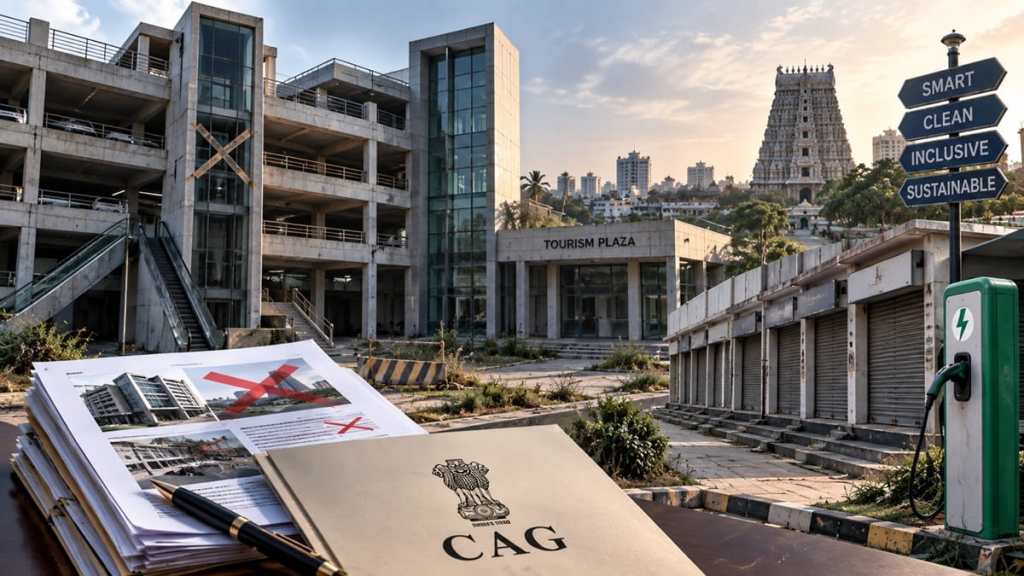

The implementation of the Smart Cities Mission (SCM) in Tamil Nadu has come under scrutiny from the Comptroller and Auditor General of India (CAG), which flagged unplanned projects worth Rs 623.86 crore, assets costing nearly Rs 116 crore lying idle or underutilised like the Special Purpose Vehicles (SPVs) set up to implement the programme.
The findings were part of a performance audit of the Smart Cities Mission in the state, with the report tabled in the Tamil Nadu Assembly on September 9.
According to the CAG report, the SPVs established for the mission lacked the operational independence prescribed under SCM guidelines and, in several cases, effectively functioned as funding channels for routine works undertaken by Urban Local Bodies (ULBs).
In its report tabled on September 8, the CAG report, noted that the audit found 70 projects involving expenditure of Rs 655.43 crore were executed outside the approved Area-Based Development (ABD) zones. In addition, as many as 44 unplanned projects costing Rs 623.86 crore were taken up across the sampled cities, including 21 projects that were executed entirely outside ABD limits.
SPVs lacked financial and operational autonomy
The Smart Cities Mission envisaged SPVs as independent entities responsible for planning, approving, implementing and monitoring projects in selected cities.
However, the CAG found that the SPVs in Tamil Nadu did not have the level of autonomy envisaged under the mission framework.
Their paid-up capital was limited to Rs 10 lakh, against the Rs 200 crore prescribed under the guidelines.
The CAG report also found that full-time chief executive officers had not been appointed in six of the seven sampled cities. Municipal commissioners continued to perform the role, creating additional responsibilities and, according to the audit, affecting the operational independence of the SPVs.
As a result, the SPVs largely financed projects proposed by ULBs rather than functioning as autonomous entities overseeing the mission’s planned investments.
Rs 624 crore spent on unplanned projects
The audit has identified spending on projects that were not part of the approved plans. Across the sampled cities, 44 unplanned projects worth Rs 623.86 crore were taken up.
Of these, 21 projects were executed completely outside the ABD areas designated for Smart Cities Mission investments.
The CAG also found that 70 projects, with expenditure of Rs 655.43 crore, were implemented outside the approved ABD zones.
The findings raise questions over the extent to which Smart Cities Mission funds were used for projects within the geographical and planning framework originally approved under the programme.
Tirunelveli diverted EV project funds
The audit cited Tirunelveli as one example of the diversion of funds from planned Smart Cities Mission projects.
The city’s SPV dropped a proposed Rs 8.25-crore electric vehicle project and instead diverted Rs 16.50 crore towards the procurement of street sweepers and jet-rodding machines for the city corporation.
The audit also found instances in which funds earmarked for administrative and office expenses were used for purposes including clearing corporation electricity dues, paying staff salaries and purchasing vehicles.
Rs 115.92 crore commercial assets remain idle
The CAG also noted the problems with assets created with the expectation that they would generate revenue and contribute to the financial sustainability of the SPVs.
Multi-Level Car Parking (MLCP) facilities and commercial complexes constructed across four cities at a cost of Rs 115.92 crore could not be put to full use.
According to the audit, incomplete installation of facilities such as lifts, automation systems and access ramps prevented these assets from being fully operational.
These facilities’ underutilisation has affected their ability to generate the revenues anticipated when the projects were taken up.
Madurai tourism plaza remains unused
In Madurai, a tourism plaza constructed at a cost of Rs 2.62 crore remained idle and unmaintained for more than three years, the CAG found.
It is reportedly said that the asset was intended to serve as part of the city’s Smart Cities Mission infrastructure but had not been put to effective use during the period examined by the audit.
Only 39 of 202 Salem shops leased
The audit also pointed to poor utilisation of commercial space created as part of redevelopment projects. In Salem, the redevelopment of the Old Bus Stand was undertaken at a cost of Rs 104.53 crore.
However, only 39 of the 202 shops created as part of the redevelopment had been leased out, according to the CAG.
The low level of occupancy meant that a huge portion of the commercial space was not generating the expected revenue.
Rs 57.72 crore revenue not credited to SPVs
The CAG further flagged the treatment of revenue generated by completed Smart Cities Mission assets. A total of Rs 57.72 crore in revenue generated from completed smart city assets was retained by the municipal corporations instead of being credited to the respective SPVs.
The audit said this affected the long-term financial viability of the SPVs.
The mission’s SPV structure was intended to provide cities with an institutional mechanism to manage projects and build sustainable revenue streams. Retention of project-generated revenue outside the SPVs weakened that financial model, according to the audit findings.