


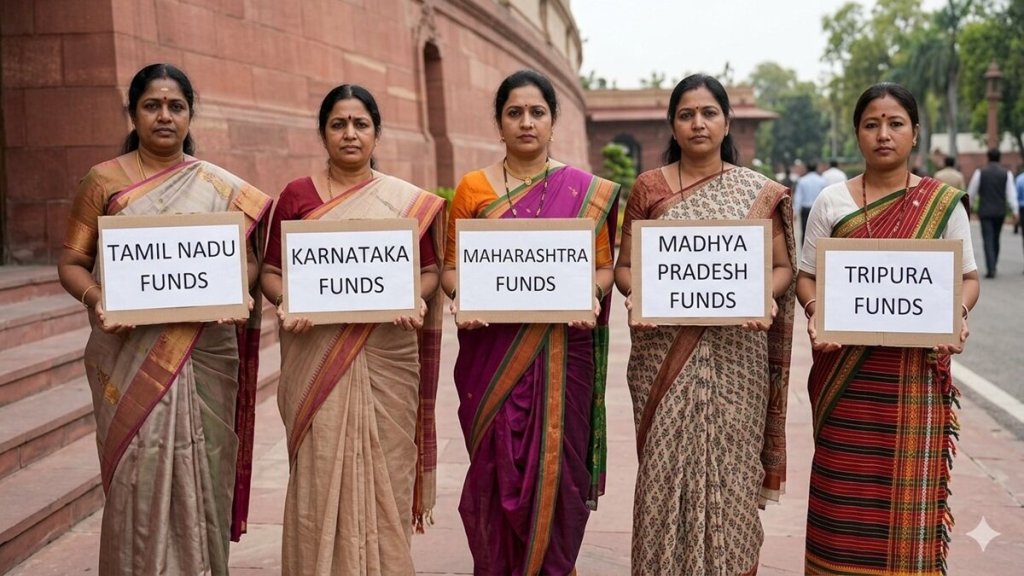

At least five states cutting across party lines have asked the Centre to urgently release funds for India’s flagship urban livelihood programme, warning that the absence of a successor scheme is putting at risk self-help groups (SHG), bank credit linkages and field staff serving more than one crore urban poor women.
Tamil Nadu, Karnataka, Maharashtra, Madhya Pradesh and Tripura have separately written to Prime Minister Narendra Modi and the Ministry of Housing and Urban Affairs (MoHUA), according to a report published by The Indian Express on October 14. The states say that the end of the Deendayal Antyodaya Yojana-National Urban Livelihoods Mission (DAY-NULM) in October 2024, followed by an inconclusive pilot, has left them without clear financial support.
What the states are asking
The states are seeking the release of pending central funds and clarity on how to continue operations until a new mission is approved. Tamil Nadu has sought Rs 350 crore for 2026-27, Maharashtra Rs 80.99 crore, Madhya Pradesh Rs 101 crore and Tripura Rs 6.5 crore, The Indian Express reported.
Karnataka has raised a narrower but immediate concern: whether it can use Rs 4.48 crore released for the pilot in Bengaluru to pay staff salaries. The state told the ministry that no funds were available for salaries from July 2025 onwards and sought guidance on using the pilot implementation fund for this purpose.
The appeals cut across party lines as Tamil Nadu is governed by Tamilaga Vettri Kazhagam (TVK), Karnataka by the Congress, while Maharashtra, Madhya Pradesh and Tripura are Bharatiya Janata Party (BJP)-ruled.
A decade-old programme in limbo
DAY-NULM ran from 2014 to September 30, 2024, as the successor to the UPA-era Swarna Jayanti Shahari Rozgar Yojana. It created 10.02 lakh women’s self-help groups in cities, covering about one crore women, and provided each group a Rs 10,000 revolving fund, training, interest subvention on bank loans and support for micro-enterprises.
In a Rajya Sabha reply cited by The Indian Express, MoHUA said that, as on September 30, 2024, over one crore urban poor women had been brought into SHGs, more than 39.43 lakh livelihoods had been created through skill training and placement, and over 6.56 lakh SHGs had received bank linkage.
After DAY-NULM ended, the ministry launched a pilot called Deendayal Jan Aajeevika Yojana-Shehari (DJAY-S) from October 1, 2024, in 25 cities across 13 states. The pilot focused on six vulnerable occupational groups: gig workers, transport workers, construction workers, waste workers, care workers and domestic workers.
The pilot was expected to form the basis of a new national scheme. But sources told The Indian Express that it is no longer under consideration, leaving states uncertain about the future of the programme and its workforce.
Tamil Nadu seeks Rs 350 crore
Tamil Nadu Chief Minister C Joseph Vijay’s government has made the largest demand. In a letter to the Prime Minister on August 27, the state said NULM funds had been completely exhausted as of April 2025 and sought Rs 350 crore for 2026-27.
Tamil Nadu has 1.72 lakh SHGs with 18.70 lakh members under the mission. Chennai and Tiruppur were among the pilot cities, where the state said around 1.26 lakh vulnerable occupational families were identified and about 2,500 SHGs were formed.
“Promotion of the self-help group activities in urban areas is indispensable for realising the objectives of the Urban Livelihood Mission and ensuring sustainable livelihood opportunities, financial inclusion and social protection for the urban poor,” the Chief Minister wrote, according to The Indian Express.
The state argued that continued assistance was needed to protect community institutions, sustain mission personnel and prevent disruption to services built over a decade.
Tripura warns of institutional breakdown
Tripura Chief Minister Manik Saha wrote to Housing and Urban Affairs Minister Manohar Lal on September 11, describing a critical financial situation in the Tripura Urban Livelihoods Mission. He said the state had not received fresh funds from MoHUA in the past two years.
Tripura has 6,796 SHGs formed under NULM. These groups are involved in activities such as mid-day meal services, canteens, school uniform stitching and municipal service delivery. In July, the state had sought Rs 6.5 crore to meet committed liabilities.
“This financial constraint is seriously affecting the grassroots beneficiaries and the overall livelihood economy of Tripura,” CM Saha wrote. He warned that a funding pause could disrupt bank linkages and institutional credit, weakening community structures created over several years.
Maharashtra, Madhya Pradesh flag unpaid dues
Maharashtra’s state mission wrote to MoHUA on September 29 seeking Rs 80.99 crore as the central share to clear previous dues and begin a new scheme. It said it last received NULM funds in March 2024 and had exhausted them.
“Staff remuneration, interest subvention and revolving funds liabilities are constantly piling up every month,” the state mission wrote, according to The Indian Express.
Madhya Pradesh sought Rs 101 crore on September 7, including Rs 13.71 crore specifically for interest subsidies under NULM’s self-employment programme. The state argued that the closure of the scheme does not erase interest-subsidy obligations on bank loans already sanctioned to beneficiaries.
“Failure to settle these committed interest subsidy liabilities may adversely affect beneficiaries who had availed bank credit in good faith under a Government-supported livelihood programme,” the Madhya Pradesh government wrote.
Ministry says no pending demand
MoHUA sources told The Indian Express that there is “no pendency of any demand from any state” and that around Rs 9,000 crore was spent by the Centre and states over NULM’s 10-year period. The ministry said a new livelihood programme’s contours are being discussed based on lessons from the pilot and emerging urban-sector opportunities.
The ministry also pointed to convergence with other schemes. It said over 1.5 lakh SHG women are engaged with the Swachh Bharat Mission, about 50,000 work as AMRUT Mitras, and around 38,000 SHGs have been supported under the PM Formalisation of Micro Food Processing Enterprises scheme.
On staff, the ministry said states were responsible for recruiting support staff under NULM’s operational guidelines, and that existing personnel were being used by missions such as PM SVANidhi and state programmes.
The dispute highlights a transition problem i.e, a large, decade-old institutional network of women’s SHGs, community resource persons, bank ‘sakhis’ and urban livelihood staff is being maintained without a confirmed successor programme or assured funding.
For beneficiaries, the immediate concerns are practical: staff salaries may be delayed, interest subsidies may remain unpaid, revolving funds may be stalled, and access to bank credit could weaken. For the Centre, the key question is whether existing schemes for housing, sanitation, water and solar energy can support these groups in place of a dedicated urban livelihood mission, or whether states will need a new, funded NULM 2.0.