


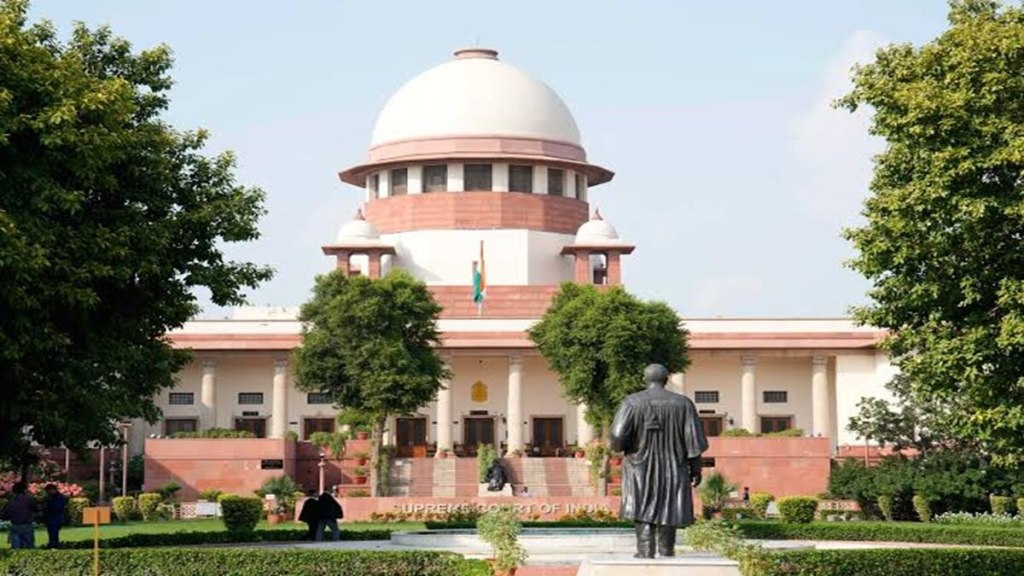

Tamil Nadu BC Muslim Quota Case: The Supreme Court of India has upheld a Madras High Court order holding that a person who converts from Hinduism to Islam cannot claim reservation under the Backward Class (Muslim) category solely on the basis of conversion.
A bench of Justices Prashant Kumar Mishra and Shree Chandrashekhar dismissed the Tamil Nadu government’s appeal against the High Court verdict, which had quashed a state order allowing converts to Islam from certain backward communities to be treated as Backward Class Muslims for reservation purposes.
What the Supreme Court held
The court said a person moving from the Hindu social order to a non-Hindu social order cannot claim affirmative action under Article 16(4) of the Constitution merely because of the social backwardness associated with his pre-conversion status.
“A person who converts from the Hindu social order to a non-Hindu social order cannot claim affirmative action under article 16(4) of the Constitution merely on the basis of the social backwardness associated with his pre-conversion status,” the bench said, as per the news report of Live Law.
The Supreme Court held that backwardness suffered in the earlier social order cannot automatically be carried forward into the religion to which the person has converted.
“Backwardness suffered in the antecedent social order cannot by itself be carried forward so as to confer upon him the status of a backward class in the religion to which he has converted,” the court said.
Scheduled Caste status also ruled out
The bench referred to Paragraph 3 of the Constitution (Scheduled Castes) Order, 1950, which restricts Scheduled Caste status to persons professing Hinduism, Sikhism or Buddhism.
“By virtue of paragraph 3 of the Constitution (Scheduled Castes) Order, a person who professes a religion other than Hinduism, Sikhism or Buddhism cannot be deemed to be a member of a Scheduled Caste,” the court said, according to a report by Live Law.
This means a person converting to Islam cannot claim Scheduled Caste benefits merely on the basis of their earlier caste status.
Tamil Nadu’s 2024 order
The case arose from a Tamil Nadu government order issued on March 9, 2024. It said a person converting to Islam from Backward Classes, Most Backward Classes, Denotified Communities or Scheduled Castes could be treated as Backward Class (Muslim) for availing reservation.
The order also provided that such a person could be issued a community certificate identifying them as belonging to one of seven notified Backward Class Muslim sects. The state government argued that the order was intended to ensure that people from socially and educationally backward communities were not deprived of reservation benefits solely because they converted to Islam.
Madras High Court had struck it down
The Madras High Court had quashed the March 2024 government order on June 25, holding that it went against earlier judicial pronouncements of the High Court and the Supreme Court. The High Court held that a person converting to Islam could only be treated as a Muslim. It also noted that Christian missionaries and Islamic preachers maintain that their religions offer social equality, unlike Hinduism, which has a caste hierarchy.
The case of Sameer Ahamed
The High Court order came on a petition filed by Sameer Ahamed, who embraced Islam in 2015, changed his name and married according to his adopted religion. Relying on the 2024 government order, Ahamed applied for a community certificate identifying him as a ‘Muslim Lebbai’, one of the seven Backward Class Muslim communities recognised under the order.
The Tehsildar rejected his application. Ahamed then approached the High Court, citing the same government order in support of his claim.
Tamil Nadu govt’s appeal
The Tamil Nadu government appealed to the Supreme Court through its secretary, challenging the High Court’s decision to declare the March 9, 2024 order unconstitutional. The state argued that the order was passed after detailed deliberation and was meant only to ensure that persons already enjoying reservation benefits did not lose them because of conversion to Islam.
It also contended that granting reservation to such persons would not disturb the social balance. The state’s appeal said the High Court judgment raised substantial questions concerning the permissible scope of interference with executive policy framed on the recommendation of an expert statutory commission.
Supreme Court declines interference
After hearing the matter, the Supreme Court dismissed Tamil Nadu’s plea and upheld the High Court order. The ruling highlights that conversion to Islam, by itself, will not entitle a person to reservation under Tamil Nadu’s Backward Class (Muslim) category. The state government’s attempt to provide such benefits through its 2024 order has now been set aside.